
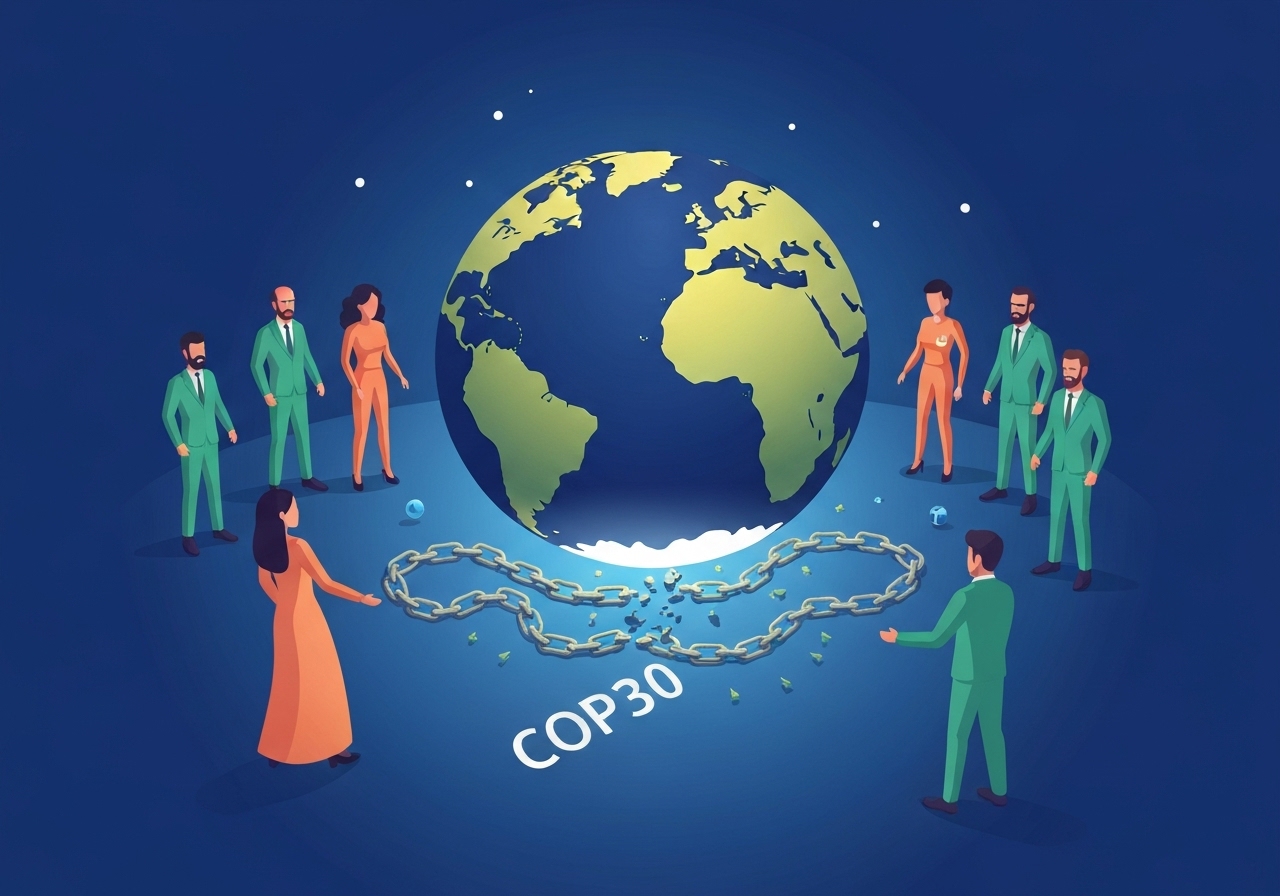
Lead: Ministers and negotiators at COP30 in Belém, Brazil, agreed on Saturday to start formal discussions on a roadmap toward an eventual phase-out of fossil fuels, but the outcome fell short of binding commitments advocates say are needed to avert severe climate impacts. The deal — reached after an all-night session and a tense standoff between a coalition of more than 80 countries and oil-producing states led by Saudi Arabia and allies plus Russia — also secured an adaptation finance objective of $120bn a year from developed countries, to be delivered by 2035. The final text dropped a roadmap to halt deforestation and left several elements as voluntary rather than mandatory, prompting disappointment from campaigners and cautious relief from some delegations.
Key takeaways
- COP30 in Belém produced a voluntary agreement to initiate negotiations on a roadmap to phase out fossil fuels; the language was not legally binding.
- Delegates from 194 countries adopted the package; the United States did not send a delegation to the talks.
- Developing countries won an adaptation finance target of $120bn per year, to be realised by 2035, drawn from the broader $300bn developed-country pledge made last year.
- A proposed roadmap to halt deforestation was removed from the final text, a major setback for rainforest protection advocates at this “rainforest COP.”
- More than 80 countries supported explicit transition language; opposition from the Arab group (including Saudi Arabia) and Russia pushed key provisions into voluntary form.
- An “accelerator” mechanism was agreed to seek stronger nationally determined contributions (NDCs) and to report back at next year’s COP in Turkey, which will be presided over by Australia.
- The negotiations nearly collapsed multiple times, with the final agreement only secured after more than 12 hours of extra-time ministerial talks and a closing meeting at 13:35 local time.
Background
COP30 was held in Belém, near the Amazon River mouth, following a leaders’ summit convened by Brazil’s president, Luiz Inácio Lula da Silva, attended by roughly 50 heads or deputy heads of state. The conference opened formally on Monday 10 November and was framed domestically and internationally as a critical moment for forests and for accelerating the clean-energy transition. Delegations arrived with sharply diverging expectations: many vulnerable and developing countries sought firm, timebound commitments and scaled finance, while major fossil-fuel producers resisted language that could limit production or exports.
The history of UN climate negotiations has seen periodic breakthroughs alongside entrenched diplomatic deadlocks. The Paris Agreement established the long-term goal of limiting warming to 1.5°C, but successive COPs have struggled to translate that goal into binding, short-term policy commitments. At COP28 in Dubai in 2023, parties agreed language signalling a transition away from fossil fuels; COP30 was widely expected to test whether that momentum could be turned into concrete roadmaps and finance packages. Stakeholders from civil society, Indigenous groups, and affected states pressed for stronger forest protection and quicker funding for adaptation and loss and damage.
Main event
Negotiations at COP30 were repeatedly interrupted by sharp divisions between a coalition of more than 80 countries calling for explicit transition language and a bloc led by Saudi Arabia, other oil-exporting states in the Arab group, and Russia. The impasse intensified late in the week and culminated in all-night ministerial sessions that extended into Saturday morning. Delegations worked through draft texts in near-empty conference halls, and the final agreement was concluded at a closing meeting at 13:35 local time on Saturday.
The final package required compromise: text on a “transition away from fossil fuels” remained in the outcome but as voluntary language to “begin discussions on a roadmap” rather than a binding timetable to cut production or phase out fuels. That downgrade followed intense lobbying by fossil-fuel producing states, which argued that any binding language must consider energy security and development needs. Negotiators from developing countries, however, pushed to secure stronger financial commitments to adaptation.
On finance, parties agreed that developing countries should receive $120bn per year for adaptation, to be mobilised from the broader $300bn pledge made by developed countries in the previous year; the timeline for reaching the $120bn target was set for 2035, not the 2030 deadline many low-income states demanded. Delegates also agreed to an “accelerator” process to address insufficient ambition in current NDCs, with the programme expected to report to next year’s COP in Turkey.
The draft roadmap to halt deforestation — a central demand given the conference’s Amazon location — was removed from the final text after objections, drawing sharp criticism from environmental groups and some delegations. Meanwhile, attempts to include stronger language on critical minerals and safeguards were blocked by China and Russia, leaving worries about social and human-rights impacts of mineral extraction largely unaddressed in the outcome.
Analysis & implications
The COP30 outcome reflects the tension inherent in global climate diplomacy: incremental multilateral progress on processes and finance, contrasted with limited immediate action on fossil-fuel production. While the voluntary roadmap language keeps a pathway open for a managed phase-out, it does not create enforceable obligations that would compel producer countries to accelerate cuts in extraction or infrastructure investments. That distinction matters because scientists say keeping warming near 1.5°C requires steep and rapid reductions in both demand and supply of fossil fuels.
Financially, the $120bn adaptation objective represents progress in recognising the urgent needs of vulnerable countries, but the 2035 timeline and its relationship to the earlier $300bn pledge raise questions about additionality and immediacy. Delaying material support until 2035 risks leaving countries exposed to escalating climate impacts over the next decade, and it increases pressure on multilateral institutions and donor governments to specify delivery channels and guarantees.
The removal of a deforestation roadmap undermines one of the conference’s central narratives and could slow coordinated international action to protect tropical forests — a critical carbon sink. That gap increases the burden on national and subnational initiatives, private finance commitments, and non-state actors to fill the void. It also heightens scrutiny on host-country leadership and the region’s capacity to resist illegal logging, agricultural expansion, and commodity-driven forest loss.
Geopolitically, the standoff signals a fracturing alignment around energy transition timelines. Opposition from fossil-fuel exporters and key mineral producers highlights competing priorities — energy security, economic development and export revenues versus rapid climate mitigation. The voluntary outcomes may preserve diplomatic consensus in the short term, but they risk weakening trust among vulnerable states that sought stronger, faster commitments and predictable finance.
Comparison & data
| Item | Amount / status | Timeline |
|---|---|---|
| Adaptation finance target agreed at COP30 | $120bn per year | By 2035 |
| Developed-country pledge referenced | $300bn (previous pledge) | Announced 2024 |
| Parties in final agreement | 194 countries (US absent) | Agreement concluded 22 Nov 2025 |
The table highlights the central financial figures that shaped negotiations. The $120bn target is framed as part of the broader $300bn pledge made last year; delegates differ on whether the newly agreed figure represents additional resources or a reallocation. The number of parties — 194 — reflects near-universal participation, though the absence of a US delegation was notable. These data points frame the practical gap between political commitments and the scale and speed of finance and policy change many experts say are required.
Reactions & quotes
“While far from what’s needed, the outcome in Belém is meaningful progress. The Paris agreement is working, the transition away from fossil fuels agreed in Dubai is accelerating,”
Jennifer Morgan, climate policy veteran
Jennifer Morgan framed the deal as incremental but positive, emphasising the continuity of Paris-era mechanisms and the diplomatic value of keeping transition language in the text, albeit voluntary.
“With an increasingly fractured geopolitical backdrop, COP30 gave us some baby steps in the right direction, but considering the scale of the climate crisis, it has failed to rise to the occasion,”
Mohamed Adow, director, Power Shift Africa
Mohamed Adow highlighted the political fractures and criticised developed countries for insufficiently ambitious national plans, arguing vulnerable nations had been let down by a lack of science-aligned commitments.
“The 30th COP has reaffirmed both the urgency of climate action and the disproportionate risks faced by the most vulnerable,”
Ali Mohamed, Kenya special climate envoy
Kenya’s envoy stressed that African leadership in the energy transition depends on meaningful finance and that adaptation cannot be an afterthought for nations responsible for a small share of global emissions.
Unconfirmed
- Whether the $120bn adaptation target represents entirely new, additional funding beyond the $300bn pledged in 2024 remains unclear and will depend on donors’ accounting methods.
- The specific modalities and channels for delivering the $120bn per year by 2035 have not been finalised and were not specified in the final text.
- The impact of the US absence on negotiation dynamics and outcomes has not been fully assessed and may be subject to differing interpretations from delegations.
Bottom line
COP30 produced a pragmatic, compromise package: it preserved momentum by keeping transition language on the table and advanced an adaptation finance objective, but it stopped short of legally binding, immediate measures to curb fossil-fuel production and to halt deforestation. For vulnerable countries, the deal offers a financial signpost but delays the more rapid, scaled support many argued was essential to respond to accelerating climate impacts.
The conference’s voluntary approach reduces immediate political friction but raises the risk that global emissions and forest loss will not fall quickly enough. How delegates convert voluntary roadmaps, accelerator reviews, and finance pledges into concrete national policies, investment shifts, and measurable outcomes will determine whether COP30 is a stepping stone or a missed opportunity in the race to limit warming.
Sources
- The Guardian (news media) — reporter account of COP30 negotiations and quotes.
- UNFCCC (official UN climate convention) — COP30 documentation and official proceedings.
- Power Shift Africa (think tank/NGO) — commentary from Mohamed Adow.
- ActionAid (NGO) — analysis on climate finance and justice.
- Greenpeace Brazil (environmental NGO) — statements on deforestation and forest protections.