
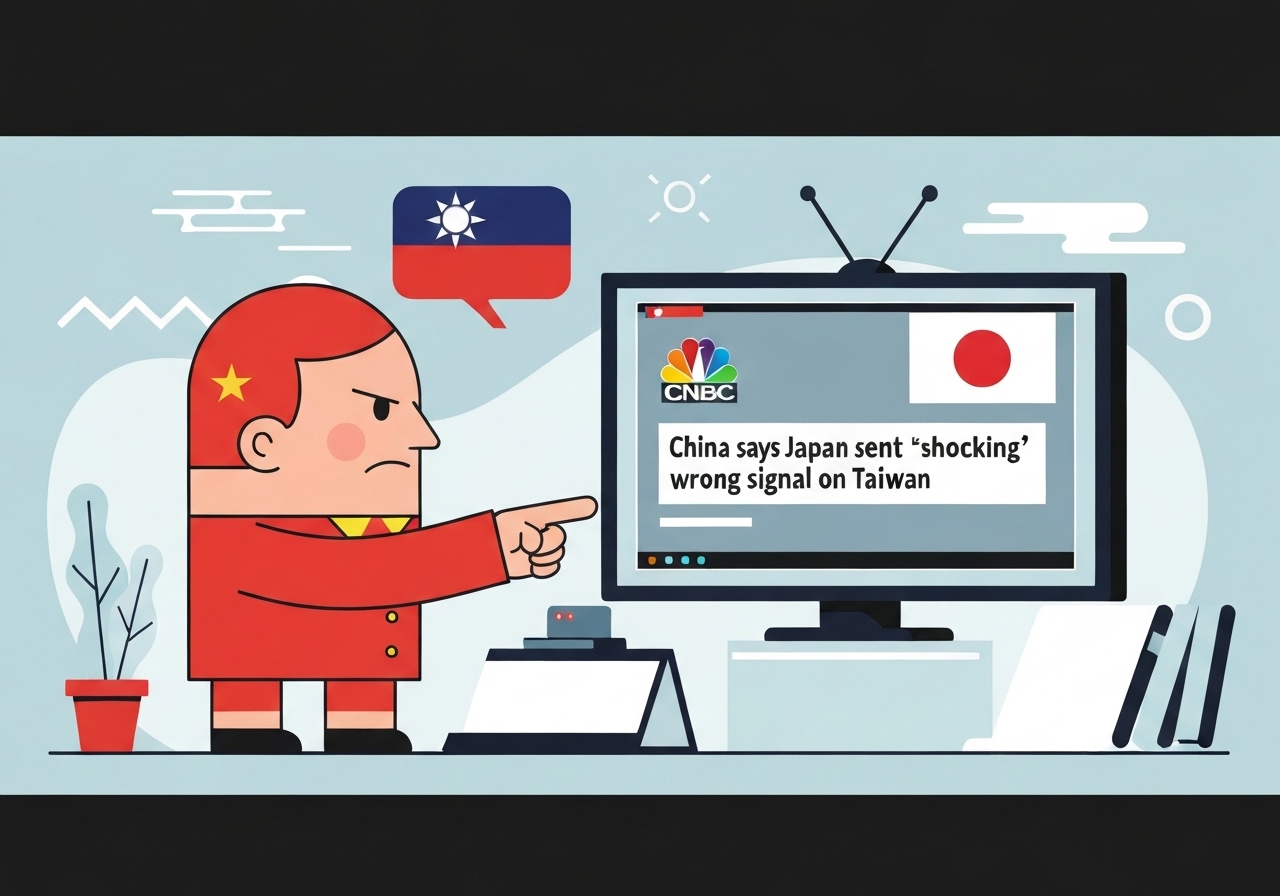
China’s top diplomat, State Councilor and Foreign Minister Wang Yi, on Sunday publicly condemned comments by Japanese Prime Minister Sanae Takaichi as a “shocking” and dangerous signal over Taiwan, escalating a diplomatic row that has frayed ties for more than two weeks. Wang accused Japan of crossing a red line after Takaichi said on November 7 that a hypothetical Chinese attack on Taiwan could prompt a military response from Tokyo. The dispute has spilled beyond rhetoric into trade and cultural exchanges; China raised the matter with U.N. Secretary-General António Guterres and warned it would defend itself. Japan’s role as a security partner and its large trade relationship with China — which bought about $125 billion of Japanese goods in 2024 — make the confrontation consequential for the region.
Key Takeaways
- Wang Yi publicly called Prime Minister Sanae Takaichi’s remarks “shocking” and said Japan crossed a red line in statements about Taiwan.
- Takaichi’s November 7 comment suggested a hypothetical Japanese military response to a Chinese attack on Taiwan, prompting Beijing’s protest.
- China formally raised the issue with U.N. Secretary-General António Guterres on Friday, signaling use of diplomatic channels beyond bilateral contacts.
- The dispute has already affected diplomatic, trade and cultural links between China and Japan, two of East Asia’s largest economies.
- China bought about $125 billion of Japanese goods in 2024, making it Japan’s largest export market after the United States, per UN COMTRADE data.
- Japan’s Foreign Ministry called parts of China’s letter to the U.N. “entirely unacceptable” while reiterating Japan’s commitment to peace.
- Taiwan’s Foreign Ministry condemned Beijing’s letter to the U.N., saying it maliciously distorts history and violates U.N. Charter Article 2(4).
Background
The status of Taiwan has long been a central and sensitive issue in East Asian diplomacy. Beijing regards Taiwan as part of its territory and reserves the right to use force to achieve unification; Taipei rejects that claim and maintains that the island’s people determine their future. Japan and China have complex ties rooted in geography, deep trade links, and historical grievances that periodically resurface. Japan’s postwar security posture has evolved in recent years through reinterpretations of constitutional constraints and closer security cooperation with the United States, prompting debates at home about Tokyo’s role in regional defense.
Against this backdrop, statements about Taiwan from political leaders can produce outsized diplomatic reverberations. Prime Minister Sanae Takaichi’s November 7 parliamentary remark — framing a possible Chinese attack as a trigger for Japanese action — collided with Beijing’s sensitivity about external interference. China has used both diplomatic notes and public rhetoric previously to signal displeasure when it perceives cooperation between other states and Taiwan as crossing a line. Economic interdependence, however, complicates escalatory responses: large volumes of trade, supply-chain links, and people-to-people exchanges raise the political and economic costs of prolonged confrontation.
Main Event
The immediate flashpoint began with Takaichi’s comments on November 7 in Japan’s parliament, where she suggested that a Chinese attack on Taiwan could lead to a Japanese military response. Beijing quickly framed that remark as interventionist and released a statement on the Chinese Foreign Ministry website citing Wang Yi’s condemnation. Wang said Japan was sending a “wrong signal” and warned that China would “resolutely hit back” to safeguard sovereignty and territorial integrity.
On Friday, China elevated the issue to the United Nations by sending a letter to Secretary-General António Guterres, a move that broadened the dispute from a bilateral row to a matter raised at the U.N. Secretariat. Tokyo responded to the U.N. submission by calling parts of China’s claims “entirely unacceptable,” while insisting that Japan’s commitment to peace remains unchanged. Taiwan’s Foreign Ministry also spoke out, denouncing Beijing’s letter as an unlawful threat that distorts historical facts and contravenes Article 2(4) of the U.N. Charter, which bars the threat or use of force.
The diplomatic exchange quickly affected non-political ties, with reports of disruptions to cultural events and increased scrutiny on trade engagements. Analysts say such spillovers are predictable when strategic tensions rise between major neighbors with deep economic links. Japanese and Chinese officials have not yet announced bilateral crisis talks specifically to defuse the current episode, and Tokyo declined to provide an immediate comment on Wang’s latest remarks.
Analysis & Implications
Politically, the incident underscores the sensitivity of language in the Taiwan dispute and how domestic politics in one country can have outsized international impact. Prime Minister Takaichi’s statement likely aimed at reassuring domestic constituencies about Japan’s security posture, but in doing so it risked provoking Beijing. For China, strong public rebukes serve both to deter perceived external interference and to bolster nationalist messaging at home.
Strategically, the row could accelerate discussions in Tokyo and Washington about contingency planning, intelligence sharing, and rules of engagement in crisis scenarios around Taiwan. If Tokyo’s political leadership signals a willingness to take a more assertive role, Beijing may respond with military demonstrations or tightened economic measures. That in turn would ratchet up regional tensions and could unsettle markets sensitive to supply-chain disruptions, especially in semiconductors and automotive parts where Japan and China are integrated.
Economically, the prospect of sustained diplomatic friction raises real costs. With China accounting for about $125 billion of Japanese exports in 2024, even targeted measures or informal slowdowns could hit manufacturers and exporters. Investors and companies will be watching diplomatic backchannels closely for signs of de-escalation or of measures that could impede trade flows. Multilateral institutions, including the U.N., may play a limited role as a forum for airing grievances, but they lack enforcement tools to resolve the underlying cross-Strait dispute.
Comparison & Data
| Metric | Value (2024) |
|---|---|
| Japan exports to China | $125 billion |
| China’s rank among Japan’s export markets | Largest after the United States |
The data point above highlights the scale of economic interdependence: China purchased roughly $125 billion in Japanese goods in 2024, concentrated in sectors such as industrial machinery, semiconductors, and automobiles. That level of trade incentivizes both governments to manage tensions, yet it also provides Beijing leverage should it choose targeted economic measures. Observers caution that while short-term political signaling is common, protracted diplomatic breakdowns can produce measurable economic harm over quarters rather than days.
Reactions & Quotes
Chinese government commentary framed the issue as a red-line breach and a test of political limits. Wang Yi’s remarks were published on the Chinese Foreign Ministry site and amplified by state media.
“It is shocking that Japan’s leader would openly send such a wrong signal concerning Taiwan,”
Wang Yi, Chinese State Councilor and Foreign Minister (official statement)
Japan’s Foreign Ministry pushed back on Beijing’s U.N. letter and reiterated Tokyo’s insistence on peace and stability in the region.
“Parts of China’s letter are entirely unacceptable,”
Japan Ministry of Foreign Affairs (official response)
Taiwan’s government condemned the Chinese letter to the U.N., invoking international law and rejecting Beijing’s framing.
“The letter maliciously distorts historical facts and violates Article 2(4) of the U.N. Charter,”
Taiwan Ministry of Foreign Affairs (official statement)
Unconfirmed
- There is no independent confirmation that Japan has prepared specific military plans to intervene in a Taiwan contingency; public reports describe only hypothetical policy positions.
- Claims that Beijing will apply immediate economic sanctions on Japan tied directly to Takaichi’s remarks are currently speculative and unverified.
Bottom Line
This episode illustrates how combustible the Taiwan issue remains and how comments by leaders can escalate into broader diplomatic crises. With both sides trading formal notes and public rebukes, the immediate risk is political hardening rather than open conflict, but economic spillovers are already visible. Businesses, allied capitals, and investors should monitor diplomatic communications, trade indicators, and any changes to port or customs activity that would signal wider economic measures.
What to watch next: whether Tokyo issues clarifying language or rescinds the implication of military intervention; whether Beijing pursues calibrated economic or diplomatic measures beyond the U.N. letter; and whether the United States or other regional actors step up back-channel mediation. Short of de-escalatory diplomacy, the dispute could become a recurring source of instability in East Asia.
Sources
- CNBC (news report)
- UN COMTRADE (international trade database)