
Lead
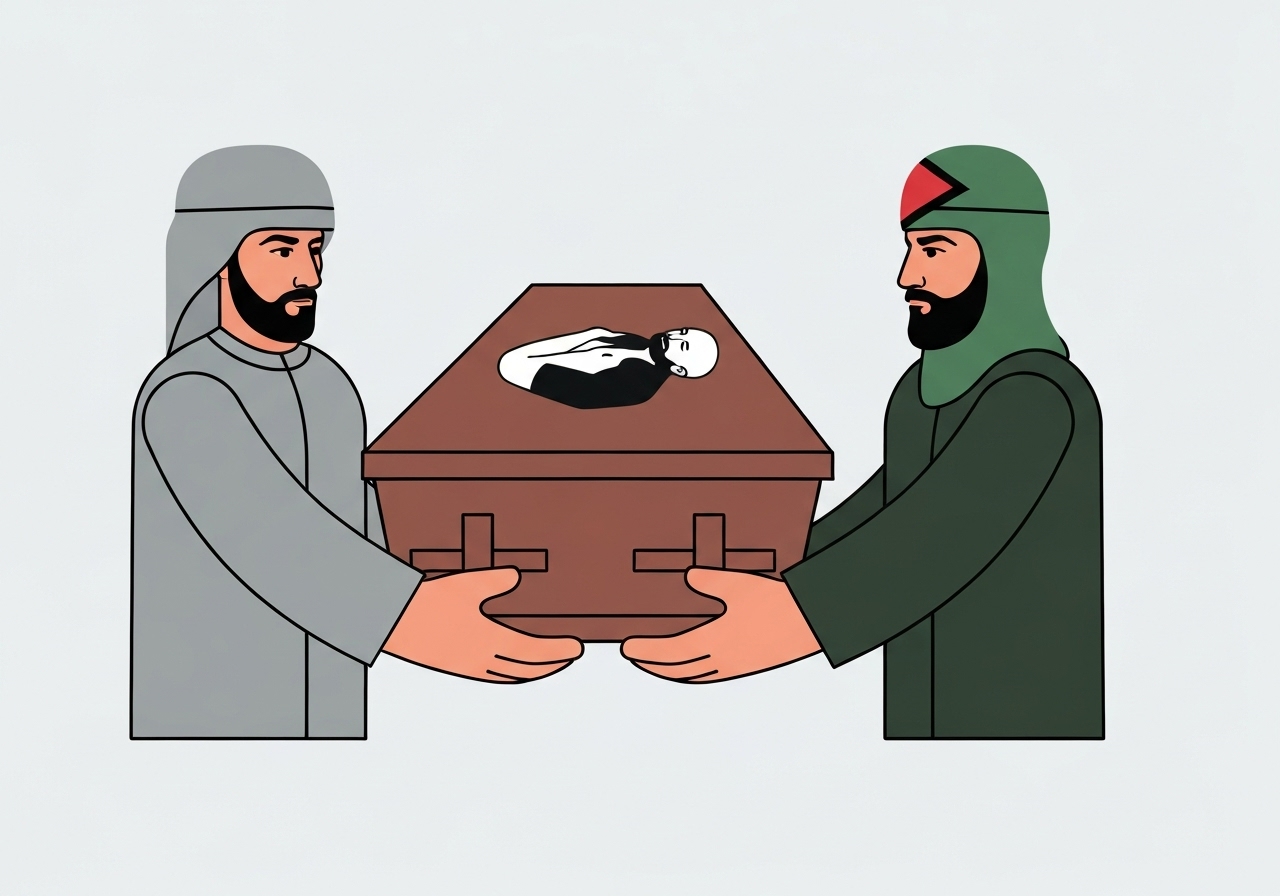
Israel has taken custody of a coffin, delivered via the International Committee of the Red Cross, that Hamas and Palestinian Islamic Jihad (PIJ) say holds the remains of one of the last three dead hostages believed to be in Gaza. The Israeli prime minister’s office confirmed receipt and said the transfer will move the remains to the National Centre of Forensic Medicine in Tel Aviv for formal identification. Hamas and PIJ had announced earlier that a body was located in central Gaza on Monday; the handover took place in central Gaza on Tuesday afternoon. Israeli officials say families of the three deceased hostages were informed following the handover.
Key takeaways
- Red Cross transfer: The coffin was received via the International Committee of the Red Cross (ICRC) and handed to Israeli authorities for forensic processing.
- Forensic identification: Israel will move the remains to the National Centre of Forensic Medicine in Tel Aviv for DNA and forensic confirmation.
- Ceasefire timeline: Under the first phase of the US-brokered ceasefire, effective 10 October, Hamas agreed to return 20 living hostages and the bodies of 28 dead hostages within 72 hours.
- Prisoner exchanges: All 20 living hostages were released on 13 October in exchange for 250 Palestinian prisoners and 1,718 detainees from Gaza.
- Exchanges to date: To date, remains of 22 deceased Israeli hostages and three foreign hostages (one Thai, one Nepalese, one Tanzanian) have been handed over.
- Remaining cases: Three dead hostages are still reported in Gaza — Israelis Ran Gvili (24) and Dror Or (48), and Thai national Suthisak Rintalak (43).
- Reciprocal returns: Israel has returned the bodies of 330 Palestinians killed in the conflict as part of the exchange process.
- Casualty context: The dead hostages were among 251 people abducted on 7 October 2023; roughly 1,200 people were killed in that attack and Gaza’s health ministry reports over 69,770 fatalities during the ensuing campaign.
Background
The developments sit within the framework of a US-brokered ceasefire that took effect on 10 October. Under the agreement’s first phase Hamas committed to returning 20 living hostages and 28 sets of remains within a 72-hour window. That initial timeline framed a rapid exchange: the 20 living hostages were released on 13 October in return for more than 1,900 detainees sent from Israeli custody to Gaza-controlled areas.
Despite the early releases, the handover of remains has proceeded unevenly. Israeli officials have repeatedly accused Hamas of delaying or obstructing the prompt transfer of bodies; Hamas and PIJ counter that searches are complicated by rubble and active combat conditions across parts of the territory. The discrepancy over timing and access has become a recurring source of diplomatic friction around the ceasefire’s implementation.
Main event
On Monday, Hamas and PIJ announced that a body they described as an Israeli hostage had been located in central Gaza. The following day the ICRC facilitated the transfer of a sealed coffin to Israeli authorities in a handover described by the Israeli prime minister’s office as occurring in central Gaza on Tuesday afternoon. Israeli forces then moved the remains to the National Centre of Forensic Medicine in Tel Aviv where DNA and other forensic procedures will be used to establish identity.
Netanyahu’s office publicly criticized what it called a delay in the immediate transfer of the body, saying the lag represented an additional breach of the ceasefire’s terms. Officials emphasized the need for timely returns and said families of the three deceased hostages were notified after the handover. The prime minister’s office reiterated its stated objective that efforts to secure the return of all hostages — living or dead — will continue until the last person is recovered.
The latest delivery raises the tally of returned remains to 25 previously confirmed bodies (22 Israeli, three foreign), leaving three still reported inside Gaza. Israel names the two remaining Israeli deceased as Ran Gvili, 24, and Dror Or, 48; the third remaining case is identified as Suthisak Rintalak, 43, a Thai national. Israeli authorities have signalled they will press for the recovery of those remaining cases through diplomatic and operational channels.
Analysis & implications
Procedurally, handovers mediated by the ICRC are intended to provide neutral facilitation and a chain of custody that helps both sides and families accept forensic outcomes. A formal identification at a national forensic centre will aim to close open cases for bereaved families and enable legal and administrative follow-up, including death certifications and next-of-kin notifications. The technical work can take days to weeks depending on the condition of remains and availability of comparative DNA samples.
Politically, delays in returns feed mutual recrimination and erode trust between parties and mediators. Israel has framed the intermittent pace of handovers as a violation of the ceasefire timetable; Hamas points to operational obstacles inside Gaza and the difficulty of locating remains under extensive destruction. That dispute complicates movement to the ceasefire’s second phase, which addresses governance, Israeli troop withdrawal, disarmament, and reconstruction — elements that require broader trust and leverage beyond immediate prisoner exchanges.
Internationally, the exchanges have precedent-setting dimensions: the scale of detainee swaps and body returns since October is large and politically sensitive, influencing regional diplomacy and the posture of mediating states. Continued gridlock over remaining cases risks hardening domestic political positions in Israel and heightening humanitarian pressure in Gaza, where reconstruction and services remain acutely strained.
Comparison & data
| Metric | Count |
|---|---|
| People abducted on 7 Oct 2023 | 251 |
| Living hostages agreed to be returned (phase 1) | 20 |
| Living hostages returned (by 13 Oct) | 20 |
| Dead hostages to be returned (phase 1) | 28 |
| Remains returned so far | 25 (22 Israeli, 3 foreign) |
| Remaining deceased hostages in Gaza | 3 (2 Israeli, 1 Thai) |
| Palestinian bodies returned by Israel | 330 |
| Reported Gaza fatalities (Hamas-run health ministry) | 69,770+ |
The table highlights the asymmetry between completed returns and outstanding cases. While the core swap for living hostages proceeded quickly in mid-October, the slower pace on remains has left a small but politically consequential number of outstanding cases. The figures above are drawn from official statements and reporting: abducted and hostage counts relate to the 7 October attack, exchange tallies reflect the first-phase agreement, and fatality totals are those reported by Gaza’s health authorities.
Reactions & quotes
Israeli government spokespeople framed the handover as necessary but insufficient without full compliance on remaining cases. The prime minister’s office publicly criticized the delay as an additional violation of the ceasefire, emphasizing the continuing effort to return all hostages.
“We view with severity the delay in the immediate transfer”
Office of Prime Minister Benjamin Netanyahu (official statement)
Hamas and PIJ provided the initial on-the-ground notification that a body had been located in central Gaza. Their statements have focused on operational limits inside Gaza—searching under rubble and within contested areas—which they say constrain how fast remains can be recovered and handed over.
“A body was found in central Gaza and arrangements were made for transfer”
Hamas / Palestinian Islamic Jihad (organisational statement)
Unconfirmed
- Exact condition and forensic status of the remains in the delivered coffin have not been publicly disclosed and remain pending laboratory results.
- Claims about deliberate obstruction of transfers by either side lack independently verifiable evidence accessible to reporters at this time.
Bottom line
The handover of a coffin that Hamas and PIJ say contains one of the last three sets of remains in Gaza marks a procedural step toward closure for at least one family and maintains momentum in the first-phase agreement. Forensic work in Tel Aviv will determine identity and provide formal confirmation, but the transfer does not by itself resolve the outstanding political disputes tied to the ceasefire’s next phase.
Remaining impediments — contestation over timelines, operational access inside Gaza, and mutual accusations — mean diplomacy and neutral facilitation will remain essential. If the outstanding cases are resolved promptly, it could ease one source of tension and create space for talks on governance, troop movements, disarmament, and reconstruction outlined in the ceasefire’s second phase; if not, the stalemate risks deepening mistrust and limiting progress on broader political goals.
Sources
- BBC News — media reporting on the handover and related statements (media)
- International Committee of the Red Cross (ICRC) — neutral facilitator of humanitarian transfers (aid organisation)
- Office of the Prime Minister of Israel — official statements and briefings (official)