
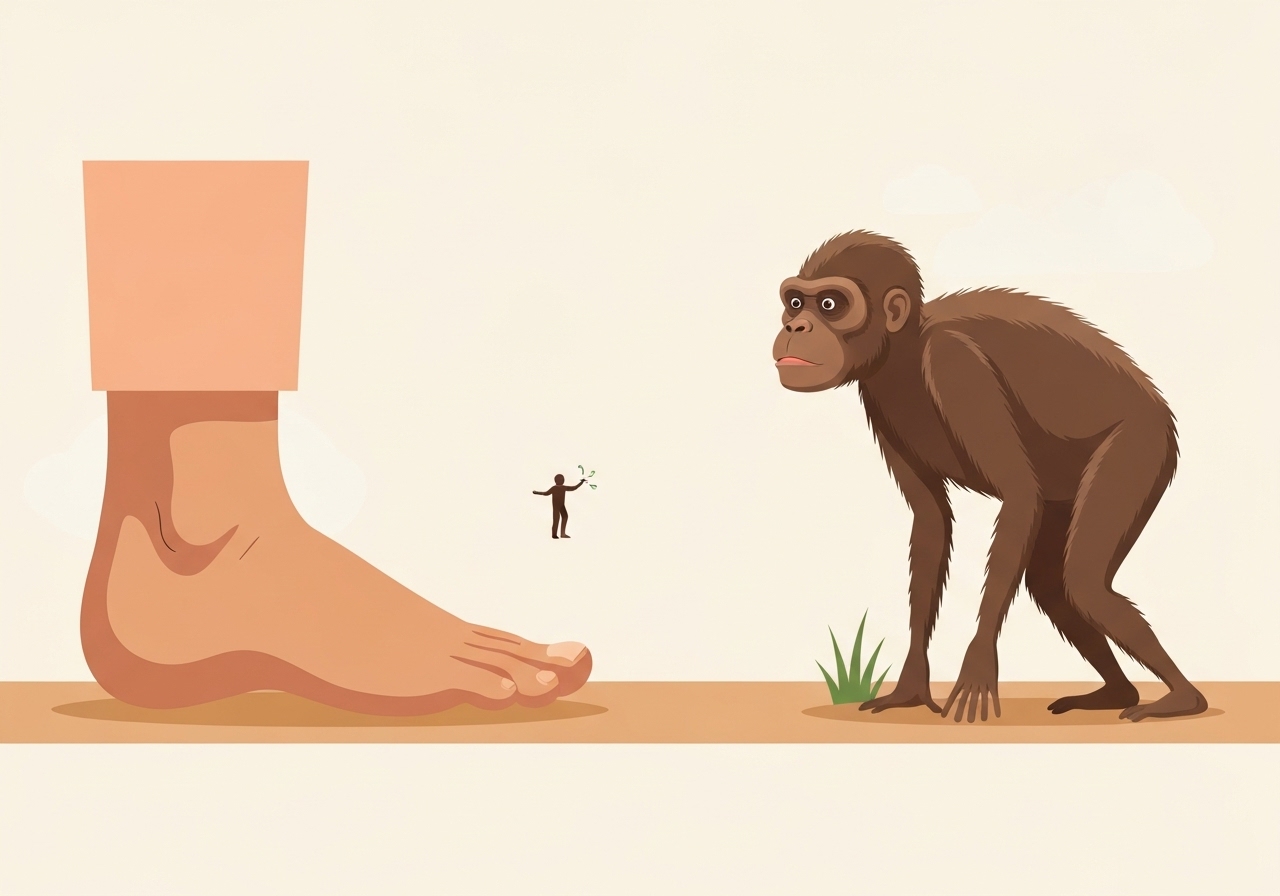
Lead: New analysis of fossils from northeastern Ethiopia ties the long-mysterious Burtele foot—first recovered in 2009—to a little-known hominin, Australopithecus deyiremeda, researchers announced. The team reports a newly found jaw with 12 teeth at the Burtele site that matches the foot’s anatomy, strengthening the 2015 species identification. The fossils date to roughly 3–3.4 million years ago and imply that at least two different Australopith species shared the Afar landscape. If confirmed, the find changes how scientists view niche partitioning and the search for the direct ancestor of Homo sapiens.
Key takeaways
- The Burtele foot, first discovered in 2009 at Burtele in Afar, Ethiopia, has been reassigned to Australopithecus deyiremeda based on a newly recovered jaw with 12 teeth.
- The jaw and teeth are dated to about 3.4 million years, while the foot has been described as roughly 3 million years old, indicating contemporaneity within the Pliocene Afar ecosystem.
- A. deyiremeda exhibits a grasping, opposable big toe and dental morphology consistent with a diet heavy in leaves, fruits and nuts, per CT and isotope analyses.
- Coexistence with A. afarensis (Lucy’s species) in the same region suggests ecological partitioning: A. deyiremeda more arboreal and A. afarensis more terrestrial.
- The study was led by Yohannes Haile-Selassie (Arizona State University) and published as a follow-up tying the Burtele foot to the 2015 species designation.
- Experts note that fossil scarcity leaves room for debate; A. deyiremeda is currently unlikely to displace A. afarensis as the leading candidate ancestor of Homo.
Background
The Burtele foot elements were recovered in northeastern Ethiopia’s Afar Region in 2009 and puzzled researchers because the big toe retained an opposable orientation, a feature more like arboreal primates than previously described Australopith feet. In 2015, a research team named a new species, Australopithecus deyiremeda, on the basis of partial jaws and teeth from the same Burtele area; those fossils were dated to roughly 3.4 million years. Historically, Australopithecus afarensis—best known from the 3.2-million-year-old skeleton “Lucy” from Hadar—was viewed as the dominant hominin across eastern Africa in this time window.
Because Pliocene fossil remains are sparse, every new specimen can reshape phylogenetic hypotheses; researchers must weigh anatomical detail against small sample sizes. Debate over species boundaries and behavioural interpretation has been prolonged in part because isolated bones (hands, feet, jaws) may not be directly linkable to named species without additional context. The Burtele material sat at the centre of such debates: a distinctive foot and separate jaw fragments suggested diversity, but the lack of an articulated skeleton left open alternative explanations.
Main event
The team reports that newly excavated material at Burtele includes a jaw with 12 teeth whose morphology—cusp patterns, enamel thickness and root structure—matches earlier A. deyiremeda specimens. Using comparative anatomy and CT imaging, researchers concluded the dental features align with the species named in 2015 and with the Burtele foot’s associated fauna. Lead author Yohannes Haile-Selassie said the new jaw provides the “missing link” tying the foot and teeth to a single species, though the paper presents the evidence with measurements and imaging rather than a single definitive specimen.
Isotope analysis of the tooth enamel indicates a diet skewed toward arboreal resources—leaves, fruits and nuts—supporting the functional interpretation of a grasping big toe adapted to climbing. In contrast, published datasets for A. afarensis suggest a more mixed diet and foot anatomy optimized for terrestrial bipedalism. The authors argue these differences allowed sympatry—two closely related hominins occupying different ecological niches in the same landscape during the early Pliocene.
The Burtele foot retains a medially divergent hallux (big toe) that would permit grasping, a trait that complicates simple narratives about linear progression from tree-climbing to obligate bipedality. The study’s comparative tables and CT-derived metrics show statistically significant contrasts between the Burtele foot bones and canonical A. afarensis foot elements. Field notes and stratigraphic descriptions in the paper place the jaw and foot within the same regional horizon, improving confidence in their association.
Analysis & implications
If the Burtele foot and new jaw conclusively belong to A. deyiremeda, the fossil record for the early Pliocene becomes demonstrably more diverse than previously assumed, with at least two Australopith taxa persisting in Afar at the same time. This supports an ecological scenario where morphological experimentation—different locomotor adaptations and diets—allowed multiple hominins to coexist. Such niche partitioning weakens simplistic ancestor–descendant models and suggests that the road to Homo likely passed through a branching, mosaic process.
For paleoanthropology, the find underscores the limits of inferring lineage from single traits. A grasping big toe in a close relative does not automatically exclude habitual bipedalism on the evolutionary pathway; it indicates functional diversity and possibly graded transitions. The discovery therefore urges caution in assigning direct ancestor status solely on morphological resemblance and highlights the need for richer, associated skeletal material to resolve phylogeny.
Economically and culturally, the find adds to the scientific value of the Afar region as a research priority, reinforcing calls for continued excavation, local capacity-building and conservation of sites. International collaborations, improved dating techniques and expanded sampling could clarify whether A. deyiremeda represents a side branch, a regional adaptation, or a species with closer ties to Homo than currently appreciated.
Comparison & data
| Feature | Australopithecus deyiremeda (Burtele) | Australopithecus afarensis (Lucy) |
|---|---|---|
| Approx. age | ~3–3.4 million years | ~3.2 million years |
| Big toe | Opposable/grasping | Aligned for toe-off in bipedal gait |
| Diet (isotopes) | Leaves, fruits, nuts (arboreal signal) | Mixed diet (more terrestrial resources) |
| Key fossils | Burtele foot elements; jaw with 12 teeth | AL 288-1 (“Lucy”) complete skeleton elements |
The table summarizes primary contrasts emphasized in the new study. While dates overlap, the anatomical differences support a model of ecological separation: A. deyiremeda shows adaptations consistent with more tree use, whereas A. afarensis appears more specialized for ground-based bipedalism. Researchers caution that sample sizes are small and morphological variation within species can be wide, so these comparisons are indicative rather than definitive.
Reactions & quotes
Researchers and commentators stressed both the importance of the new association and the continued need for caution. The study team framed the connection between the Burtele foot and the new jaw as a major step forward in resolving a decade-old puzzle.
“We have no doubt about the Burtele foot belonging to the same species as these teeth and the jaw.”
Yohannes Haile-Selassie (Arizona State University, lead author)
Haile-Selassie’s comment accompanied CT and isotopic results; the team supplied measurements and comparative imaging to support their confidence while acknowledging the fossil record’s limits.
“We are the last biped standing… all of those other ways of life became extinct.”
Rick Potts (Smithsonian human origins program)
Potts used the discovery to reflect on broader patterns of extinction and survival in hominin evolution, noting that multiple experiments in locomotion and diet occurred before the emergence of our lineage.
“There will always be sceptics, but I think these new finds… will help many researchers to be more accepting of A. deyiremeda.”
John McNabb (University of Southampton, independent paleolithic archaeologist)
McNabb praised the validation of earlier material but emphasized that ongoing critique and independent verification are part of healthy scientific progress.
Unconfirmed
- Whether A. deyiremeda is ancestral to the genus Homo remains unresolved and requires more associated skeletal material to test definitively.
- Precise temporal overlap and population-level interactions between A. deyiremeda and A. afarensis are inferred from available horizons but cannot be fully confirmed without denser stratigraphic sampling.
- Claims that the Burtele materials alone rewrite the hominin family tree are premature pending independent replication and broader comparative analyses.
Bottom line
The new jaw with 12 teeth strengthens the case that the Burtele foot belongs to Australopithecus deyiremeda, painting a picture of greater hominin diversity in the Afar Region around 3 to 3.4 million years ago. Functional differences—grasping toes and leaf-heavy diets in A. deyiremeda versus more terrestrial traits in A. afarensis—support ecological partitioning as a mechanism for sympatry.
While the finding does not yet overturn the view of A. afarensis as a leading candidate ancestor for Homo, it highlights a more complex early Pliocene landscape where multiple hominins experimented with locomotion and diet. Resolving ancestry questions will depend on new, associated skeletons, refined dating and continued open scientific scrutiny.
Sources
- CBS News / AFP (news report summarizing the study)
- Institute of Human Origins, Arizona State University (research institute / lead authors’ affiliation)
- Smithsonian Institution — Human Origins Program (museum / research program comment)