
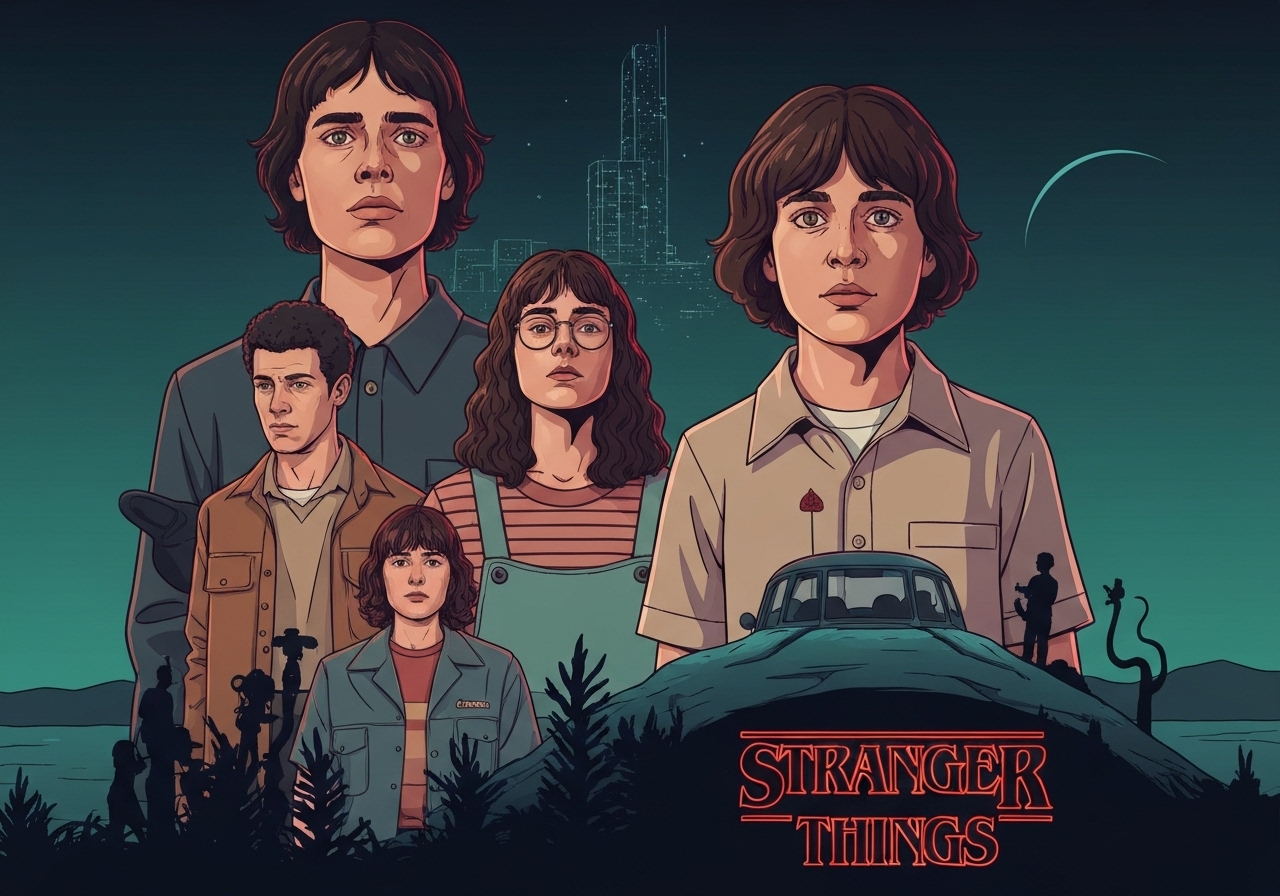
The first half of Stranger Things season 5 arrived this week, releasing four episodes that many critics praised for emotional stakes and spectacle while others found the instalment overstuffed or dour. The episodes were posted on Wednesday in the United States and early Thursday in the UK (01:00 GMT), briefly overwhelming Netflix’s service before playback was restored, according to reports. Reviewers ranged from four-star endorsements in major outlets to damning remarks about tone and pacing, and the remaining three episodes are scheduled for release on Christmas Day (US) / Boxing Day (UK) with the finale due at New Year. Fans and critics alike are weighing the show’s effort to close its long-running arc as its core cast matures and the antagonist Vecna looms toward a final showdown.
Key Takeaways
- The first four episodes of season 5 (Volume One) were released Wednesday in the US and early Thursday (01:00 GMT) in the UK, with the remaining three arriving at Christmas and the finale at New Year.
- Major publications including The Times and The Guardian gave four-star reviews, praising the episodes’ emotional stakes and entertainment value.
- Other outlets such as USA Today and The Atlantic voiced reservations, calling parts of the run thrilling but also “joyless” or uneven.
- Netflix experienced a brief outage tied to the release; the service reportedly resumed normal operation within five minutes.
- At the time of reporting, Rotten Tomatoes shows an 86% critics’ score for the season overall.
- Caveats among reviewers focus on a crowded plot, the cast’s aging, and a sense that the show has grown top-heavy with lore.
Background
Stranger Things debuted on Netflix in 2016 and quickly became a global phenomenon by blending 1980s genre pastiche with coming-of-age drama. Over four prior seasons the Duffer Brothers built an ensemble whose childhood friendships and battles with supernatural forces—most recently the villain Vecna—have driven both emotional stakes and fan investment. As the series progressed, its tonal palette shifted from nostalgic mystery to increasingly high-stakes, effects-heavy set pieces, and Season 5 was framed from the outset as the show’s concluding chapter.
The cast has aged alongside the series; actors who began as children are now young adults, a reality critics repeatedly note when assessing whether the series’ youthful sensibility still fits the stories being told. Creators have had to adapt scripts and character arcs to that change, and some critics argue the show has sometimes struggled to expand character depth in proportion to its scale. Commercially, each new season has generated strong viewership and cultural conversation, making the resolution of this final season a major media event.
Main Event
Volume One’s four episodes were met with an immediate critical response. The Times’ Ed Potton called the installments “richly entertaining” and awarded four stars, while The Guardian’s Jack Seale also gave a four-star appraisal and praised the run’s exuberant moments. Other voices were less impressed: USA Today’s Kelly Lawler wrote that the series “seesaws between thrilling and annoying,” and Sophie Gilbert at The Atlantic described much of the material as “largely joyless and grim.” These divergent takes capture the split between reviewers who welcomed the show’s return and those who felt it was past its peak.
At the fan level, some viewers rose early to binge the new episodes after the UK release at 01:00 GMT; one viewer told BBC Radio 1 she watched without looking away and felt the instalments were “incredible” and worth the wait. On the technical side, Netflix briefly faltered when Volume One dropped; reports indicate the platform recovered normal service in roughly five minutes. Looking ahead, the narrative has set up a climactic confrontation between the now-mature protagonists and Vecna, positioning the remaining three episodes as the series’ denouement.
Critical emphasis varies by outlet: several reviews applauded the show’s emotional core, dark humour and sense of fun, while others argued that an excess of characters, long episode runtimes and complicated plot strands dilute the season’s impact. Some reviews singled out specific episodes—one critic called the fourth instalment “bombastic” and emblematic of the series at its most thrilling—while others warned that too much spectacle risks overshadowing character growth.
Analysis & Implications
Creative closure for a long-running, youth-centered franchise presents a structural challenge: the show must reconcile nostalgia for its earlier tone with the need to depict realistic maturation. Critics who praise Volume One tend to emphasize the season’s emotional payoffs and technical confidence; opponents stress a mismatch between the characters’ ages and the script’s insistence on adolescent set-pieces. That tension has implications for how the series will be judged historically—it could be read as a triumphant finale or as a satisfying but flawed conclusion.
Commercially, Season 5’s rollout—staggered release dates culminating in a New Year finale—keeps Stranger Things in the cultural conversation across the holiday period, likely boosting sustained viewership and social-media engagement. For Netflix, maintaining uninterrupted streaming during high-traffic drops is a technical imperative; the reported five-minute disruption was short, but any outage during a marquee release can erode user trust if repeated.
Creatively, the show’s reliance on extensive lore and a growing ensemble raises questions about narrative economy. Several critics argue that condensing focus on fewer character arcs or trimming side plots might have produced a tighter, more resonant final act. Conversely, fans invested in multiple characters will welcome a sprawling wrap-up. How the remaining episodes balance scale with intimacy will determine whether the series’ end is widely seen as earned.
Comparison & Data
| Outlet | Early Reaction / Rating |
|---|---|
| The Times | 4 stars — praised emotion and jeopardy |
| The Guardian | 4 stars — celebrated exuberance and fun |
| Telegraph | 3 stars — “top-rank comfort viewing” with caveats |
| Rotten Tomatoes (critics) | 86% (aggregate score at time of reporting) |
This table summarizes representative critical responses and the season’s aggregated critics score at the time of writing. It highlights that while several major outlets gave top marks, a meaningful minority offered mixed or negative takes; that spread suggests a broadly positive reception tempered by substantive criticism about pacing, scope and character development.
Reactions & Quotes
“This luxurious final run will have you standing on a chair, yelling with joy.”
Jack Seale, The Guardian
Seale’s review captures the exhilaration some critics feel at the show’s return, particularly its capacity for crowd-pleasing set pieces and heartfelt moments.
“It’s not just Hawkins that feels cut off from the world. It’s Stranger Things itself, a show now sealed in an airless, impenetrable bubble of stagnant characters and snarled lore.”
Sam Adams, Slate
Other commentators, such as Adams, argue the series is burdened by accumulated mythos and insufficient character evolution, a line of critique echoed across several outlets.
“It’s time to let these adolescents do as adolescents are meant to do: grow up and move on with the rest of their lives.”
Angie Han, The Hollywood Reporter
Several reviews emphasize the cast’s aging as a core issue; critics like Han frame the final season as a test of whether the show can convincingly depict its characters’ transition into adulthood.
Unconfirmed
- Wider metrics on viewing minutes and global audience size for Volume One have not been publicly released by Netflix and remain unconfirmed.
- Some social-media claims about widespread prolonged outages at Netflix following the drop exceed the five-minute disruption reported to Variety; those broader outage reports lack independent confirmation.
Bottom Line
Volume One of Stranger Things season 5 has arrived to a mixed-but-not-uniformly divided critical response: several outlets applaud its emotion, scale and entertainment value, while others criticize an overabundance of plot, a sense of tonal heaviness and limited character depth. The aggregate Rotten Tomatoes critics score (86% at time of reporting) reflects more positive than negative sentiment, but does not erase recurring substantive critiques.
With three episodes remaining and the series finale scheduled for New Year, the deciding factor will be how adeptly the show converts spectacle into satisfying closure. Viewers and critics will be watching whether the remaining episodes tighten focus, deepen character arcs and resolve the Vecna storyline in a way that justifies the series’ expansive ambition.
Sources
- BBC News (news media) — original report summarizing critical reaction and release details.
- Rotten Tomatoes (review aggregator) — critics’ score cited for season 5 at time of reporting.
- Variety (news media) — reported on Netflix service disruption tied to the episodes’ release.