
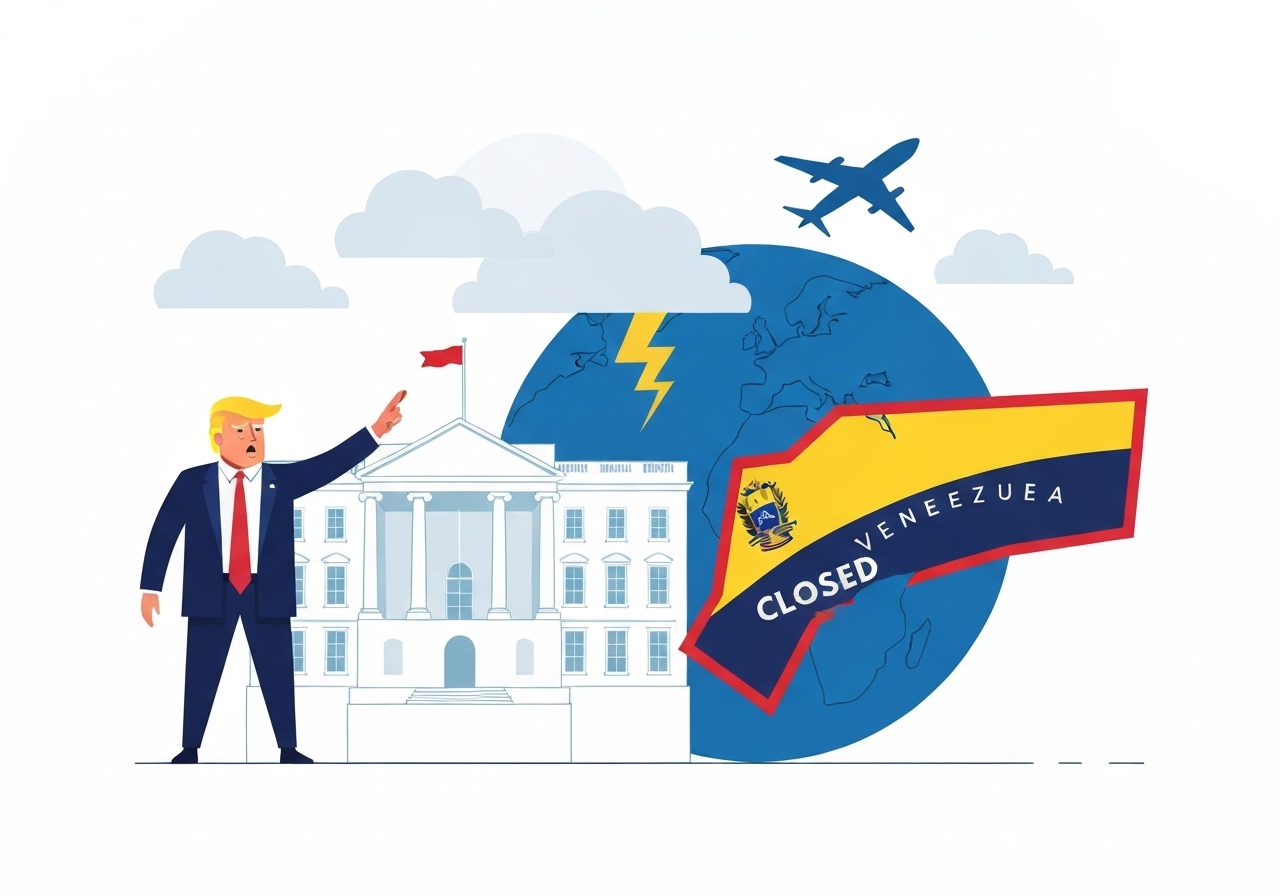
President Donald J. Trump on Nov. 29, 2025 posted that the airspace above and surrounding Venezuela should be considered closed, a move the White House framed as part of an intensified campaign against drug trafficking. The message, directed at airlines, pilots, drug dealers and human traffickers, followed earlier remarks this week that the United States could soon extend lethal operations off Venezuelan waters to strikes on territory. While Mr. Trump used presidential channels and social media to broadcast the directive, international law assigns sovereign control of national airspace to Venezuela, not the United States. The post has already raised concerns about disrupted travel, commercial harm for Venezuelan carriers and heightened tensions in the Caribbean.
Key Takeaways
- The president’s post on Nov. 29, 2025 declared the airspace above and surrounding Venezuela closed, addressed to airlines, pilots, drug dealers and human traffickers.
- Mr. Trump earlier this week said the United States could “very soon” expand lethal operations from Venezuelan waters to its territory, a comment interpreted as a possible escalation.
- The United States has increased its military presence in the Caribbean in recent months; officials say the posture is intended to deter maritime drug smuggling.
- As president, Mr. Trump does not have legal authority to close Venezuelan sovereign airspace; such a claim could nevertheless deter commercial carriers.
- The New York Times reported that Mr. Trump spoke by phone with President Nicolás Maduro last week, according to two people familiar with the call, a development that complicates diplomatic signaling.
- Airlines may reroute flights or suspend service to Venezuela pending assessments, risking further disruption to Venezuelan commerce and passenger travel.
- Administration officials have publicly stated deterrence of narcotics trafficking is a principal aim, but some also signal a desire to remove President Maduro from power.
Background
Relations between Washington and Caracas have been strained for years, driven by ideological conflict, sanctions and disputes over democratic legitimacy. Since 2019 the United States has recognized opposition figures and imposed stepped-up sanctions targeting Venezuelan officials and oil revenues. Throughout 2024 and 2025 the Biden and Trump-era approaches to Venezuela differed in tone but shared an emphasis on disrupting narcotics flows and weakening the Maduro government.
Drug interdiction has become a central public rationale for increased U.S. activity in the region. U.S. officials point to rising shipments of cocaine and precursor chemicals transiting Caribbean transit routes, prompting deployments of naval and air assets. Yet policymakers and legal experts note a sharp distinction between deterrent maritime operations and kinetic strikes on another state’s territory, which carry substantial legal and diplomatic consequences.
Main Event
On Nov. 29, 2025 Mr. Trump posted that the airspace above and surrounding Venezuela should be treated as closed in its entirety. The post did not include operational details or an effective time frame. According to the administration, the announcement is part of a broader campaign aimed at drug cartels that transport narcotics through Caribbean routes.
The message arrived days after Mr. Trump told reporters that the United States could “very soon” expand its campaign of killings of suspected traffickers in international waters to include strikes on Venezuelan territory. That comment drew immediate concern from aviation authorities and foreign governments, who warned of the practical and legal implications of such a posture.
The New York Times reported that Mr. Trump spoke by phone with President Nicolás Maduro last week, with the discussion including the possibility of a future meeting. Two people with knowledge of the call provided that information to the paper, a claim that has not been independently confirmed by Venezuelan or U.S. officials publicly at the time of this report.
Analysis & Implications
Legally, sovereign airspace belongs to the state beneath it, and international aviation law limits other governments’ authority to unilaterally declare foreign airspace closed. A unilateral U.S. declaration lacks binding legal force on Venezuela or on international aviation regulators, but strong language from the U.S. president can influence carrier risk assessments and insurance costs, prompting airlines to reroute flights preemptively.
Operationally, an expanded U.S. military presence in the Caribbean intended for interdiction could increase encounters between U.S. and Venezuelan forces. Even if the stated objective is narcotics deterrence, signaling that strikes on territory are contemplated raises the risk of miscalculation, particularly where communication channels are limited and local command-and-control lines are complex.
Economically, sustained avoidance of Venezuelan airspace would further isolate the country’s already fragile economy. Reduced commercial flights would curtail cargo and passenger flows, aggravating supply shortages and limiting remittances and trade that Venezuelans rely on. For regional neighbors, flight diversions and military activity will add logistical costs and political pressure to manage refugee and transit flows.
Reactions & Quotes
to all airlines, pilots, drug dealers and human traffickers the airspace above and surrounding Venezuela should be considered closed in its entirety
Donald J. Trump / Social media post, Nov. 29, 2025
We could very soon expand our campaign of killing people at sea suspected of drug trafficking to attacking Venezuelan territory
Donald J. Trump / Public remarks, Nov. 27, 2025
The administration says its deployments are intended to deter maritime smuggling, though some officials have described pressure on the Maduro regime as an objective
U.S. administration official (summarized)
Those statements illustrate the tension between public messaging aimed at criminal networks and the geopolitical fallout of threatening force against another nation. Airline executives and international regulators will now assess safety, insurance and diplomatic factors when routing flights. Regional capitals and multilateral organizations are likely to press for clarification to reduce the risk of unintended clashes.
Unconfirmed
- The reported phone call between President Trump and President Nicolás Maduro last week is based on reporting by two people familiar with the conversation and has not been publicly confirmed by either government.
- Whether the administration will actually carry out strikes on Venezuelan territory remains undecided and was described in public remarks as a potential near-term option rather than a confirmed plan.
- The scale and duration of any airline rerouting or suspension of Venezuelan service are not yet established and will depend on carrier risk assessments and directives from aviation authorities.
Bottom Line
The president’s declaration that Venezuelan airspace is closed is a significant escalation in rhetoric with real-world implications for aviation, commerce and regional stability. Legally the United States cannot unilaterally close another nation’s sovereign airspace, but the statement can still influence airline behavior and raise insurance and safety concerns that effectively isolate Venezuela.
Policymakers and international aviation authorities will now face pressure to clarify the operational intent and to manage the risks of miscalculation. For Venezuelans and neighboring states the primary near-term consequences are likely to be economic disruption, weakened transport links and increased diplomatic strain.
Sources
- The New York Times (press report on presidential post, Nov. 29, 2025)
- International Civil Aviation Organization (international aviation authority, legal framework for sovereign airspace)