
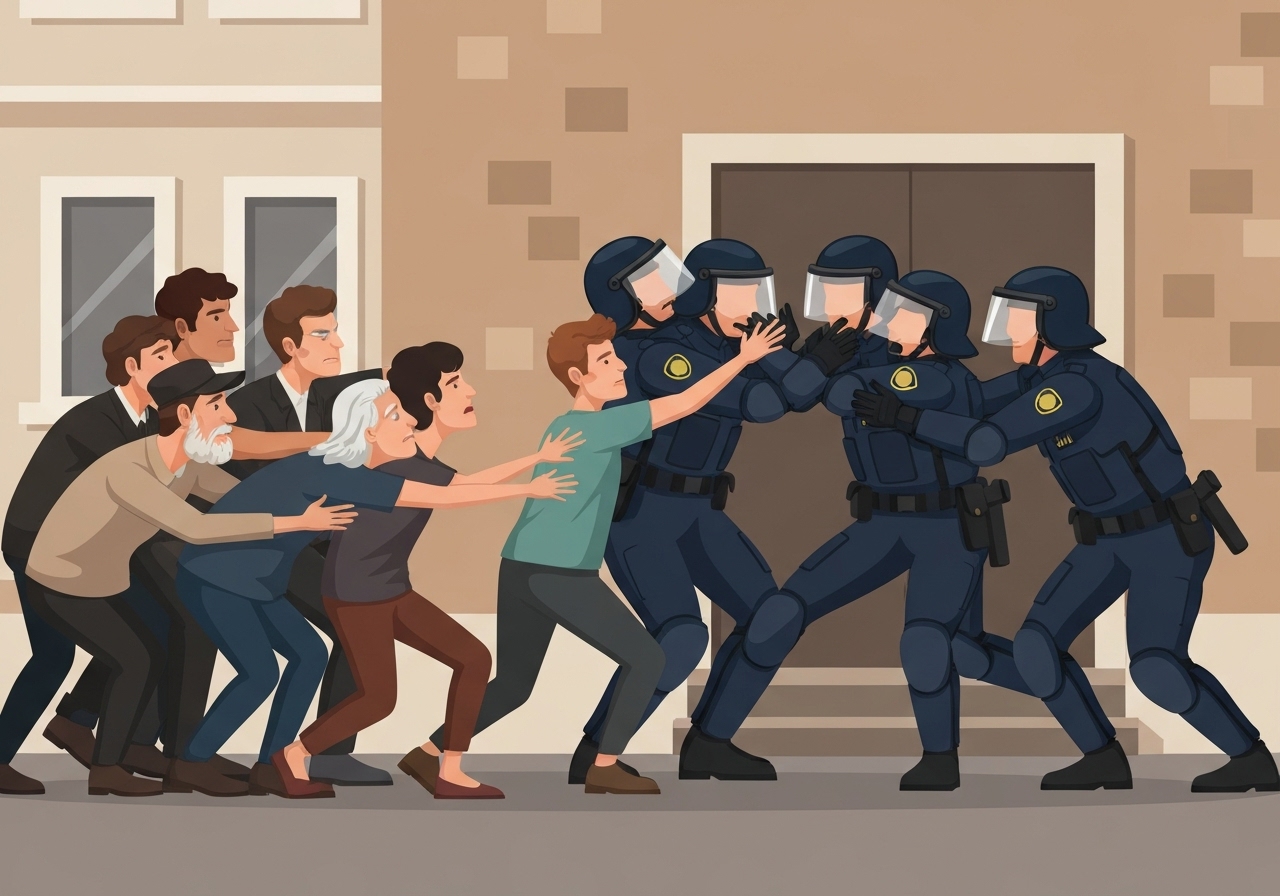
Lead: On Nov. 29, 2025, a confrontation outside a Lower Manhattan parking garage near Centre and Hester Streets interrupted what federal agents appeared to be preparing as an immigration enforcement action. Dozens of agents from U.S. Customs and Border Protection and the Department of Homeland Security were present as protesters gathered just after 11 a.m., forming human barricades and delaying the agents’ movement. The standoff lasted roughly an hour and ended with several demonstrators arrested and metal barriers placed between the crowd and the vehicles. The episode highlights enforcement challenges in densely populated, politically resistant cities like New York.
Key Takeaways
- Timing and place: The confrontation began just after 11 a.m. on Nov. 29, 2025, at a parking garage on Centre and Hester Streets in Lower Manhattan, near Chinatown.
- Agencies on site: Agents identified as members of U.S. Customs and Border Protection and the Department of Homeland Security were reported to be assembling at the garage.
- Crowd size: Nearly 200 people gathered outside the garage by early afternoon, chanting and obstructing agent movement.
- Duration and outcome: The standoff continued for about an hour; police arrested several protesters and erected metal barricades to separate agents and demonstrators.
- Contextual link: The scene was a few blocks from a large-scale immigration raid conducted in October 2025, underscoring a pattern of enforcement operations and local pushback.
- Operational impact: Protesters’ physical obstruction appeared to prevent or postpone an enforcement action at that location, though federal officials have not publicly confirmed the intended target.
- Local policing: New York City police intervened to maintain separation but did not immediately clear the crowd en masse, reflecting a measured on-site response.
Background
New York City has long been a focal point for clashes over federal immigration enforcement. Dense neighborhoods, high public visibility and a politically active civil-society infrastructure make large-scale operations difficult to execute without attracting attention. In recent months federal authorities have carried out multiple enforcement actions in the city, including a wide operation in October 2025 that drew extensive media and community attention.
Advocates and organized protesters have increasingly mobilized when they learn of planned actions, employing tactics ranging from legal monitoring to direct physical obstruction. Local officials and community groups often warn of humanitarian and public-safety risks linked to aggressive street-level enforcement in immigrant communities. Federal agencies, in turn, say that arrests and removals are part of mandated responsibilities, citing national law and public-safety priorities.
Main Event
Witnesses said agents from U.S. Customs and Border Protection and the Department of Homeland Security arrived at the garage just before and after 11 a.m. on Nov. 29, parking vehicles and preparing to exit. A small group of protesters initially gathered at the garage entrance and then expanded as more people arrived. Demonstrators formed a human chain at the garage mouth and placed piles of garbage bags near the entrance, impeding agents’ ability to leave the facility.
The crowd swelled to nearly 200 people by early afternoon, according to observer accounts, with protesters chanting and confronting the agents, who were partly sheltered inside vehicles and the garage. City police units reached the scene, arrested several demonstrators and set up metal barricades to create a buffer zone between the federal personnel and the crowd. Tensions remained high, with officers working to keep the situation contained rather than escalating to broader arrests.
Local observers described the disruption as effectively preventing an immediate enforcement action at that site; federal agencies did not publicly confirm whether they abandoned or postponed a planned raid. The standoff lasted about an hour before agents and law enforcement adjusted their positions and the crowd began to disperse in the afternoon.
Analysis & Implications
The incident exposes a recurring operational friction: urban density and organized civic resistance complicate federal enforcement in cities. Protesters can quickly assemble in public spaces, creating both physical obstacles and political costs that may deter or delay actions. For federal agencies, the reputational and logistical risks of operating in such visible settings are growing, increasing the likelihood of strategic adjustments like quieter operations or alternative tactics.
Politically, the episode reinforces the divide between federal immigration policy priorities and local governance in liberal cities. New York officials and advocates frequently emphasize the public-safety and community harms that can follow aggressive street-level enforcement; conversely, federal officials frame enforcement as a legal obligation. These competing narratives will likely shape both courtroom challenges and local political debates in coming months.
Economically and socially, repeated, high-profile enforcement attempts can strain trust between immigrant communities and municipal institutions, potentially reducing cooperation with local policing and public services. If federal agencies increasingly avoid overt operations in crowded urban areas to reduce confrontation, enforcement may shift to less-visible settings or rely more on administrative processes, changing the character of how immigration policy is implemented on the ground.
Comparison & Data
| Event | Date | Location | Reported Crowd | Arrests (reported) |
|---|---|---|---|---|
| Garage standoff | Nov. 29, 2025 | Centre & Hester Sts., Lower Manhattan | Nearly 200 | Several (exact count not released) |
| Large-scale operation | Oct. 2025 | Nearby neighborhood (few blocks away) | Not specified in contemporaneous reports | Reported in prior coverage (details vary by report) |
This table summarizes publicly reported counts and acknowledges that exact arrest figures and target details have not been made publicly available. The pattern of repeated operations and public resistance suggests a growing mismatch between federal enforcement methods and urban political realities.
Reactions & Quotes
Protesters said they physically blocked agents from exiting the garage, forming a human barricade at the entrance.
Witnesses/Organizers (paraphrase)
Police described making several arrests and using metal barricades to separate the crowd from federal vehicles while keeping the situation under control.
Police statement (paraphrase)
Federal officials noted their presence but did not immediately confirm whether a planned enforcement action at that location was canceled or deferred.
Federal agency spokespersons (paraphrase)
Unconfirmed
- Whether a specific individual or address inside the garage was the intended target of the federal operation remains unconfirmed by federal officials.
- The exact number of protesters arrested was described as “several” or a “handful” in reports; an official arrest tally has not been publicly released.
- It is unconfirmed whether the agents subsequently carried out the enforcement action elsewhere the same day.
Bottom Line
The Nov. 29, 2025 standoff in Lower Manhattan illustrates the practical limits federal agencies encounter when conducting immigration enforcement in politically active urban centers. Rapid public mobilization and dense street-level conditions can delay or deter visible operations, complicating agency planning and execution.
For policymakers and community leaders, the episode underscores the need for clearer coordination and transparency: federal agencies must weigh legal and operational risks, while municipalities and advocates must balance protest strategies with community safety. In the near term, expect federal enforcement to evolve tactically in cities and for local political debate over such operations to intensify.