
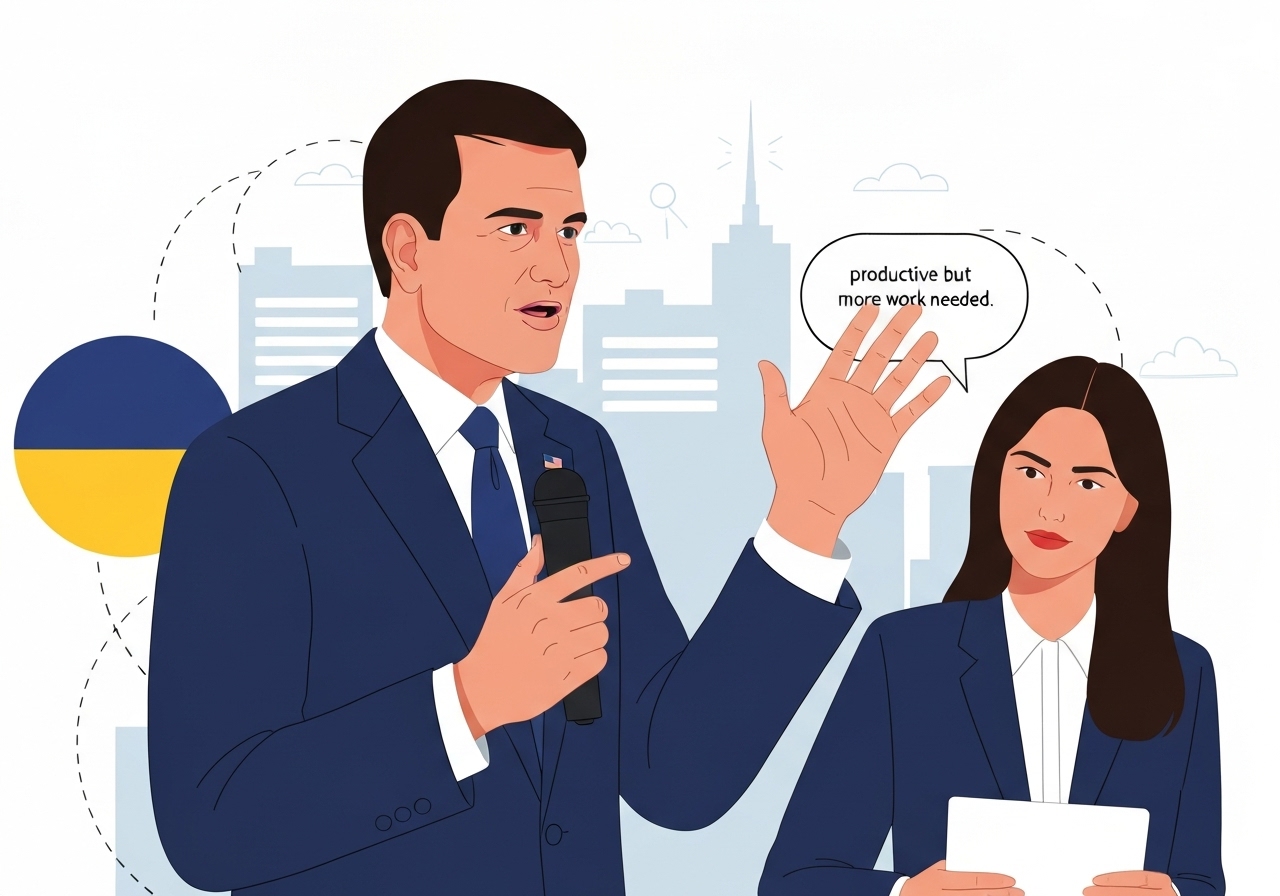
Lead: Senator Marco Rubio described Sunday’s talks between US and Ukrainian officials in Hallandale Beach, Florida, as “productive” while warning that substantive obstacles remain. The meeting was attended by Ukraine’s new chief negotiator, Rustem Umerov, and US envoys including Steve Witkoff and Jared Kushner, with President Donald Trump signaling ongoing diplomatic efforts. The discussions followed a highly contentious leak of a 28-point US proposal and came amid renewed shuttle diplomacy this month. Participants said progress was made on long-term reconstruction and security guarantees, but territory and sovereignty questions remain unresolved.
Key takeaways
- Meeting location and date: Talks took place on Sunday in Hallandale Beach, Florida, with a Ukrainian delegation led by Rustem Umerov.
- Participants: US side included Senator Marco Rubio, Trump envoy Steve Witkoff and Jared Kushner; President Trump commented aboard Air Force One.
- Negotiation posture: US officials called the session “productive”; Ukrainian leaders described it as constructive while stressing sovereignty concerns.
- Origins of talks: Diplomatic activity intensified after a leaked 28-point US plan sparked alarm among Ukraine and European allies for perceived concessions to Russia.
- Outstanding issue: Control and legal status of territory Russia annexed or occupies remains a core unresolved item.
- Next steps: Witkoff is reported to be due in Moscow next week to pursue discussions; Trump said a delegation may meet President Vladimir Putin.
- Human cost: Since Russia’s full-scale invasion on 24 February 2022, tens of thousands of soldiers and thousands of civilians have been killed or wounded; at least seven million people are recorded as refugees.
Background
Diplomacy between Kyiv, Washington and Moscow accelerated in recent weeks after portions of a proposed US plan leaked publicly, provoking strong reactions in Ukraine and among European partners. The 28-point draft, as reported, was criticized for appearing to offer terms that many Ukrainians saw as favoring Russia; that leak set off a flurry of private and public contacts aimed at recalibrating positions. Rustem Umerov, who leads Ukraine’s negotiating team at these talks, replaced Andriy Yermak after Yermak resigned following an anti-corruption raid on his home, a move Kyiv said touched off internal reshuffling.
The context for these negotiations stretches back to 2014, when Russia annexed Crimea and supported separatist uprisings in eastern Ukraine, and escalated dramatically with the full-scale invasion that began on 24 February 2022. Western governments and Kyiv have insisted any settlement must preserve Ukrainian sovereignty and territorial integrity, while Moscow has pressed for security guarantees and formalized recognition of control over some areas. These competing priorities make compromise difficult and explain why multiple rounds of talks and shuttle diplomacy are underway.
Main event
The Florida session convened senior Ukrainian and US figures to review a reworked peace framework and to set priorities for security, reconstruction and political arrangements. Umerov opened by framing the agenda around Ukraine’s future security, rebuilding and safeguarding against renewed aggression, emphasizing Ukraine’s insistence on sovereignty. Rubio emphasized that ending active hostilities is only one objective and that any agreement must set Ukraine on a path to long-term prosperity and independence.
President Trump, speaking later on Air Force One, described the talks as “going along well” and indicated a US delegation could travel to Moscow to continue discussions with President Vladimir Putin. Steve Witkoff, identified as a Trump envoy, is reported to be scheduled to visit Moscow next week; media reports also said Jared Kushner could be involved in follow-up meetings, though roles and timing remain fluid.
Ukrainian officials described the session as candid and practical but acknowledged difficult trade-offs remain, particularly over territory. The delegation stressed that any deal must prevent a recurrence of aggression and secure resources and legal frameworks for rebuilding. Participants left the meeting describing progress but signaling further work and additional rounds of diplomacy will be needed before any framework is finalized.
Analysis & implications
Domestically in Ukraine, the talks test political cohesion at a sensitive moment: leadership changes in the negotiating team and the fallout from leaked proposals have heightened public scrutiny. If Kyiv is perceived to have conceded too much, internal backlash could constrain negotiators’ flexibility and complicate implementation of any deal. Conversely, demonstrating progress in international diplomacy could reassure allies and investors about post-conflict reconstruction prospects.
For the US, engagement led by private envoys and high-profile political figures underscores a White House strategy that blends formal and informal channels. That approach can open doors quickly but risks confusing allies about official American positions if communications are not tightly coordinated. European partners, particularly France and other NATO members, have stressed the need for a settlement that secures Ukraine’s sovereignty—any perception that Washington is diverging from that line could strain transatlantic unity.
From Moscow’s perspective, talks offer a chance to seek formal recognition of gains and security commitments; for Kyiv, the central aim is to secure guarantees that restore and protect territorial integrity. The unresolved question of status and control over occupied or annexed territories is the single most consequential sticking point, with political, legal and security dimensions that will shape any long-term outcome. Economically, a credible road map for reconstruction—linked to security guarantees—will be essential to attract the scale of investment Ukraine needs for recovery.
Comparison & data
| Metric | Figure/Date |
|---|---|
| Full-scale invasion | 24 February 2022 |
| Estimated refugees | At least 7 million |
| Civilian & military casualties | Tens of thousands (soldiers), thousands (civilians) |
The table above summarizes key, widely reported data points referenced during and around the talks. These aggregate figures reflect the severe human and social toll that negotiators repeatedly cite as a reason to seek a durable settlement. Any negotiated deal will need mechanisms to address population displacement, property claims, and accountability, which are not resolved by ceasefires alone.
Reactions & quotes
Officials and leaders reacted cautiously but positively to the Florida session, combining guarded optimism with clear statements of unresolved priorities. Below are representative remarks put into context.
“It’s not just about the terms that ends fighting… it’s about also the terms that set up Ukraine for long-term prosperity.”
Senator Marco Rubio
Rubio framed the talks as balancing immediate cessation of hostilities with long-term reconstruction and sovereignty guarantees. His comment reflects US emphasis on tying any peace arrangement to economic and institutional measures aimed at restoring Ukrainian stability.
“We are discussing about the future of Ukraine, about the security of Ukraine… US is hearing us. US is supporting us.”
Rustem Umerov, Ukrainian chief negotiator
Umerov, speaking in English at the meeting, repeated Kyiv’s central demands for security guarantees and reconstruction aid while signaling that Ukrainian negotiators felt heard by the US side. He described the talks as productive and successful afterward.
“The talks are going along well,”
President Donald Trump (on Air Force One)
President Trump suggested momentum may exist toward a deal and confirmed plans for US envoys to travel to Moscow, underscoring the administration’s active role in shuttle diplomacy.
Unconfirmed
- Reports that Jared Kushner will definitely travel to Moscow remain unconfirmed; public statements indicated he might be involved but timing and participation were not finalized.
- Precise contents of a revised US proposal being discussed in private have not been published; specific territorial formulas attributed to any draft should be treated as unverified.
- Claims that the revised plan would guarantee immediate border changes have not been corroborated by independent documents or official treaty texts.
Bottom line
The Florida meeting brought Kyiv and Washington into closer, candid discussion and achieved a degree of common purpose on long-term reconstruction and security goals, but it did not resolve the central territorial dispute with Russia. Key diplomatic next steps—reported travel to Moscow by US envoys and further French and European consultations—will determine whether momentum can be sustained toward a politically and legally durable deal.
For Ukrainians and their international partners, the crucial yardsticks will be whether any agreement preserves Ukraine’s sovereignty in practice and whether robust verification and reconstruction mechanisms are built into the package. Negotiators face a narrow window to translate productive exchanges into concrete, verifiable commitments that can survive domestic and international scrutiny.
Sources
- BBC News — Media report summarizing the Florida talks and statements from participants.