
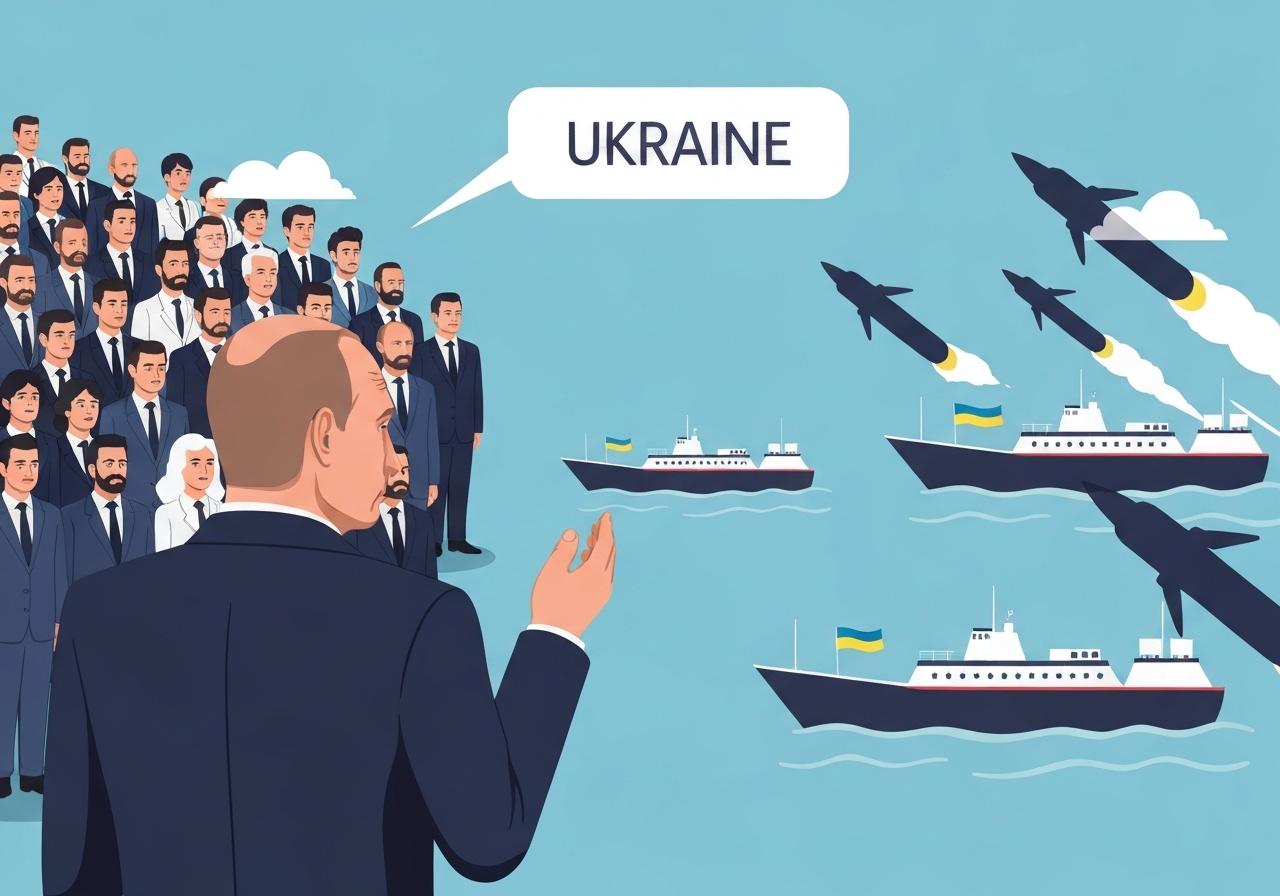
Lead: On December 2, 2025, President Vladimir Putin warned in Moscow that Russia could target vessels belonging to countries supporting Ukraine if a recent wave of attacks on Russian tankers does not stop. The remark, carried on state-run Rossiya 24, framed the incidents as hostile acts tied to Kyiv’s supporters and raised the prospect of Moscow extending its maritime response beyond direct combatants. Putin characterized the strikes on Russian shipping as unlawful and said they could prompt retaliatory measures against foreign-flagged ships thought to assist Ukraine.
Key Takeaways
- On December 2, 2025, Vladimir Putin warned Russia might strike ships of countries assisting Ukraine if attacks on Moscow’s tanker fleet persist, as broadcast by Rossiya 24.
- Putin described the attacks on Russian tankers as akin to piracy in televised remarks, marking a rhetorical escalation by the Kremlin.
- The warning links recent incidents targeting Russian energy vessels to states that support Kyiv, though Moscow did not name specific countries on-air.
- State television carried the comments, underlining the Kremlin’s choice to signal the threat publicly rather than through closed diplomatic channels.
- Such a threat could affect commercial shipping routes, insurance premiums and naval deployments in contested waters, creating broader economic and security ripple effects.
Background
Since the war’s escalation, both maritime commerce and naval activity around the Black Sea and adjacent waterways have become contested spaces. Russia has repeatedly accused Ukraine and its partners of facilitating attacks on Russian commercial vessels, particularly tankers linked to energy exports. Those allegations come amid wider sanctions, interdictions and a pattern of maritime incidents that have complicated neutral shipping and insurance calculations.
Historically, claims of state-backed interdiction at sea raise complex legal and military questions. International law differentiates between lawful naval interdiction, private piracy and acts of war, and states rarely announce plans to strike third-party commercial ships without escalating diplomatic fallout. Moscow’s public framing, via state media, signals a willingness to broaden the conflict’s geographic and legal contours if it deems its commercial lifelines under sustained attack.
Main Event
Putin spoke to reporters in Moscow on December 2, 2025, and his remarks were broadcast by the state-run Rossiya 24 channel. He tied a recent surge in incidents against Russian tankers to countries that have supported Ukraine, saying continued attacks could prompt Russia to consider targeting their vessels. The address did not list specific maritime incidents by date or location during the broadcast, but linked the pattern of strikes to hostile policy toward Moscow.
The Russian leader used the term “piracy” to describe the reported actions against his country’s maritime assets, a choice of language with legal and rhetorical weight. By framing the attacks as criminal rather than purely military, the Kremlin sought a broader justification for possible countermeasures aimed at ships perceived to be complicit or facilitating hostile operations.
The announcement was delivered publicly on state television rather than exclusively through diplomatic channels, signaling to domestic and international audiences that Moscow wanted the message widely known. Commercial carriers, maritime insurers and naval planners took note of the warning because it introduced the possibility of retaliatory measures that could affect neutral-flagged vessels in contested waters.
Analysis & Implications
Politically, the statement raises the stakes for countries backing Ukraine. If Moscow follows through on striking allied shipping, affected states could view such acts as direct attacks on their assets, potentially prompting naval escorts, legal complaints at international fora or escalation in arms and logistics support for Ukraine. The Kremlin’s rhetoric serves both as deterrent and bargaining leverage in wider diplomatic negotiations.
Economically, threats to commercial shipping increase the cost and complexity of moving energy and other goods. Shipowners may reroute vessels to avoid perceived high-risk zones, and insurers typically respond by raising war-risk premiums for transits in contested areas. That in turn can drive up fuel and commodity prices and disrupt supply chains linked to the region.
Legally, labeling actions as “piracy” attempts to place them in a criminal framework, which has different remedies and thresholds than interstate armed conflict. However, proving state responsibility for maritime attacks is difficult and frequently contested, making legal recourse slow and politically fraught. The ambiguity benefits actors seeking to operate below thresholds that would trigger a full military response.
Comparison & Data
| Issue | Typical Consequence |
|---|---|
| Targeted strikes on merchant ships | Higher insurance premiums; rerouting; naval escorts |
| Public state warnings | Diplomatic protests; deterrence; escalation risk |
The table summarizes strategic and commercial impacts commonly observed after states threaten or undertake maritime interdiction. While specific incident counts for the recent surge were not released in the broadcast, the pattern is consistent with prior episodes that have prompted insurers and carriers to change behavior.
Reactions & Quotes
“What the Ukrainian armed forces are doing now is piracy.”
Vladimir Putin — quoted on Rossiya 24
“Putin warns Russia may hit Ukraine allies’ ships if attacks last.”
Bloomberg (news outlet)
Putin’s comment was immediately picked up by state media and international press. The Kremlin’s decision to air the warning publicly indicates a desire to signal consequences beyond bilateral military engagement. Analysts say such language is intended to deter further attacks on Russian commercial vessels by raising the diplomatic and economic costs for third-party supporters.
Unconfirmed
- Attribution: There is no public, independently verified evidence in the broadcast that Ukraine or its armed forces directly ordered the attacks on Russian tankers.
- Target list: Moscow did not identify specific countries, ships or incidents that would be subject to retaliatory strikes.
- Operational intent: It remains unconfirmed whether Russia has operational plans to strike third-party commercial vessels or whether the remarks are intended primarily as deterrence.
Bottom Line
Putin’s December 2, 2025 broadcast marks a rhetorical escalation by framing attacks on Russian tankers as piracy and warning of potential strikes on the vessels of countries supporting Ukraine. The immediate impact is likely political: the remarks increase pressure on allies to weigh the maritime risks of their support while signaling Moscow’s willingness to broaden its response options.
Practically, the statement could raise shipping costs, prompt precautionary route changes and complicate diplomatic relations between Russia and states that back Ukraine. Whether the warning leads to concrete strikes against allied ships will hinge on future incidents, attribution evidence and how third-party states respond diplomatically and militarily.
Sources
- Bloomberg — international news outlet reporting Putin’s remarks and the Rossiya 24 broadcast
- Rossiya 24 (state broadcaster) — state-run television network where the comments aired (broadcast reported by Bloomberg)