
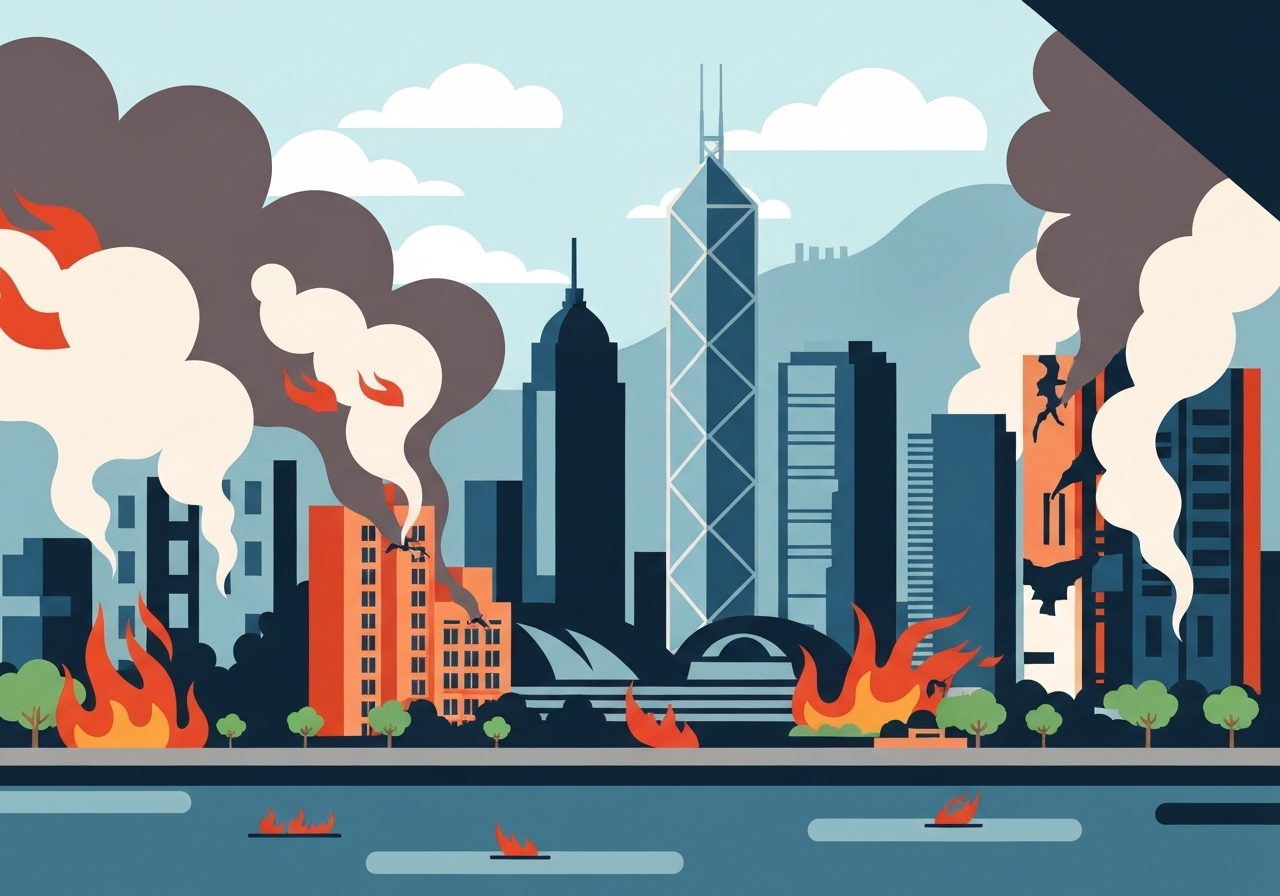
Lead
Hong Kong and Beijing officials on Wednesday accused unspecified “external forces” of seeking to exploit last week’s catastrophic blaze at the Wang Fuk Court estate in northern Hong Kong. The fire, which authorities say has killed 159 people, is the city’s deadliest disaster in 75 years and the world’s most lethal residential-building fire since 1980. The eight-tower complex, home to nearly 5,000 residents, was undergoing major renovation work that investigators now say used highly flammable, substandard materials. As rescue teams continue recovery and forensic testing, the government has moved to ban certain protective nettings and opened a judge-led review of the tragedy.
Key Takeaways
- Confirmed fatalities stand at 159, with 19 of the dead not yet identified; forensic testing is ongoing for suspected human remains.
- The fire occurred at Wang Fuk Court, an eight-tower estate housing about 5,000 people; the youngest confirmed victim was one year old and the oldest 97.
- Authorities have arrested 15 people on suspicion of manslaughter and six others on separate charges relating to malfunctioning fire alarms.
- Development Secretary Bernadette Linn ordered removal of scaffolding netting from major maintenance sites by Saturday; South China Morning Post reported roughly 200 buildings would be affected.
- At least three people have been detained under national security laws since the fire, including student Miles Kwan for promoting an online petition demanding support and accountability.
- Investigators are focused on renovation materials — bamboo scaffolding, protective netting and foam boards — believed to have accelerated flame spread.
- The government set up a judge-led independent review committee rather than a statutory inquiry commission, prompting calls for a stronger investigatory mandate.
- More than 2,900 displaced residents have been offered temporary housing while one unaffected tower’s occupants were briefly allowed to retrieve belongings.
Background
The Wang Fuk Court fire erupted at an eight-block estate in northern Hong Kong that was undergoing extensive renovation. The complex sheltered nearly 5,000 people across eight towers; renovation works had wrapped the buildings in bamboo scaffolding, plastic netting and foam-like boards intended as protective cladding. Early findings by investigators point to the renovation materials as key contributors to the extreme speed and intensity of the blaze.
The incident comes after years of heightened political control in Hong Kong following the 2019 pro-democracy protests and subsequent government crackdowns. Authorities in the city and Beijing have prioritized national security policies that have curbed organized dissent; officials say that context influences how public expressions around the disaster are being handled. Public grieving and criticism have surfaced alongside official rescue and investigative operations, increasing political sensitivity around the response.
Main Event
Emergency services responded to the fire at Wang Fuk Court late last week; flames quickly leapt across facades covered in scaffolding and netting, according to investigators. Rescuers recovered bodies and continued searches of charred apartments, with authorities cautioning that the confirmed death count could still change as forensic testing proceeds. Police have said 19 of the 159 dead remain unidentified while teams process suspected human remains.
Law enforcement announced arrests tied to the estate: 15 people detained on suspicion of manslaughter and six others held on separate charges connected to malfunctioning fire alarms during the blaze. Officials have emphasized the criminal probes will run alongside technical examinations of the renovation work and materials. Development Secretary Bernadette Linn ordered the removal by Saturday of scaffolding netting from buildings undergoing major maintenance, a step reported to affect about 200 sites.
The Hong Kong government also announced a judge-led independent review committee to examine the circumstances of the fire rather than establishing a statutory inquiry commission. Some pro-establishment voices and victims’ advocates have called for a stronger, legally empowered inquiry to compel testimony and documents. In the immediate aftermath, mourners have flocked to a nearby park to leave flowers and notes; organisers say the memorial has drawn hundreds of tributes and public expressions of grief.
Analysis & Implications
The rapid spread of the fire highlights longstanding safety gaps in renovation practices and building oversight. Investigators’ focus on flammable renovation materials — including foam cladding and netting over bamboo scaffolds — echoes findings from other deadly façade fires worldwide, where combustible external layers dramatically increase risk. If inquiries confirm regulatory failures, the government will face pressure to tighten renovation approvals, material standards and on-site inspections.
The authorities’ framing of post-disaster civic activity as potential manipulation by “external forces” elevates political stakes for what is otherwise a public-safety crisis. Arrests under national security statutes and the blocking of university noticeboards have fueled concerns among rights groups that civic dissent and demands for accountability could be criminalized. That dynamic may chill public participation in memorials and petitions, complicating efforts by families and community groups to press for transparent answers.
Economically, the blaze and subsequent policy responses could trigger a short-term construction slowdown in affected sectors and heighten compliance costs for renovation contractors. The order to remove protective netting from roughly 200 buildings will create logistical challenges and potential repair costs, while tougher material standards and inspections would add regulatory overhead. Internationally, the disaster may draw scrutiny over Hong Kong’s building-safety regimes and affect perceptions among residents and investors about urban governance and risk management.
Comparison & Data
| Metric | Figure |
|---|---|
| Confirmed fatalities | 159 |
| Unidentified among dead | 19 |
| Estate towers | 8 |
| Residents (approx.) | 5,000 |
| Temporary housing provided | 2,900+ |
| Arrests (manslaughter) | 15 |
| Other arrests | 6 |
| Buildings affected by netting order (reported) | ~200 |
The table summarizes figures released by authorities and media reports to date. The death toll makes this the deadliest residential-building fire globally since 1980 and the most severe disaster of its kind in Hong Kong in 75 years. Numbers may be revised as forensic identification and inquiries proceed; policy measures such as the netting removal order are already being implemented to limit risks while investigations continue.
Reactions & Quotes
Government and mainland security bodies framed civic responses as potential interference, urging restraint while calling for respect for rescue teams.
“Foreign forces, including anti-China media organisations, are attempting to sow discord and launch malicious attacks against our response efforts,”
Hong Kong government statement
Officials offered the remark as part of a broader warning against actions they say could exploit the tragedy; the statement did not name specific organisations or give examples beyond citing online petitions.
“A small group of hostile external forces have taken advantage of the disaster to stir up trouble and incite chaos,”
Office for Safeguarding National Security (Beijing)
The national security office used vivid language to condemn unnamed actors, including an idiom saying such actions had “provoked the wrath of both man and god.” Its statement focussed on petitions and protest tactics it described as echoes of 2019 unrest.
Civil-society voices and campus groups described restrictions as curbs on legitimate public grief and calls for answers.
“We are Hongkongers. Urge the government to respond to public demands so justice can be done,”
Noticeboard message, Hong Kong Baptist University student union
The message was displayed on a campus “democracy wall” that authorities later cordoned off; students and volunteers said the slogan asked for a formal, accountable response to victims’ families.
Unconfirmed
- Whether the suspected human bones recovered will materially change the confirmed death toll until forensic tests conclude.
- The identities or specific organisations referred to by officials as “external forces” remain unnamed; no public evidence linking particular foreign actors has been presented.
- Precise technical causes among multiple renovation materials (netting, foam boards, scaffolding) are still under technical investigation and have not been definitively apportioned.
Bottom Line
The Wang Fuk Court fire has exposed a convergence of public-safety failings and political sensitivity. With 159 confirmed dead and ongoing forensic work, the immediate focus remains recovery and identification, while criminal and technical probes seek to establish responsibility for the rapid spread.
How the government balances a transparent, evidence-driven inquiry with national-security concerns will shape public trust and policy reform. Expect pressure for stronger statutory powers to compel testimony and documents, accelerated regulation of renovation materials, and wider inspections of maintenance projects across the city in the weeks ahead.
Sources
- The Guardian — news report summarising events and official statements (media)
- South China Morning Post — reporting on netting removal order and affected buildings (media)
- Associated Press — on-scene coverage and images of the estate (news agency)
- Agence France-Presse — campus reaction and details about blocked noticeboard (news agency)
- Hong Kong Free Press — commentary on inquiry options and local legislative reactions (independent media)
- Hong Kong Government Press Releases — official statements, orders and announcements (official)