
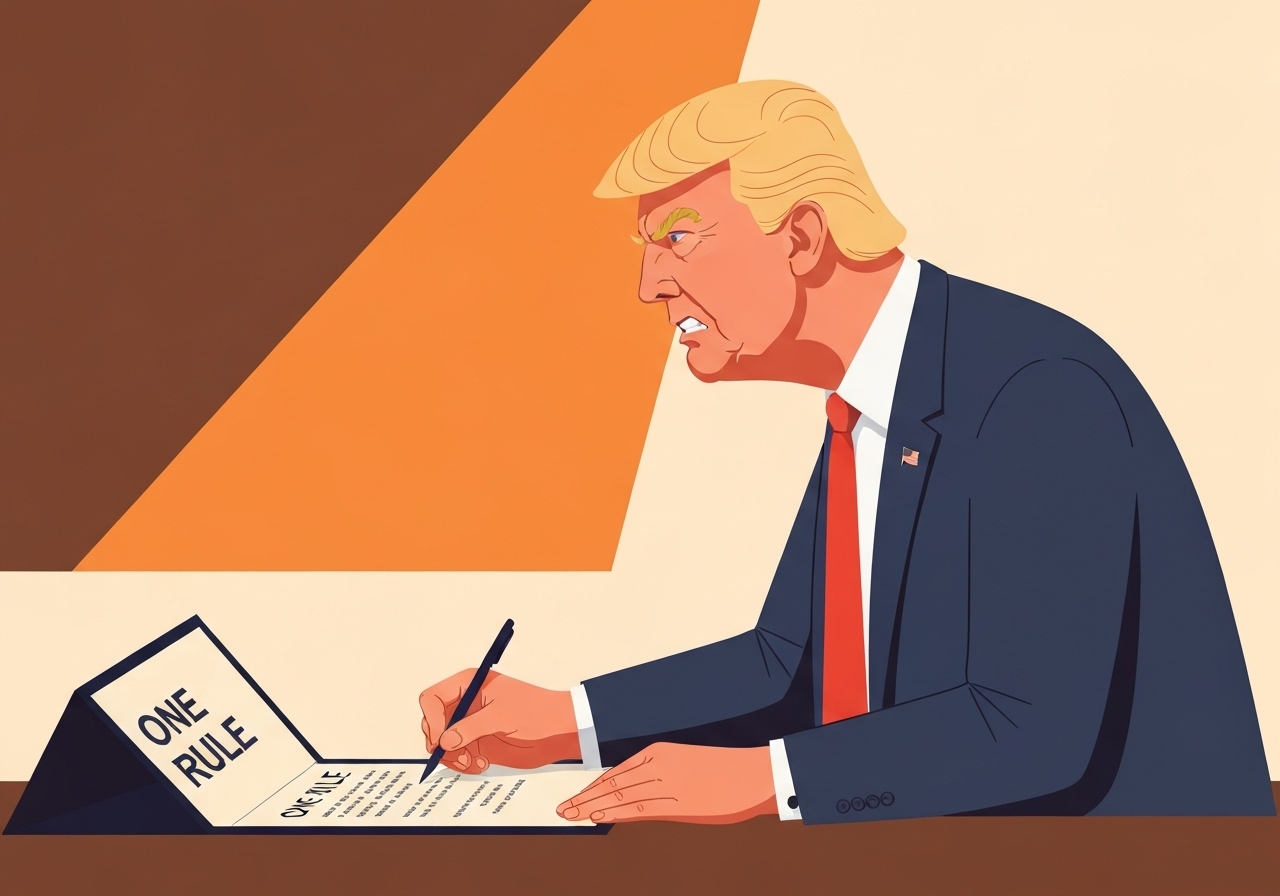
President Donald Trump said on December 8, 2025, he will sign an executive order this week to impose a single federal standard for artificial intelligence, aiming to curtail state-level regulations. Speaking from the White House, Trump said a unified rule would prevent companies from seeking multiple state approvals for AI deployments. The announcement was made in a social media post on Monday and reiterated during remarks in Washington, D.C. The administration has not published the text of the order as of the statement.
Key Takeaways
- The president announced on December 8, 2025, an upcoming executive order called a “ONE RULE” approach to AI regulation that seeks to limit state-level policies.
- Trump’s public comment included the line: “You can’t expect a company to get 50 Approvals every time they want to do something,” signaling a focus on regulatory uniformity.
- The administration said the order would be issued this week, but no text or implementation timetable had been released as of the announcement.
- Federal preemption of state rules could streamline compliance for multi‑state companies but may raise legal challenges over executive authority.
- States have moved separately on AI governance in areas such as hiring, biometric use and safety standards, creating a patchwork of obligations.
- Industry groups have generally pushed for federal clarity; consumer and civil‑liberties advocates have stressed the need for safeguards and accountability.
- The legal and operational scope — which agencies will enforce the order and which classes of AI systems it will cover — remains unclear.
Background
Over the past two years a growing number of U.S. states have proposed or enacted measures aimed at different aspects of artificial intelligence, including workplace use, biometrics, automated decisionmaking and algorithmic transparency. State-level activity has ranged from legislative bills to agency guidance, producing varied obligations for companies that operate across state lines. The federal government has issued policy documents and interagency guidance, but Congress has not passed a comprehensive national AI statute as of December 2025. Against that backdrop, successive administrations have debated whether executive tools can create uniformity where federal legislation is absent.
Preemption — the legal principle that federal law can supersede state law — is often invoked when national policymakers seek to harmonize standards across jurisdictions. Historically, preemption claims tied to regulatory policy have led to court battles testing the boundaries of executive power and agency authority. Industry associations have argued that a single federal standard would reduce compliance complexity and costs, while state governments and advocacy organizations contend that local rules address region‑specific harms and protect residents. The competing incentives — national uniformity versus localized protections — frame the debate that the announced order is intended to resolve.
Main Event
On December 8, 2025, President Trump publicly stated he would sign an executive order intended to establish a single federal approach to AI rules. The remark — delivered in Washington and posted to social media earlier the same day — framed the action as a response to what the administration called an inefficient plurality of state regulations. Trump emphasized that companies should not have to secure many different approvals when deploying technology across the country.
The White House has not released the executive order text or an implementing schedule, and spokespeople did not provide an immediate breakdown of which federal agencies would oversee compliance. That omission leaves open questions about whether the order will rely on sweeping preemption language, targeted federal standards, or directives to agencies to coordinate rulemaking. Legal experts note that the practical effect depends heavily on drafting: narrow preemption aimed at specific regulatory domains differs materially from broad proclamations of supremacy over state law.
In the immediate aftermath, market and legal observers parsed the announcement for signals on enforcement and scope. Technology firms and trade groups signaled interest in federal clarity; however, some state officials indicated they would review any federal text for encroachment on state authority. The interplay between a presidential directive and state statutes is likely to unfold through administrative rulemaking and, potentially, litigation testing the order’s limits.
Analysis & Implications
If the executive order intends to preempt state AI rules, its legal durability will turn on statutory authority and the administrative steps the federal government takes to implement it. Courts typically evaluate preemption claims against the text and purpose of federal statutes and the scope of delegated authority to agencies. An order that instructs agencies to create uniform standards could be more defensible than one that attempts to declare immediate nationwide preemption without statutory underpinning.
From an economic perspective, a single federal standard could lower compliance costs for firms operating in multiple states and speed deployment of AI-powered products and services. Reduced regulatory fragmentation can benefit scale‑dependent industries such as cloud providers and large platform operators. Conversely, states that saw themselves as policy innovators may view a federal rule as constraining experimentation in areas such as consumer protection, labor rules, or privacy.
The order’s international implications should not be overlooked. Other jurisdictions — the EU, the UK and parts of Asia — are actively shaping their own AI governance regimes. A U.S. federal standard could influence transatlantic and transpacific regulatory dialogues, affect market access for foreign companies, and alter how multinational firms allocate compliance resources across regions. If the EO narrows the range of permissible state restrictions, some jurisdictions abroad might press for higher safeguards to cover perceived gaps.
Operationally, important questions remain: which federal agencies will be charged with enforcement, whether the order will distinguish by AI risk level, and how it will interact with existing sectoral statutes. The administration’s answers will determine both the practical reach of the policy and the avenues available for states and civil‑society actors to seek modifications or challenge implementation.
Comparison & Data
| Feature | Proposed Federal “ONE RULE” EO | Typical State AI Rule |
|---|---|---|
| Scope | Unspecified; intended to be nationwide and uniform | Varies by state; focused on specific sectors or uses |
| Enforcement | Expected via federal agencies or directive | State agencies, attorneys general, civil penalties |
| Flexibility | Potentially rigid if nationally prescriptive | Often tailored to local priorities and risks |
The table summarizes qualitative differences between a single federal executive approach and the mosaic of state measures. Without the EO text, comparisons must remain conditional: a narrowly drawn federal standard that sets minimum requirements and permits states to add protections would differ sharply from a sweeping preemption that closes off state action.
Reactions & Quotes
“I will be doing a ONE RULE Executive Order this week. You can’t expect a company to get 50 Approvals every time they want to do something.”
President Donald Trump (social media post, Dec 8, 2025)
“A single federal standard could reduce compliance costs for companies operating across many states.”
Major technology trade group (statement)
“Federal-level action must preserve safeguards for civil rights and public accountability.”
Civil liberties advocates (statement)
Each of the quoted reactions signals differing priorities: the administration emphasizes national uniformity, industry groups stress operational efficiencies, and advocacy organizations underscore the need for protections and oversight.
Unconfirmed
- Whether the White House has drafted the executive order text and, if so, what precise language it contains.
- Which federal agencies would be assigned enforcement or rulemaking responsibility under the planned order.
- Whether the order will assert broad preemption over existing state statutes or establish minimum federal standards while leaving states room to supplement.
- Exact timeline for issuance, publication of implementing rules, or anticipated effective dates for any new requirements.
- The likelihood, scope and timing of legal challenges that could delay or narrow the order’s practical effect.
Bottom Line
President Trump’s announcement on December 8, 2025, signals an administration priority to centralize AI regulation at the federal level and reduce statutory variation among states. The proposition of a single, nationwide standard appeals to companies seeking predictable rules across jurisdictions, but it raises immediate questions about legal authority, enforcement mechanisms and the degree to which states will retain regulatory space.
Observers should watch for the release of the executive order text and subsequent agency directives to assess the policy’s legal footing and operational impact. The coming weeks are likely to produce quick reactions from state governments, industry groups and civil‑liberties organizations, and those reactions — along with early court filings if any — will shape whether the “ONE RULE” approach becomes a durable national framework or a contested stopgap in a larger legislative and judicial process.