
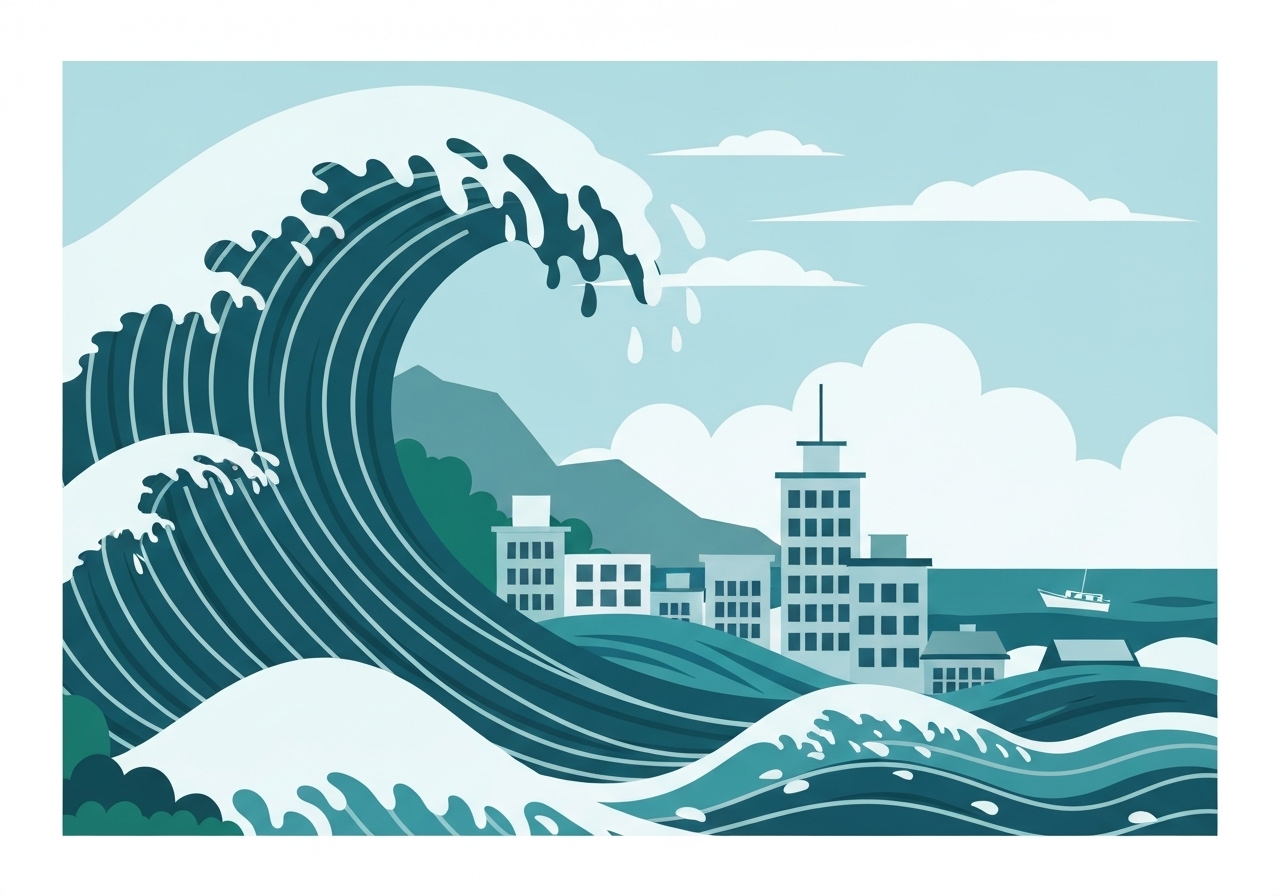
Lead: A 7.6-magnitude earthquake struck off Japan’s northeastern coast late Monday, prompting evacuation orders and a tsunami warning for parts of Iwate, Aomori and Hokkaido. Japan’s Meteorological Agency (JMA) warned that waves of up to about 3 meters (nearly 10 feet) could impact some coastal areas, and recorded a 40-centimeter (16-inch) wave in parts of Aomori and Hokkaido. The United States Geological Survey (USGS) reported the quake occurred at 11:15 p.m. local time (9:15 a.m. ET), roughly 44 miles (70 km) offshore at a depth near 33 miles. National and local authorities ordered evacuations and inspected critical infrastructure, including nuclear facilities, with no abnormalities reported at Higashidōri and Onagawa at the time of initial checks.
Key Takeaways
- The earthquake measured magnitude 7.6 and occurred at 11:15 p.m. local time (9:15 a.m. ET), about 44 miles (70 km) off Japan’s northeast coast, at roughly 33 miles depth (USGS).
- JMA issued tsunami warnings and estimated waves up to about 3 meters (nearly 10 feet) could strike parts of Iwate, Aomori and Hokkaido; 40 cm (16 in) waves were already observed in some areas.
- Evacuation orders and advisories were issued for coastal communities; officials urged residents to move to higher ground or designated shelters immediately.
- Chief Cabinet Secretary Minoru Kihara urged people in affected zones to evacuate to safe buildings or higher ground; immediate emergency checks were ordered at other nuclear facilities.
- Japan’s prime minister, Sanae Takaichi, pledged coordinated national and local response measures and emphasized prioritizing human life in rescue and relief planning.
- No immediate reports of large-scale infrastructure failure or widespread casualties were confirmed in the first hours following the quake.
- The event revived comparisons with the 2011 Tohoku 9.1 earthquake and tsunami, underscoring Japan’s ongoing seismic risk along the Pacific “Ring of Fire.”
Background
Japan sits where several tectonic plates meet, making it one of the world’s most seismically active countries. Large earthquakes are frequent along the Japan Trench and neighboring fault systems, and the region has extensive monitoring networks and evacuation plans maintained at national and local levels. The 2011 Tohoku earthquake and tsunami, which measured magnitude 9.1 and caused catastrophic coastal inundation and a nuclear crisis, remains a benchmark for emergency planning and public awareness in Japan. Since then, authorities have updated alert systems, fortified some coastal defenses, and run regular evacuation drills, but significant quakes continue to test preparedness and infrastructure resilience.
Japan’s Meteorological Agency and the United States Geological Survey operate complementary monitoring systems that provide rapid magnitude, location and tsunami forecasts. Local governments retain responsibility for issuing evacuation orders, opening shelters and coordinating rescue teams. Power plants and critical facilities are required to run immediate inspections after major shaking; nuclear plant operators follow regulatory protocols and report findings to government agencies. The current quake occurred in a region with scattered coastal communities, fishing ports and several nuclear installations, which drove the rapid governmental response this evening.
Main Event
The USGS placed the epicenter approximately 44 miles (70 km) offshore at a depth of about 33 miles, and recorded the event as magnitude 7.6. JMA quickly raised tsunami warnings for parts of the northeastern coast and began broadcasting evacuation instructions by local channels and sirens. Observers in Aomori and Hokkaido reported an initial measured wave of roughly 40 cm (16 in), but JMA cautioned that much larger surges up to about 3 meters (nearly 10 ft) were possible along some stretches of shoreline.
In Tokyo, more than 200 miles south of the epicenter, a CNN reporting team felt strong ground shaking that lasted longer than 30 seconds, forcing momentary interruptions in public transit and office activity. Local authorities in Iwate, Aomori and northern Hokkaido activated emergency response centers and opened evacuation shelters. Roads and ports in exposed coastal areas were temporarily closed as officials assessed damage and searched for localized flooding or landslides triggered by the shaking.
Japan’s chief cabinet secretary, Minoru Kihara, addressed the nation with a clear evacuation directive and said teams were checking critical infrastructure. He reported there were no immediate abnormalities at Higashidōri and Onagawa nuclear power plants but added that other facilities were being inspected as a precaution. Prime Minister Sanae Takaichi, who took office after an October election, said her government would work closely with local officials to evaluate damage and implement relief measures under a “human life first” principle.
Analysis & Implications
The immediate priority is humanitarian: ensuring residents move to higher ground and that emergency services can reach affected communities. Tsunami forecasts can change rapidly as waves propagate and interact with coastal topography; a measured 40 cm rise in one location does not preclude larger surges elsewhere along the coastline. Coastal evacuation orders reduce casualties but place stress on transport networks, shelters and emergency logistics, especially in colder months when sheltering and medical support become more complex.
Economically, a magnitude-7.6 offshore event can cause localized damage to ports, fisheries and coastal infrastructure; the full cost depends on wave heights, run-up distance and any coastal inundation. Disruption to shipping lanes and port operations can have short-term supply-chain impacts for regional fisheries and transported goods. Insurance losses will depend on the number of properties affected in low-lying zones and on the extent of secondary hazards such as landslides and liquefaction in vulnerable communities.
From a policy perspective, the quake will test recent investments in early-warning communications, coastal defenses and the capacity of municipal response teams. Japan’s nuclear sector has strict post-shaking inspection protocols; rapid confirmation of plant integrity is crucial to prevent public alarm. Internationally, the event will likely prompt exchanges of data and support with Pacific-nation tsunami-monitoring partners and may trigger offers of assistance if damage assessments indicate larger humanitarian needs.
Comparison & Data
| Metric | Value |
|---|---|
| Magnitude | 7.6 |
| Time (local) | 11:15 p.m. (9:15 a.m. ET) |
| Epicenter distance | ~44 miles (70 km) offshore |
| Depth | ~33 miles |
| Observed tsunami | ~40 cm (16 in) in parts of Aomori/Hokkaido |
| Potential tsunami warning | Up to ~3 meters (nearly 10 ft) in some coastal areas |
The table summarizes the initial, confirmed measurements published by USGS and observations reported by JMA. Historical perspective: the 2011 Tohoku earthquake was magnitude 9.1 and produced far larger tsunami run-ups that overwhelmed defenses; the current magnitude is lower but still capable of dangerous coastal surges. Emergency managers will refine these figures as tide gauge and coastal sensor networks return fuller datasets over the coming hours.
Reactions & Quotes
Authorities and leaders issued succinct public directives while teams on the ground began assessments. The following quotes reflect official guidance and political leadership in the immediate aftermath.
Please evacuate to higher ground or move to safe buildings such as evacuation shelters; do not return until authorities say it is safe.
Minoru Kihara, Chief Cabinet Secretary (government official)
Kihara’s statement accompanied orders to inspect critical facilities and mobilize rescue resources. Officials emphasized the need for calm compliance with evacuation orders to reduce harm while assessments continue.
We will work closely with local governments to assess damage and provide emergency measures, acting under the principle of putting human life first.
Sanae Takaichi, Prime Minister (national leadership)
The prime minister framed the response as a coordinated national effort. Her office signaled deployment of national disaster-response teams to support municipal operations and agreed to prioritize evacuation logistics and shelter support.
Unconfirmed
- Reports of widespread structural collapses along the coast are unconfirmed; damage assessments are still being compiled by local authorities.
- Claims of abnormalities at facilities beyond Higashidōri and Onagawa remain unverified pending formal operator reports.
- Any casualty or injury totals are preliminary; official tallies have not been released at the time of this bulletin.
Bottom Line
The earthquake off Japan’s northeast coast is a significant seismic event that triggered tsunami warnings and precautionary evacuations; measured and potential wave heights require residents in exposed coastal zones to remain cautious. Early inspections show no immediate issues at two named nuclear plants, but authorities are conducting broader checks as a safety priority. Emergency response will focus on search-and-rescue readiness, shelter operations and rapid damage assessment to inform recovery planning in the coming days.
Observers should expect updates as tide-gauge networks, local governments and national agencies refine measurements and release consolidated damage reports. International monitoring partners will share oceanic data and may offer assistance if domestic needs outpace local capacities; for now, the emphasis remains on immediate life-safety actions and careful, data-driven assessments.
Sources
- CNN (media report summarizing initial government and agency statements)
- Japan Meteorological Agency (JMA) (official tsunami and seismic warnings)
- United States Geological Survey (USGS) (seismic event data and location)
- Prime Minister’s Office of Japan (official government statements)