
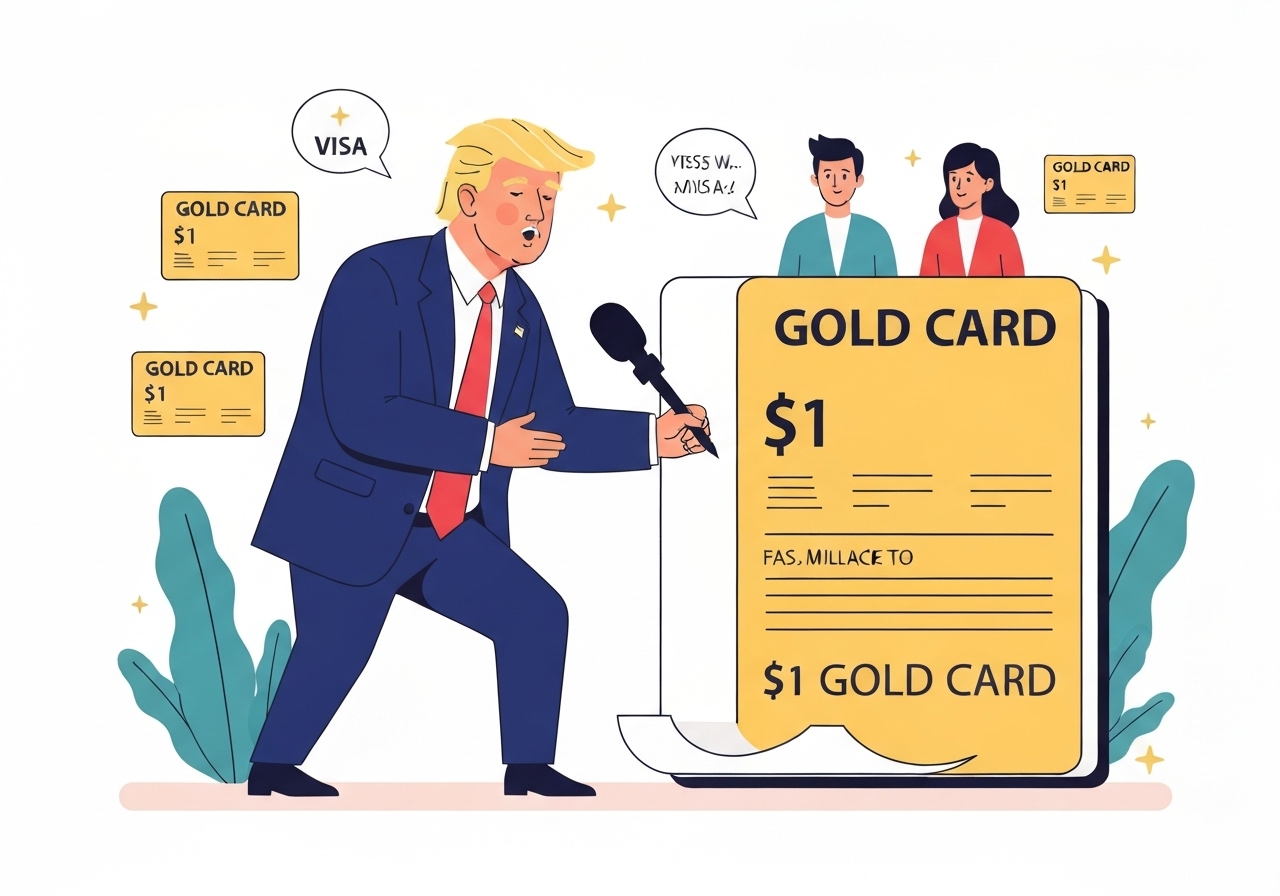
Lead: On December 10, 2025, President Donald Trump announced the formal launch of a new immigration pathway dubbed the “Trump Gold Card,” unveiled at a White House roundtable. The program, posted on trumpcard.gov the same day, allows foreign nationals to pay a $1 million contribution plus a $15,000 DHS processing fee for an expedited route to lawful permanent residency, or permits companies to sponsor workers for $2 million. The administration says successful applicants will receive EB-1 or EB-2 employment-based status after background checks and a visa interview, with processing expected to take “weeks.” The White House also promoted a future “Platinum Card” for a $5 million contribution that would offer extended U.S. stays and a claimed tax benefit.
Key Takeaways
- The program launched on December 10, 2025, with the application portal posted at trumpcard.gov and a stated DHS processing fee of $15,000 plus a $1,000,000 contribution for individual applicants.
- Companies may sponsor foreign workers under a $2,000,000 option, according to the site; successful applicants are slated to receive EB-1 or EB-2 status, both employment-based categories.
- The White House said adjudication would take “weeks,” require a visa interview and background vetting, and might involve additional State Department fees depending on the applicant.
- The site previews a forthcoming “Platinum Card” priced at $5,000,000 that it says would allow up to 270 days in the U.S. without being subject to U.S. taxes on non-U.S. income.
- The administration links the rollout to a broader tightening of immigration after a December shooting that wounded two National Guard members in Washington, D.C., and traces the policy’s public arc from a February announcement and a September executive order.
- Officials, including Commerce Secretary Howard Lutnick and Homeland Security Secretary Kristi Noem, have said the plan would modify investor-visa arrangements; Lutnick has projected substantial revenue potential, a claim experts say faces legal and legislative hurdles.
Background
The “Gold Card” follows months of public statements by the administration about creating paid pathways for wealthy foreign nationals. President Trump first announced a paid-citizenship pathway in February 2025 and signed an executive order in September 2025 directing federal agencies to implement the program. The administration positions the policy as a selective replacement or overhaul of existing investor-visa mechanisms, notably the EB-5 investor program, which has historically allowed foreigners to gain residency through job-creating investments.
Commerce Secretary Howard Lutnick has framed the proposal as a corrective to what he calls an overly broad admissions process, saying it will target “extraordinary” talent and, in February, floated the possibility of raising significant revenue. Lutnick and Homeland Security Secretary Kristi Noem have been cited as coordinating implementation, but immigration law specialists note that major statutory changes to EB-5-style programs typically require congressional action. The rollout also comes amid an administration-wide tightening of many legal and irregular routes into the U.S. after a recent shooting in Washington, D.C., which officials said prompted immediate security reviews.
Main Event
At a White House roundtable on December 10, 2025, President Trump declared the program open and pointed visitors to trumpcard.gov, where the official application and program terms were posted. The site sets a $15,000 DHS processing fee and states that, after background checks and a timely interview, a $1,000,000 contribution will qualify applicants for expedited consideration. It also describes an employer-sponsored lane with a $2,000,000 sponsorship charge for companies seeking to bring foreign workers into the U.S.
The website specifies that approved applicants would be granted lawful permanent resident status as EB-1 or EB-2 visa holders — categories reserved for individuals with “extraordinary” (EB-1) or “exceptional” (EB-2) abilities or achievements. The administration says the timeline from submission to decision will be measured in weeks, though additional State Department fees may apply “depending on the applicant.” The site requires applicants to appear for an interview and to submit requested documents promptly.
Also highlighted on the portal is a “Trump Platinum Card” that is not yet available; the site invites interested parties to join a waiting list and promises that, upon payment of a $15,000 processing fee plus a $5,000,000 contribution, eligible holders would be able to spend up to 270 days in the United States without being subject to U.S. taxes on non-U.S. income. The portal does not give a launch date for the Platinum Card and offers limited detail on eligibility or enforcement of the tax claim.
Analysis & Implications
The Gold Card reconfigures core principles of U.S. immigration policy by introducing a price-based fast track to permanent residency. If implemented as described, the program would effectively create a paid premium channel that accelerates access to EB-1/EB-2 classifications, categories that historically require evidence of sustained achievement or national benefit. Legal scholars warn that reassigning these statutory visa categories through executive action risks litigation and could face legislative pushback because Congress sets immigration categories and admission rules.
Economically, administration officials have framed the program as revenue-generating; Commerce Secretary Lutnick has suggested the model could raise substantial sums. Projections offered publicly—such as an administration claim that millions of cards could be sold and even a $1 trillion revenue target—are large and would rely on both high demand and legal durability. Experts say converting public interest into realized revenue would be far from automatic and depends on judicial review, congressional responses, and the practical limits of vetting and processing capacity.
On policy and social fronts, the plan intensifies debates over merit, fairness and the role of wealth in immigration. Supporters argue that channeling investment and top talent can boost the economy, while critics contend that selling expedited residency exacerbates inequality and undermines family- and employer-based pathways. Internationally, the introduction of a paid residency product with claimed tax advantages could prompt reciprocal policies or tax-law scrutiny from other governments and U.S. tax authorities.
Comparison & Data
| Program | Primary Fee/Contribution | Target Status | Claimed Benefit |
|---|---|---|---|
| Existing EB-5 (typical) | Investments $800k–$1.05M | Conditional green card (investment) | Pathway tied to job-creating projects |
| Trump Gold Card | $1,000,000 + $15,000 DHS fee; $2M employer sponsor | EB-1 or EB-2 | Expedited residency in weeks |
| Trump Platinum Card (preview) | $5,000,000 + $15,000 fee | Unspecified | Up to 270 days U.S. stay; claimed tax relief |
The table highlights differences between the long-standing EB-5 investment route and the administration’s new paid options. While EB-5 links residency to capital invested in job-creating projects, the Gold/Platinum concept as presented emphasizes contribution amounts and expedited processing. The administration’s characterization of EB-1/EB-2 assignment — categories with high evidentiary standards — raises practical questions about how adjudicators will reconcile contribution-based selection with existing regulatory criteria.
Reactions & Quotes
At the announcement, President Trump framed the program as both a national and personal achievement, positioning the cards as selective and revenue-positive.
“Very excitingly, for me and for the country, we’ve just launched the ‘Trump Gold Card.'”
President Donald Trump, White House roundtable
Commerce Secretary Howard Lutnick has repeatedly described the effort as a modification of investor-visa policy and suggested large revenue potential. Legal experts and immigration advocates offered measured or skeptical responses about legality and equity.
“We will modify the EB-5 agreement… For $5 million, they’ll get a license from the Department of Commerce.”
Howard Lutnick, Commerce Secretary (February remarks)
Immigration law scholars noted that substantive changes to EB-5-like programs generally require congressional authorization and warned of foreseeable court challenges. Public reaction among immigrant advocacy groups stressed concerns about fairness and administrative capacity to vet wealthy applicants rapidly.
Unconfirmed
- How many Gold Cards the administration intends to sell and whether a cap exists remains unspecified and unverified.
- The timing and operational details for the Platinum Card, including eligibility criteria and enforcement of the claimed 270-day tax treatment, are not provided on the site.
- Claims that the program could raise $1 trillion or that “millions” of cards will be sold are projections made by officials that have not been substantiated with demand estimates or legislative authority.
- Whether the assignment of EB-1 or EB-2 status to contribution-based applicants will withstand judicial review or require statutory changes by Congress is unresolved.
Bottom Line
The Gold Card represents a major policy experiment: an administration-authored, fee-driven route to U.S. residency that recasts employment-based visa categories as purchasable, expedited outcomes. If implemented as described, it would accelerate some wealthy applicants into EB-1/EB-2 classifications in weeks rather than the typical multi-month or multi-year waits, but the legal basis, congressional role and long-term consequences remain unclear.
Observers should watch for immediate follow-up signals: regulatory notices, judicial challenges, congressional responses, and operational details on adjudication standards and fraud safeguards. The program’s real-world impact—on revenue, labor markets, and immigration equity—will hinge on those developments and on whether courts or lawmakers constrain the administration’s approach.
Sources
- CNN — news reporting on announcement and White House materials (media)
- trumpcard.gov — official program portal and application (official/administration)