
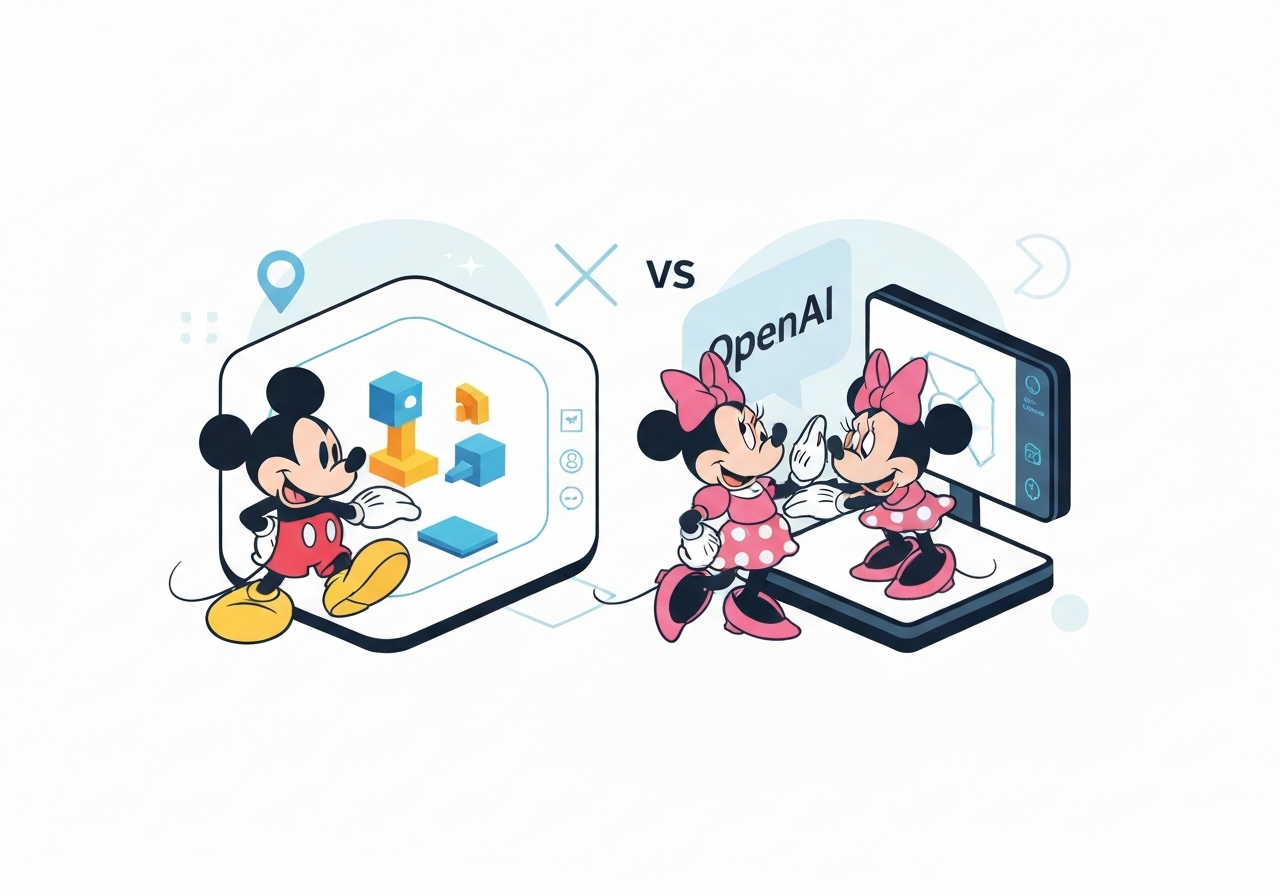
On Dec. 11, 2025, The Walt Disney Company announced a three-year agreement with OpenAI to allow Disney characters to appear on Sora, OpenAI’s short-form video platform, and to stream Sora-created videos on Disney+. As part of the deal, Disney will purchase a $1 billion stake in OpenAI, with an additional equity investment described as likely but not yet finalized. The companies said they will collaborate on new products, tools and employee deployments of ChatGPT. Disney made clear the agreement does not include talent likenesses or voices and framed the move as cautious and deliberate.
Key Takeaways
- Deal term: Three-year content licensing agreement allowing Disney characters on OpenAI’s Sora and distribution of Sora videos on Disney+.
- Equity: Disney will buy a $1 billion stake in OpenAI; both sides indicate further equity investment is likely but unconfirmed.
- Scope: The deal covers character usage in short-form Sora videos but explicitly excludes talent likenesses and voices.
- Internal use: Disney plans to deploy ChatGPT for employees and to co-develop products and tools with OpenAI.
- Industry precedent: Disney is the first major Hollywood studio to license characters directly to an AI video platform, setting a new commercial precedent.
- Legal backdrop: The move comes amid ongoing copyright disputes between studios and A.I. developers, including lawsuits against Midjourney.
- Timing: Announcement timestamped Dec. 11, 2025, 10:16 a.m. ET, marking a fast-moving phase in entertainment–AI partnerships.
Background
Hollywood studios, creators and technology companies have spent recent years wrestling with how generative artificial intelligence is trained, how copyrighted works are used, and how royalties or licensing should be structured. Major production companies have repeatedly warned that unregulated A.I. tools can replicate copyrighted characters and artistic styles without compensation to rights holders. That tension has produced litigation, public campaigns and negotiations with unions representing actors, writers and other creative collaborators.
Disney and other studios have both sued and engaged with A.I. developers: for example, lawsuits against Midjourney allege that its image-generator permits direct copying of proprietary characters and artwork, while Midjourney has defended aspects of its operations as fair use. At the same time, A.I. firms and some creators argue that new tools open novel creative and commercial opportunities, including user-generated content and new distribution formats. The industry is therefore navigating simultaneous pressure to protect intellectual property and to explore technology-driven growth.
Main Event
The announcement on Dec. 11 formalizes a three-year licensing arrangement that will permit Disney-owned characters to appear in content produced with Sora, OpenAI’s short-form video creation platform. Under the agreement, videos created on Sora that include licensed Disney characters will be eligible to stream on Disney+, widening distribution for Sora-originated clips. Disney’s $1 billion equity purchase in OpenAI was disclosed alongside the licensing terms; company statements say additional investment is likely but not yet finalized.
Disney’s chief executive, Robert A. Iger, framed the collaboration as a careful step for the company. In a brief public comment, he said the advancement of artificial intelligence “marks an important moment for our industry” and described the partnership with OpenAI as intended to extend Disney’s storytelling in a thoughtful, responsible way. Company materials stressed that talent likenesses and voice recreations were expressly excluded from the deal, a concession aimed at limiting the most sensitive labor and creative-rights flashpoints.
OpenAI characterized the deal as a commercial and creative partnership, with plans to work jointly on product development and internal deployments of A.I. tools like ChatGPT for Disney employees. Disney will thus combine an ownership stake with collaborative product work and content licensing. The announcement did not publish granular commercial terms—such as revenue splits, royalty rates or content-moderation protocols—and those operational details remain to be negotiated or disclosed.
Analysis & Implications
This agreement establishes a new precedent: a leading studio is licensing its iconic characters directly to an A.I. video platform while also taking an ownership position in the A.I. company. That dual approach aligns incentives—Disney gains influence over OpenAI’s roadmap while extracting commercial value from character licensing—but it also raises questions about competitive advantages and gatekeeping in the creator economy.
For talent and unions, the explicit exclusion of likenesses and voice cloning is meaningful but partial. Actors’ unions and voice artists have sought stronger contractual protections and revenue participation when A.I. reproduces their performances. Disney’s carve-out addresses the most immediate livelihood concern but leaves open debates over derivative uses, background characters, and what constitutes a protected performance versus an acceptable stylized character.
Regulators and rival studios will watch closely. If the deal proves commercially successful, other rights holders may follow, reshaping how A.I. platforms source popular intellectual property and how platforms compensate rights owners. At the same time, smaller creators and independent artists could face new barriers if major studios centralize marquee characters on a small number of licensed platforms.
Comparison & Data
| Term | Detail |
|---|---|
| Duration | Three years |
| Equity | $1 billion stake (additional investment likely) |
| Platform | OpenAI’s Sora (short-form video) |
| Distribution | Eligible to stream on Disney+ |
| Talent likenesses/voices | Explicitly excluded |
The table above summarizes the disclosed commercial terms. Absent from public materials are detailed revenue-sharing formulas, content-moderation thresholds, user-generated content policies tied to licensed characters, and technical safeguards against unauthorized mimicking of performers. Those gaps are central to how the industry and regulators will evaluate the agreement’s broader impacts.
Reactions & Quotes
Studio executives emphasized prudence; below are representative statements released during the announcement and reporting.
“The rapid advancement of artificial intelligence marks an important moment for our industry, and through this collaboration with OpenAI we will thoughtfully and responsibly extend the reach of our storytelling.”
Robert A. Iger, Chief Executive, The Walt Disney Company
Disney used Iger’s remark to underscore a cautious posture even as it embraces commercial ties to a major A.I. developer.
“[Midjourney] has rejected the claim, saying its actions fall under ‘fair use.'”
Midjourney (as reported)
That brief statement reflects the legal backdrop: studios are simultaneously litigating perceived infringements while negotiating commercial relationships with other A.I. firms.
Unconfirmed
- Exact commercial terms beyond the $1 billion stake remain undisclosed; revenue splits and royalty formulas have not been published.
- The size and structure of the “additional equity” investment referenced by Disney are not finalized or publicly detailed.
- How Disney and OpenAI will technically prevent unauthorized replication of performers or unlicensed likenesses in user-generated Sora content is not yet described.
- Any specific concessions or side agreements with talent unions about future use of A.I.-generated content have not been announced.
Bottom Line
Disney’s agreement with OpenAI is a landmark commercial step that signals major studios are willing to negotiate licensing deals with A.I. platforms rather than rely solely on litigation. By combining a licensing contract with an equity stake, Disney gains both a revenue channel and influence over an increasingly important technology partner.
That dual strategy may accelerate similar deals across entertainment, but it will not by itself resolve open questions about performer protections, training-data provenance, or platform gatekeeping. The next 12–36 months should reveal whether licensors and A.I. developers can convert headline deals into durable business models that respect creators and sustain broad creative participation.
Sources
- The New York Times — media reporting on the announcement (Dec. 11, 2025)