
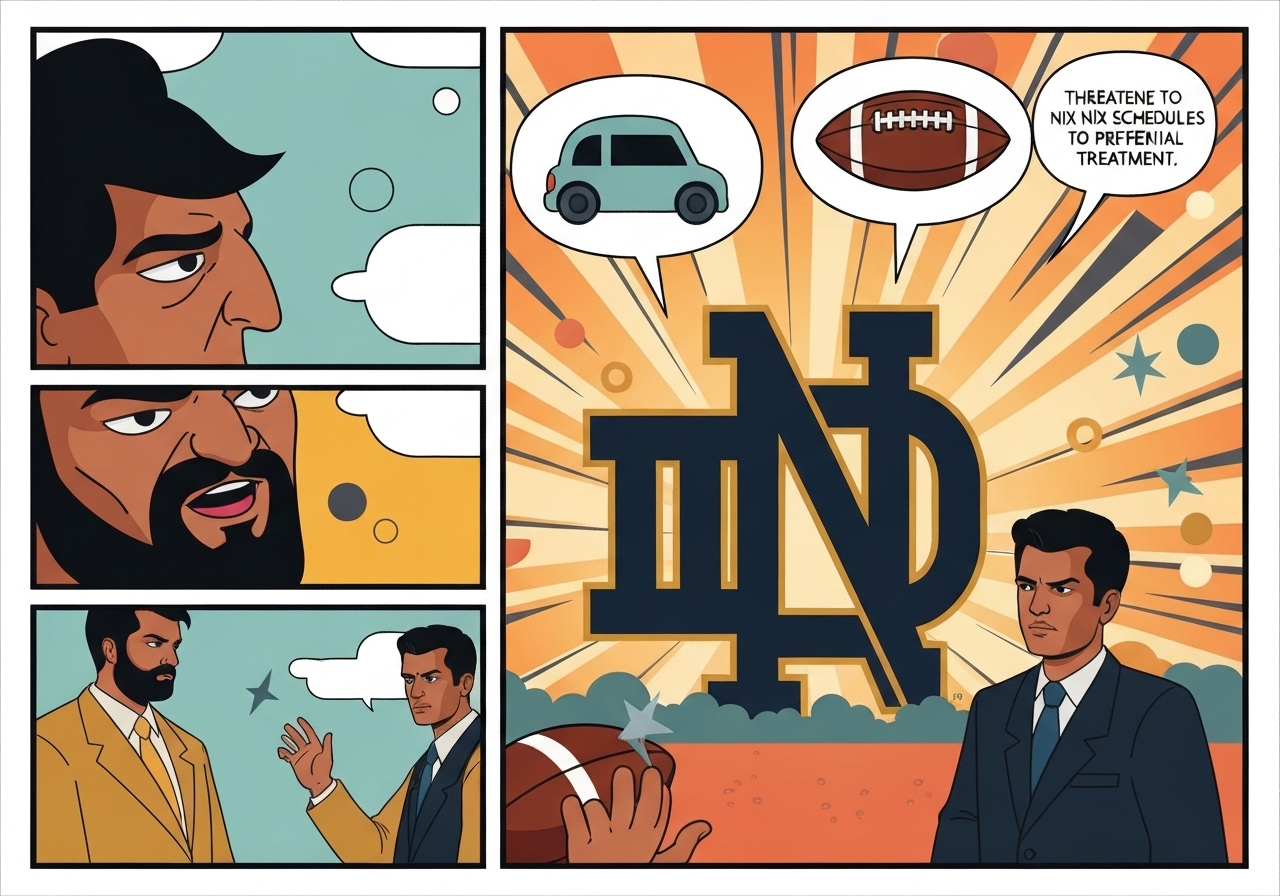
Lead: In the wake of Notre Dame’s exclusion from this season’s College Football Playoff, reporting indicates the CFP signed a memorandum that would effectively guarantee Notre Dame a spot if it ranks inside the top 12 starting next year, and in some expansion scenarios a top-13 safety net. That provision — first reported by Yahoo Sports — has prompted backlash from athletic directors at other programs, who say they are considering retaliatory steps including dropping the Irish from future nonconference schedules. Notre Dame officials have publicly protested the playoff selection and warned of lasting damage to conference relationships, while critics note the program’s reaction may erode public sympathy and leverage.
Key Takeaways
- The CFP memorandum reported by Yahoo Sports says Notre Dame would be effectively guaranteed a playoff berth if ranked in the top 12 beginning next season; if the field expands to 14 with extra at-large berths, a top-13 ranking would suffice.
- Athletic directors at multiple programs have privately told reporters they are “threatening to freeze [Notre Dame] out of future schedules,” a move aimed at punishing what they see as preferential treatment.
- Notre Dame AD Pete Bevacqua called the committee’s decision to exclude the Irish this year a “punched in the stomach” moment and warned of “permanent damage” to relations with the ACC.
- Big 12 commissioner Brett Yormak publicly criticized Bevacqua’s reaction as “totally out of bounds,” signaling resistance among conference officials and peers.
- The university bookstore briefly canceled (then rescheduled) a signing with a CFP committee member, reflecting the tension’s spillover into campus life and public events.
- Miami, a member of the ACC, took the final CFP berth this year over Notre Dame; the Irish remain independent and therefore have different scheduling and conference dynamics.
- Observers caution that threats to remove Notre Dame from future schedules could harm multiple programs financially, since Notre Dame draws large crowds and strong TV ratings.
Background
The College Football Playoff expanded to a 12-team bracket for the 2024 season, and discussions about further expansion to 14 or more teams have been ongoing among stakeholders. Amid those talks, Yahoo Sports reporter Ross Dellenger wrote that the CFP and Notre Dame reached a memorandum of understanding last spring that effectively treats the Irish as a protected participant if they meet certain ranking thresholds. That arrangement reflects Notre Dame’s unique status — the program is an FBS independent with a long national footprint, lucrative TV arrangements, and historic brand value that complicate standard conference-first selection dynamics.
Notre Dame has a long history of negotiating special arrangements with conferences and media partners to preserve its independence while gaining access to marquee matchups and postseason opportunities. The school’s occasional intersection with conferences — for example, its scheduling agreements with the ACC and individual schools — has often been transactional rather than full membership. That history helps explain why a reported MOU granting preferential access in playoff scenarios would be controversial among conference-affiliated programs that compete for limited at-large berths and scheduling slots.
Main Event
After this season’s CFP selection excluded Notre Dame in favor of Miami, the program publicly expressed strong displeasure. Notre Dame AD Pete Bevacqua described the exclusion in emotive terms and argued the decision inflicted lasting damage on the school’s relationship with the ACC. The school’s reaction included public statements and campus-level moves such as the temporary cancellation of a bookstore signing with a CFP committee member, which was later rescheduled amid backlash.
Reporting aggregated by Sports Illustrated and Yahoo Sports indicates that athletic directors at multiple schools are upset about the memorandum that appears to give Notre Dame advantageous entry conditions to future playoff fields. Those ADs have privately floated the idea of retaliating by removing Notre Dame from future nonconference schedules — a punitive step that would reduce the Irish’s available high-profile opponents and could influence revenue and television negotiation leverage.
Journalists have noted both sides of the ledger: Notre Dame’s brand still fills stadiums and attracts TV viewers, making it a valuable scheduling partner; at the same time, perceived preferential playoff treatment undermines trust among peer institutions that contend for the same at-large slots. Officials from the ACC and conference commissioners have publicly criticized the tone of Notre Dame’s response while acknowledging the program’s right to express disappointment.
Analysis & Implications
If athletic directors follow through on freezing Notre Dame out of future schedules, the immediate impact would be logistical and financial. Notre Dame regularly schedules marquee nonconference opponents to preserve national relevance; a block of refusals from conference-affiliated programs would force the Irish to rely more on Group of Five opponents, FCS matchups or investor-led neutral-site games, likely reducing gate receipts and expensive television windows.
Beyond finances, the move would be a reputational escalation. Athletic directors considering a scheduling freeze are signaling that they view formal or informal preferential treatment as a threat to competitive equity. Schedules are a form of leverage in modern college football; withholding games would be a blunt tool to disincentivize special treatment but could also reduce the quality of opponents and fan interest for programs using the tactic.
Politically, the episode may accelerate pressure on Notre Dame to seek firmer conference ties or to accept stricter transparency around any MOU with the CFP. Conferences and network partners want predictable, marketable matchups; if the Irish become harder to schedule, networks could demand concessions or reduce rights fees. Conversely, if Notre Dame’s TV draw proves immovable, other programs might hesitate to enact long-term boycotts.
Comparison & Data
| CFP Field Size | Reported Notre Dame Guarantee |
|---|---|
| 12 teams (current) | Guaranteed berth if Notre Dame ranks inside top 12 (per Yahoo Sports report) |
| 14 teams (proposed expansion) | Guaranteed berth if Notre Dame ranks No. 13 or better, with added at-large berths |
The table above summarizes the thresholds reported in coverage of the MOU. While the CFP selection criteria otherwise prioritize conference champions and at-large committments, the reported arrangement creates a conditional exception for an independent program. That asymmetry is central to the current dispute and explains why ADs from conference schools view the provision as a material change to the distribution of at-large slots.
Reactions & Quotes
Several officials and commentators have weighed in publicly. Below are representative excerpts and context.
“Threatening to freeze [Notre Dame] out of future schedules,” a phrase used in reporting on AD reactions, captures the retaliatory option under consideration by peer programs.
Dan Wolken / Yahoo Sports (media report)
That line was used by reporting to summarize private remarks from multiple athletic directors. The phrase underscores the idea that school leaders are exploring schedule-based pressure rather than regulatory or legal remedies.
“Punched in the stomach,”
Pete Bevacqua, Notre Dame AD
Bevacqua used terse language to describe his view of the selection outcome and warned of “permanent damage” to ties with the ACC. His comments helped elevate the dispute into public view and prompted pushback from other officials.
“I think he is totally out of bounds in his approach,”
Brett Yormak, Big 12 commissioner
Yormak’s remark reflects frustration among conference executives with the tone and tactics used by Notre Dame leadership. That pushback suggests peers may be less sympathetic to public displays of grievance even when the underlying selection could be debated on merit.
Unconfirmed
- Whether the full text of the CFP memorandum has been published publicly; reporting cites sources rather than a posted contract, so some specifics remain unverified.
- Whether athletic directors will actually follow through on removing Notre Dame from future schedules; several ADs described the threat privately, but concrete cancellations or formal coordinated action have not been reported.
- Whether the reported MOU language will be enforced as written if the playoff expands or if CFP governance revises selection policies; the committee has discretion and could alter procedures.
Bottom Line
The dispute highlights the tension between historical brand power and evolving expectations of competitive fairness in the College Football Playoff era. A reported MOU that effectively grants Notre Dame conditional playoff access pits an independent, nationally prominent program against conference-affiliated schools that compete for the same limited at-large opportunities.
How the conflict resolves will shape scheduling patterns, broadcast economics and the politics of playoff governance. If athletic directors take coordinated scheduling steps, Notre Dame could face reduced nonconference options and diminished negotiating leverage; if the CFP or conferences respond with policy changes or greater transparency, the episode could spur broader reforms to selection rules and to how special arrangements are disclosed to peer institutions and the public.
Sources
- Sports Illustrated (media) — original article summarizing reporting and reactions.
- Yahoo Sports (media report by Ross Dellenger and coverage citing Dan Wolken) — reported the memorandum of understanding and AD reactions.
- Atlantic Coast Conference (ACC) (official statement) — ACC response to Notre Dame’s public allegations about conference sentiment.