
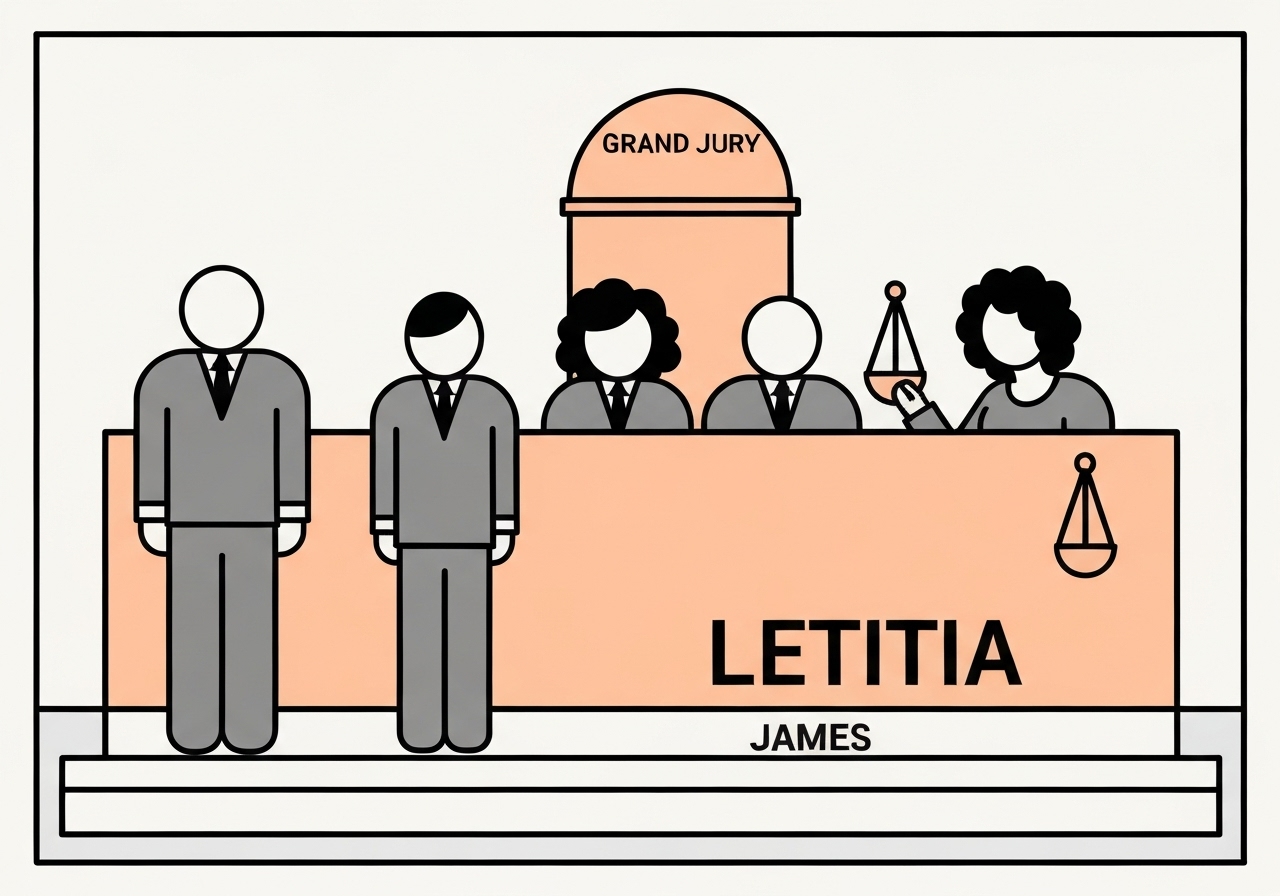
On Dec. 11, 2025, a federal grand jury in Alexandria, Virginia declined to return new charges against New York Attorney General Letitia James, marking a second consecutive grand-jury rejection within one week. The back-to-back refusals came amid a broader dispute between Ms. James and President Trump, whose administration has pursued renewed criminal scrutiny of political opponents. Prosecutors in the U.S. Attorney’s Office for the Eastern District of Virginia may legally present the case to another jury, but the twin rejections raise questions about the strength of the prosecutors’ presentation and the likelihood of a successful indictment. The outcome was described by Ms. James’s counsel as further evidence the matter should not have been prosecuted.
- A federal grand jury in Alexandria, Va., on Dec. 11, 2025 declined to reindict Letitia James, one week after a separate jury also refused to indict.
- Two successive grand juries rejected the prosecutors’ effort, signaling repeated failures to secure criminal charges in this matter.
- U.S. prosecutors in the Eastern District of Virginia retain the authority to present the case again, though repeated refusals may invite judicial scrutiny.
- Legal ethics professor Bruce Green (Fordham Law) said there is no constitutional bar to multiple presentations but that most prosecutors would stop after repeated rejections.
- Ms. James’s attorney, Abbe D. Lowell, said the second rejection “makes even clearer that this case should never have seen the light of day.”
- The twin refusals highlight practical and political challenges the Justice Department faces when pursuing high-profile targets of the Trump administration.
Background
Letitia James, the elected attorney general of New York, and former President Donald J. Trump have been adversaries for several years. Ms. James brought a high-profile civil suit against Mr. Trump, his business entities and family members, a conflict that has contributed to heightened tensions between her office and federal authorities aligned with the administration. In recent months, prosecutors in the Eastern District of Virginia pursued a criminal presentation to a grand jury in Alexandria; that jury declined to indict, and a second grand jury reached the same decision one week later.
The use of successive grand juries to seek indictments is unusual in politically charged cases, and legal scholars note it invites scrutiny over prosecutorial judgment and prosecutorial motives. Federal law permits multiple presentations to different grand juries, but repeated negative outcomes can influence how judges and appellate courts view prosecutorial conduct and the likelihood of a tryable case. Stakeholders include the U.S. Attorney’s Office in Alexandria, Ms. James’s legal team, and national political actors who have framed the prosecutions within larger narratives about accountability and retaliation.
Main Event
On Dec. 11, 2025, prosecutors presented evidence to a grand jury in Alexandria that the panel found insufficient to return an indictment against Ms. James. That decision followed a similar refusal by another grand jury exactly one week earlier, representing two consecutive rejections of criminal charges in the same matter. The precise contents of the prosecutors’ presentations have not been publicly disclosed; grand-jury proceedings are secret, and the U.S. Attorney’s Office declined to release details beyond confirming the procedural outcome.
After the second rejection, Ms. James’s lawyer, Abbe D. Lowell, issued a statement arguing the result vindicated his client and undermined the justification for pursuing the case. Legal observers noted that while prosecutors can legally attempt a third presentation, two back-to-back refusals diminish the practical prospects of securing a jury indictment at the trial stage and may shape a judge’s view of subsequent, repetitive filings.
Observers also emphasized the political optics: the Justice Department’s decision to pursue additional grand-jury presentations despite earlier failures feeds narratives about the use of federal prosecutorial resources in politically sensitive investigations. Prosecutors maintain broad discretion in charging decisions, but repeated non-indictments in high-profile matters tend to prompt questions from defense lawyers, judges and the public about prosecutorial prudence.
Analysis & Implications
Legally, the twin grand-jury refusals matter because grand juries are typically easier for prosecutors to persuade than trial juries; prosecutors call witnesses and present evidence without adversarial cross-examination. When one grand jury declines to indict, many prosecutors reassess the strength of their evidence. Two consecutive rejections therefore weaken prospects for a conviction and could deter further prosecutorial investment in the case.
Institutionally, the episode puts the U.S. Attorney’s Office in the Eastern District of Virginia in a delicate position. Persisting after repeated rejections risks judicial rebuke or appellate criticism that prosecutors are pursuing charges despite insufficient evidence. At the same time, prosecutors may argue their duty is to continue investigating if new information emerges; the law permits repeated presentations, and political considerations alone cannot dictate charging policy.
Politically, the outcome may blunt the administration’s broader strategy of using criminal process against its perceived opponents. To critics, repeated unsuccessful attempts can be cast as overreach or retaliation; to supporters of the prosecutions, a refusal to indict could appear as a temporary setback rather than a final rebuke. The effect on public opinion will depend on subsequent prosecutorial moves, judicial rulings, and how the parties frame the narrative in the coming weeks.
Comparison & Data
| Date | Grand Jury | Outcome |
|---|---|---|
| Early Dec. 2025 | First Alexandria-area grand jury | Declined to indict |
| Dec. 11, 2025 | Second Alexandria grand jury | Declined to indict |
The table above summarizes the immediate sequence: two presentations within one week, both resulting in non-indictments. While the sample is small, the back-to-back nature intensifies questions about evidentiary sufficiency. Historically, prosecutors often present to a single grand jury; repeated failures in quick succession are rare in high-profile federal matters and can affect later prosecutorial choices and judicial attitudes.
Reactions & Quotes
Legal scholars and Ms. James’s legal team reacted quickly after the second refusal. Experts placed the outcome in the context of grand-jury practice and prosecutorial discretion, while the defense framed it as vindication.
“If a grand jury isn’t indicting and you don’t even have a lawyer on the other side presenting a defense, that’s a pretty strong sign you don’t have a tryable case.”
Bruce Green, Fordham Law (legal ethics professor)
Ms. James’s attorney used the second rejection to press for closure and to criticize the decision to bring the matter at all.
“The second rejection makes even clearer that this case should never have seen the light of day.”
Abbe D. Lowell (lawyer for Letitia James)
Unconfirmed
- Whether the U.S. Attorney’s Office will present the case to a third grand jury remains undecided and has not been announced by prosecutors.
- Motivations attributed to the administration as a “retribution campaign” reflect critics’ interpretations and are not an established legal finding.
- How a federal judge would rule if asked to limit repeated presentations is unsettled until specific motions or filings appear in court.
Bottom Line
The twin grand-jury refusals on Dec. 11, 2025, mark a notable setback for prosecutors seeking to bring criminal charges against Letitia James. Two consecutive non-indictments in such a short span weaken the immediate prospects for a successful criminal case and raise practical and reputational questions for the U.S. Attorney’s Office in Alexandria.
Watch for three developments: whether prosecutors choose to present the matter again, any judicial response to repeated filings, and how both sides use the outcome to shape public and political narratives. Those next steps will determine whether this episode ends as a procedural dead end or evolves into further legal confrontation.
Sources
- The New York Times (news report)