
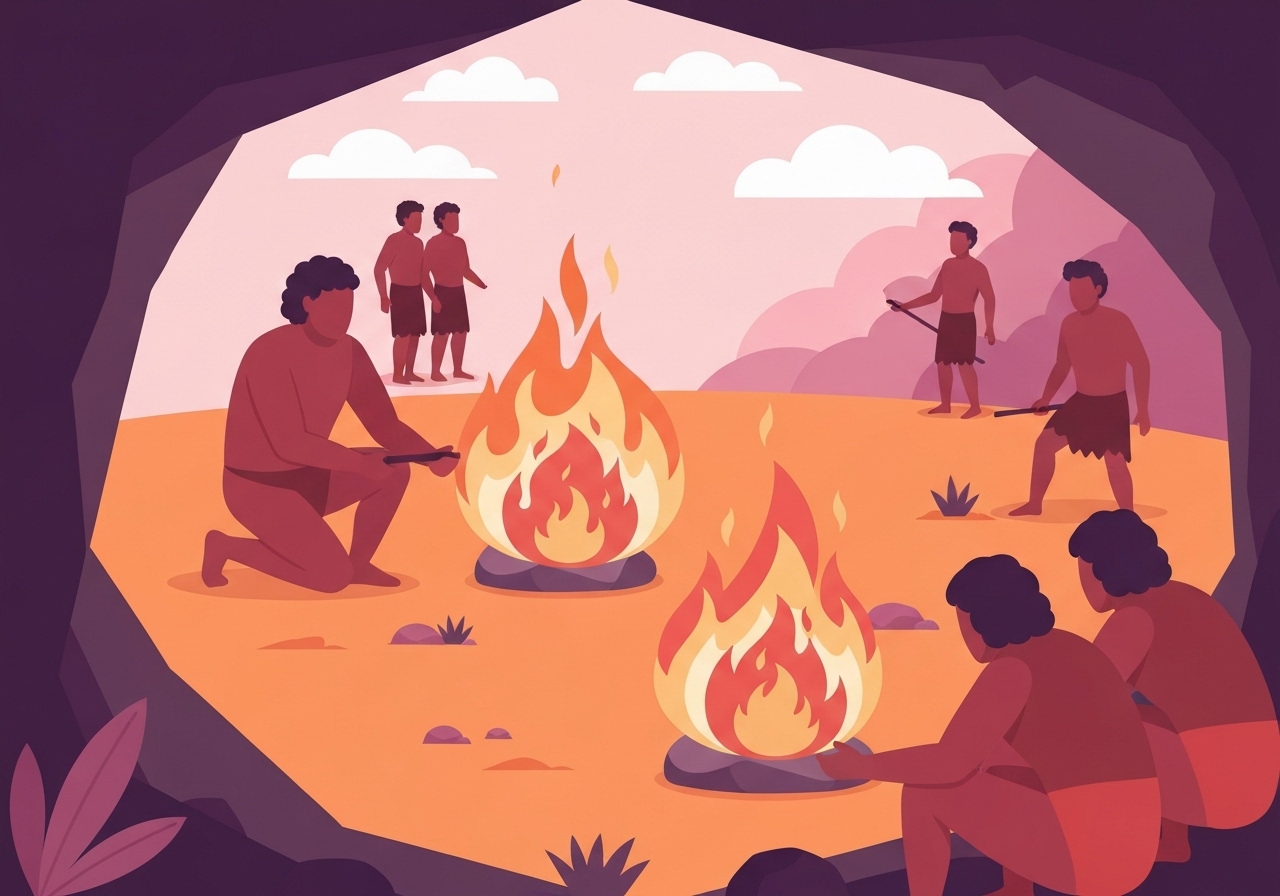
British researchers report evidence that people in what is now eastern England were creating and reusing fire about 400,000 years ago. Excavations at the Paleolithic site of Barnham in Suffolk revealed heat-altered clay, flint tools fractured by very high temperatures and two fragments of iron pyrite — a mineral that sparks when struck. Geochemical testing indicates temperatures exceeding 700°C (1,292°F) and repeated burning in the same spot, a pattern the team says is consistent with an intentionally constructed hearth. If confirmed, the find pushes back the earliest clear evidence for controlled fire-making by roughly 350,000 years compared with prior confirmed sites.
Key Takeaways
- New evidence from Barnham (Suffolk) indicates deliberate fire use around 400,000 years ago, based on heat-altered deposits and artifacts.
- Geochemical analysis shows localized temperatures above 700°C (1,292°F), with signs of repeated burning in one area rather than a single wildfire event.
- Researchers found fractured flint hand axes and two iron pyrite fragments; pyrite does not naturally occur at Barnham, implying deliberate transport.
- The research team spent four years of analysis to rule out natural causes such as lightning and wildfires before concluding controlled burning.
- Previously, the oldest widely accepted evidence for habitual fire-making came from Neanderthal-associated sites in northern France dating to about 50,000 years ago.
- Authors and commentators link controlled fire to cooking, predator deterrence, warmth in colder climates and social activities that could have supported cognitive and cultural change.
Background
Controlled use of fire is a pivotal milestone in human evolution: it affects diet, health, safety and social organization. Until now, clear archaeological traces of deliberate, repeatable fire-making were sparse and the earliest broadly accepted examples dated to tens of thousands of years ago rather than hundreds of thousands. Barnham, a long-excavated Paleolithic locality in Suffolk, has produced stone tools and fossils for decades; the new study focuses on a sealed sequence of burned deposits preserved in ancient pond sediments. Those sealed contexts are unusually well-protected from erosion and post-depositional disturbance, giving researchers an opportunity to study heat-altered materials that normally dissipate in the archaeological record.
Iron pyrite (fool’s gold) sparks when struck against flint and is known ethnographically as a fire-making aid. Its recovery at Barnham — where it is not found naturally — suggests deliberate collection and transport. The timing of the deposits places the activity between roughly 500,000 and 400,000 years ago, a period when brain size in several hominin lineages was approaching modern dimensions and material culture shows increasing complexity. Scholars have debated for decades when hominins moved from opportunistic use of wildfires to the ability to ignite and maintain flames at will; Barnham speaks directly to that question by preserving repeated, high-temperature burning in a confined location.
Main Event
Archaeologists working under the British Museum identified a concentrated patch of baked clay and sediments at Barnham, alongside flint hand axes with fracture patterns consistent with exposure to intense heat. Two small fragments of iron pyrite were recovered from the same stratigraphic layer. The research team applied multiple geochemical and microscopic techniques over four years to characterize the thermal signatures and to exclude scenarios such as peat fires, sporadic grassland burning or lightning strikes.
Analyses indicate temperatures exceeded 700°C (1,292°F) locally, and microstratigraphy shows evidence of repeated episodes of burning in roughly the same place. That repetition, together with the pyrite evidence and the heat-induced damage on knapped flint, led the authors to interpret the locus as a constructed hearth rather than the product of a single wildfire. The pyrite fragments are notable: they are not native to the Barnham bedrock, implying people deliberately selected and carried a material useful for generating sparks.
The lead analysts emphasize caution while arguing the combination of findings marks a qualitative shift in our understanding of early human behavior. The material record at Barnham does not just show passive use of fire by chance; the pattern suggests knowledge of ignition methods and management of flame. The site context — sealed pond sediments — helped preserve burned deposits and allowed the high-resolution testing that underpins the claim for deliberate fire-making.
Analysis & Implications
If controlled fire-making at Barnham is accepted broadly, the implications for human evolution are significant. Regular access to fire enables cooking, which alters the caloric and nutritional yield of many foods by breaking down toxins and tough fibers and by killing pathogens; those changes can support higher energy budgets and may have contributed to brain expansion. Fire also improves survival in colder environments, extends productive hours into the evening and reduces vulnerability to predators, shifting the ecological options available to small groups.
Beyond biological effects, hearths create social and cultural opportunities. Evening gatherings around a fire provide a setting for teaching, planning, story exchange and social bonding — activities linked in theory to the emergence of more complex communication and group organization. The presence of pyrite at Barnham suggests not only opportunistic use of flame but a transferable technique: selecting materials to create sparks requires knowledge of raw materials and coordinated behavior to maintain and share that knowledge.
Technologically, this evidence implies hominins in northern Europe had both the cognitive capacity and the cultural transmission mechanisms to sustain a complex technique across time and possibly space. The find narrows a long-standing gap between claims for early opportunistic fire use and later, well-documented habitual control. However, fully integrating Barnham into an explanatory framework will require re-evaluating other mid-Pleistocene sites and searching for corroborating signatures of pyrotechnology elsewhere.
Comparison & Data
| Item | Previous earliest (documented) | Barnham (new) |
|---|---|---|
| Approximate age | ~50,000 years | ~400,000 years |
| Maximum recorded temperature | Varies by site, typically lower evidence | >700°C (1,292°F) |
| Fire indicators | Charcoal, hearth stains | Baked clay, heat-fractured flint, pyrite fragments |
The table contrasts the new Barnham evidence with earlier, well-cited cases where the direct indicators of ignition were less definitive or much younger. Barnham’s sealed sediment context and multiple, independent thermal and material lines of evidence strengthen the case for controlled fire. Nevertheless, single-site breakthroughs must be placed in a broader geographic and chronological framework before rewriting all models of hominin behavior.
Reactions & Quotes
“The combination of very high temperatures, repeated localized burning and pyrite fragments points to deliberate fire-making rather than a chance wildfire.”
Rob Davis, Paleolithic archaeologist, British Museum
Davis led aspects of the excavation and laboratory work and frames the assemblage as a suite of interlocking evidences. His statement highlights the team’s emphasis on multiple complementary lines of analysis — stratigraphy, microcharcoal, thermal alteration and mineral provenance — rather than a single diagnostic artifact.
“Fossils from Britain and Spain suggest these inhabitants were early Neanderthals showing growing cognitive and technological sophistication.”
Chris Stringer, Natural History Museum
Stringer points to fossil morphology and genetic indicators that align some mid-Pleistocene European remains with early Neanderthal traits. His assessment connects the behavioral evidence at Barnham to wider questions about when and how Neanderthal-like populations developed distinctive cultural capacities.
“This is the most exciting discovery of my 40-year career.”
Nick Ashton, Curator, British Museum
Ashton’s reaction speaks to the potential scale of the claim within British Paleolithic research. Colleagues caution that strong statements are appropriate if the evidence withstands broader scrutiny, but they also stress the need to test whether similar signatures exist at contemporaneous sites.
Unconfirmed
- Whether the Barnham occupants represent a population that habitually manufactured fire or a group that used pyrite opportunistically remains to be demonstrated at multiple sites.
- Attribution of the individuals at Barnham to an early Neanderthal lineage is supported by morphological and genetic context but not conclusively proven for every specimen.
- The geographic extent and cultural transmission pathways for pyrite-based ignition in mid-Pleistocene Europe are not yet established.
Bottom Line
The Barnham evidence, if upheld by subsequent research, moves the origin of deliberate fire-making far earlier in the human timeline than previously confirmed. The combination of high, repeated temperatures, heat-altered artifacts and non-local spark-producing minerals presents a tightly argued case for constructed hearths around 400,000 years ago. That shift would reshape discussions about diet, social life and cognitive capacities in mid-Pleistocene populations across Europe.
Nevertheless, scientific caution is warranted: the claim rests on one well-preserved locality and must be tested against additional sites and independent datasets. Future fieldwork and reanalysis of existing collections for pyrite, high-temperature indicators and sealed contexts will be crucial to determine whether Barnham represents a localized innovation or part of a broader behavioral shift among early hominins.
Sources
- AP News — news report summarizing the study and interviews (media)
- Nature — peer-reviewed journal where the research is reported (academic journal)
- British Museum — institution involved in the excavation and analysis (museum/official)
- Natural History Museum, London — institution and expert commentary (museum/academic)