
Lead
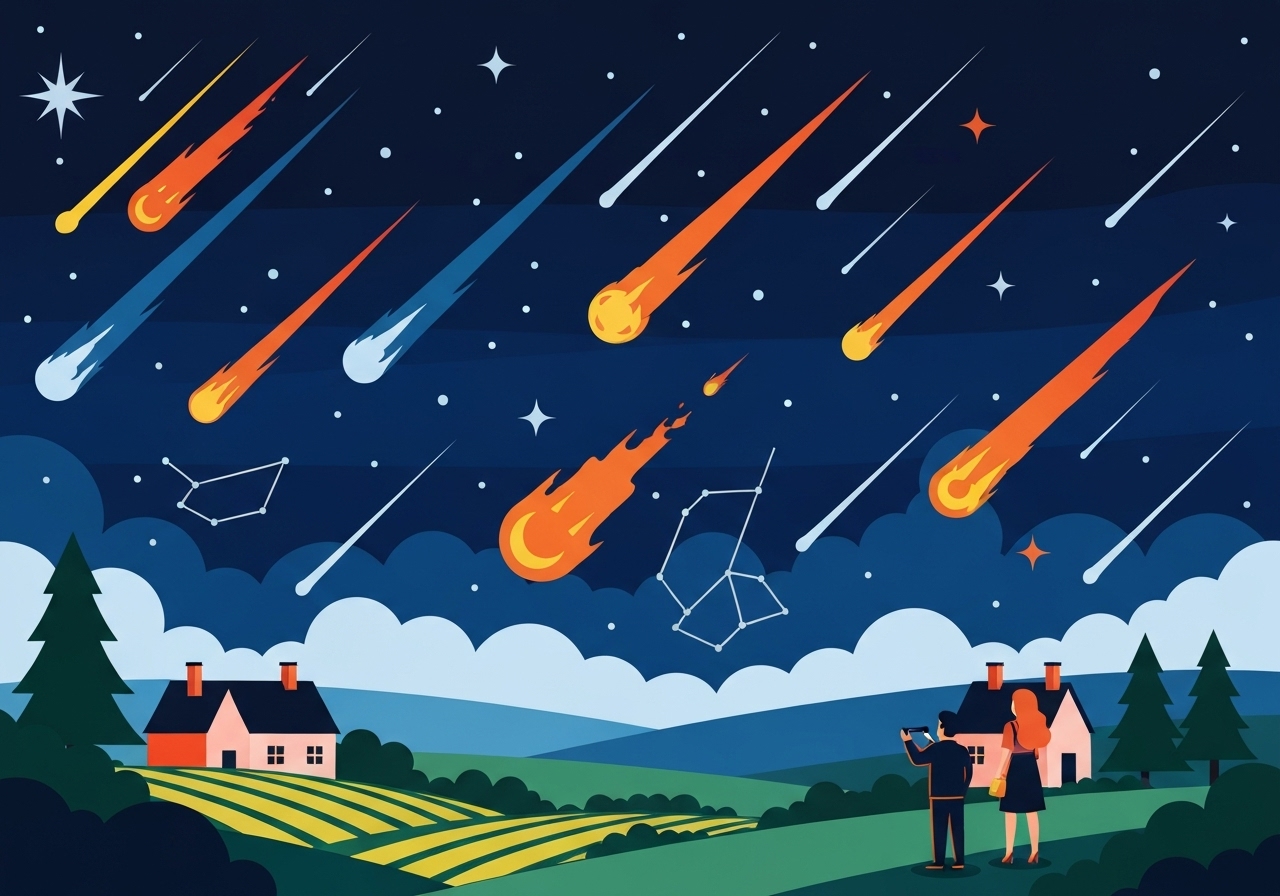
The Geminid meteor shower is due to peak on Sunday 14 December and, weather permitting, should be visible across much of the Northern Hemisphere. Astronomers say the shower — sourced from asteroid 3200 Phaethon — can produce a very high rate of meteors in a single hour. In the UK a waning crescent Moon will rise after midnight, offering several hours of darker skies for observers if clouds stay away. Local cloud and wind, however, will determine whether viewers actually get a clear display.
Key takeaways
- The Geminids peak on Sunday 14 December and are visible worldwide, with best views in the Northern Hemisphere.
- The shower originates from asteroid 3200 Phaethon; scientists found a sodium gas component in its tail two years ago, leaving some details of the dust source unresolved.
- Under a dark, clear sky observers can expect roughly 100 meteors per hour at peak rates, making Geminids one of the year’s strongest showers.
- In the UK the waning crescent Moon will not rise until after midnight, potentially providing several hours of darker conditions for late-night viewing.
- UK forecasts currently indicate windy, cloudy conditions with rain on Saturday and Sunday, though Northern Scotland, the Northern Isles, parts of East Anglia and southeast England may see clearer spells.
- Best viewing requires a dark, open location away from urban light pollution and allowing at least 30–60 minutes for eyes to adapt to the dark.
- The Met Office cloud cover map is a useful, near-real-time tool for checking local sky conditions ahead of the peak.
Background
Meteor showers occur when Earth crosses streams of debris left by comets or, less commonly, asteroids. Particles entering the atmosphere at high speed heat and ionize the air, producing the bright streaks commonly called shooting stars. The exact colours of meteors depend on the chemical composition of the grains — sodium, magnesium and calcium can produce yellow, green or red hues as they vaporise.
The Geminids are unusual because their parent body is an asteroid, 3200 Phaethon, rather than a conventional icy comet. Observations published two years ago revealed that Phaethon’s tail contains glowing sodium gas, prompting questions about how and when the solid dust that produces the Geminids was released. That uncertainty means researchers continue studying Phaethon to resolve whether thermal fracturing, past activity or other processes created the debris trail.
Main event
The shower’s intensity concentrates around the peak night and the hours before dawn, when Earth crosses the densest part of the debris stream. For the 14 December peak, activity will be broadly centred on late-night to early-morning hours in the Northern Hemisphere. Observers should look for meteors radiating from the constellation Gemini but looking a little away from the radiant gives a wider view and often more frequent sightings.
In the UK the Moon phase is favourable: a thin waning crescent will not illuminate the sky until after midnight, potentially leaving a darker window for late-night observers. However, meteor visibility is highly sensitive to local cloud cover and wind-driven sky clarity, so actual counts will vary from place to place. Dress warmly, choose an elevated, open site without nearby streetlights, and give your eyes time to adapt — binoculars and telescopes are unnecessary and limit the field of view.
Amateur and professional astronomers often encourage people to watch for extended periods; an hour or two centred on local pre-dawn can produce the best returns. Citizen observations reported to global monitoring projects help refine shower profiles and can feed back into research on the parent body and stream structure.
Analysis & implications
The Geminids are important scientifically because they provide a dense, repeatable shower tied to an unusual asteroid parent. Understanding the composition and release mechanisms of 3200 Phaethon’s debris informs broader questions about small-body evolution in the inner solar system and the transition between comets and asteroids. The sodium gas detection two years ago added a new data point that complicates simple dust-release models and highlights the need for continued observations and targeted spacecraft study.
For public engagement, the Geminids are among the best annual opportunities to connect wide audiences with observational astronomy. High rates — potentially near 100 meteors per hour under ideal skies — mean that even casual viewers in semi-rural locations can witness multiple events in a single hour, boosting interest in skywatching and informal science. Local astronomy clubs and outreach groups often use the shower to stage public viewings, although their success depends heavily on local weather.
Economically and recreationally, strong showers like the Geminids can drive short-term increases in night-time tourism and equipment sales (blankets, reclining chairs, portable warm clothing), but these impacts are modest and weather-dependent. Internationally, coordinated observations from different latitudes and longitudes help map stream structure and improve predictive models for future peaks.
Comparison & data
| Shower | Typical peak month | Parent body | Typical peak rate (per hour) |
|---|---|---|---|
| Geminids | December | Asteroid 3200 Phaethon | ~100 (dark sky, peak) |
| Perseids | August | Comet Swift–Tuttle | ~60–100 (typical peak) |
The table places Geminids alongside the Perseids to show relative strength and timing. While rates vary year-to-year and by local conditions, Geminids are consistently cited as one of the most prolific annual showers, particularly for observers in the Northern Hemisphere.
Reactions & quotes
A representative of the Royal Astronomical Society underlined the shower’s strength and accessibility for the public, noting both scientific and cultural value.
“In a clear, dark sky you could see on the order of 100 meteors an hour at peak,”
Dr Robert Massey, Royal Astronomical Society
The Met Office has been pointed to by observers as the best source for near-term cloud forecasts and advised using its cloud cover map when planning a watching session.
“Check the Met Office UK Cloud Cover Map for live updates on where gaps in cloud may appear,”
Met Office (official guidance)
Unconfirmed
- Precisely how and when the bulk of the solid dust producing the Geminids was released from 3200 Phaethon remains under investigation; competing hypotheses exist but no definitive consensus.
- Short-term, localized clear-sky windows for the UK peak night are possible but not guaranteed; forecasts should be checked within hours of planned observation.
Bottom line
The Geminids offer one of the best annual opportunities to see a rich meteor display, with potential peak rates near 100 meteors per hour under dark, clear conditions. For the 14 December peak, the Moon phase is favourable in the UK, but cloud, wind and rain expected across much of the region will decide whether people actually see the shower.
If you plan to watch, aim for a dark site away from artificial lights, allow time for your eyes to adjust, and monitor the Met Office cloud cover map for the latest local conditions. Observations from this year can also help researchers refine models of 3200 Phaethon and the stream that produces the Geminids.
Sources
- BBC News (news article summarising forecasts and expert comment)
- Met Office UK Cloud Cover Map (official forecasting tool)
- NASA: 3200 Phaethon (agency summary of the asteroid and observations)
- Royal Astronomical Society (scientific society, expert comment)