
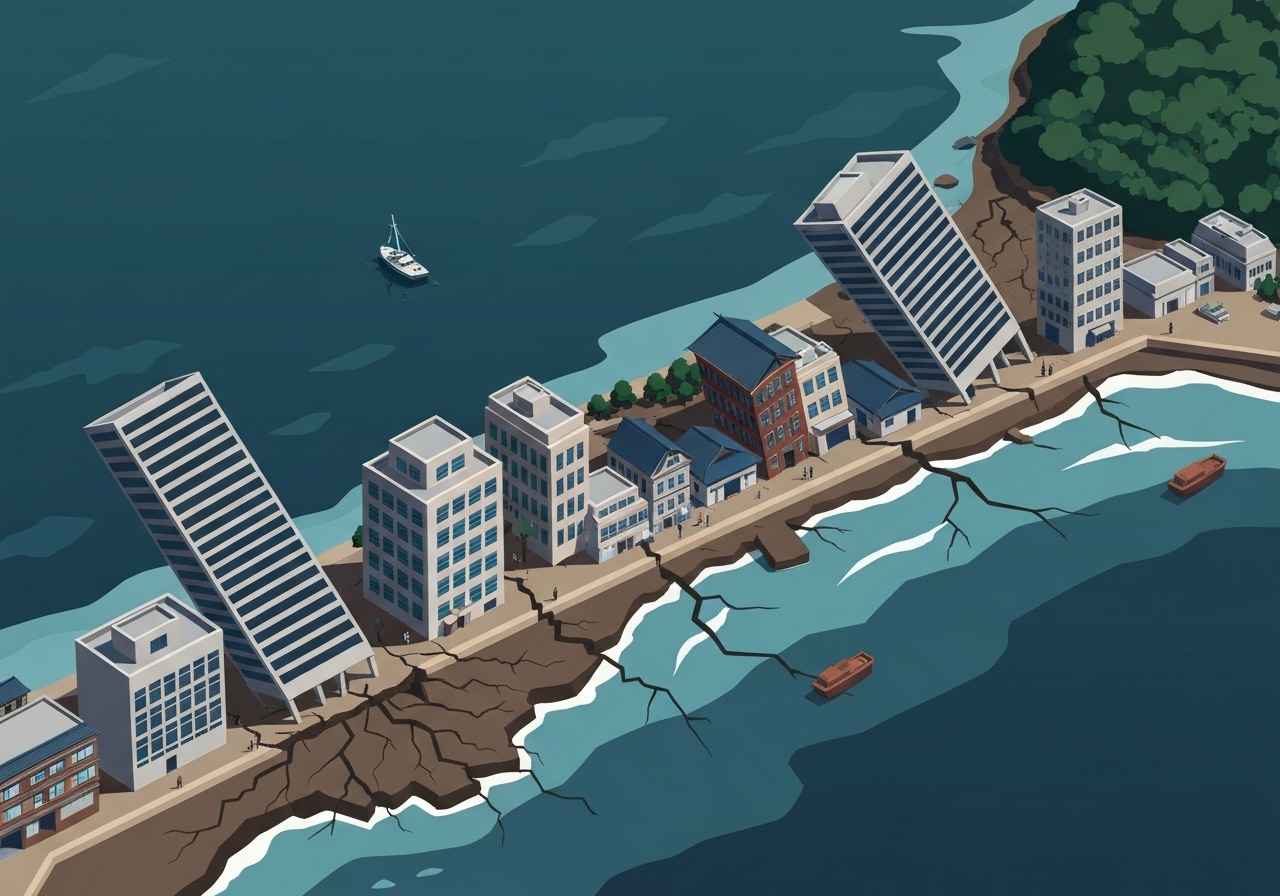
A magnitude-6.7 earthquake struck off the east coast of Aomori Prefecture in northeastern Honshu on Friday, producing small tsunami waves but no reported major damage. The Japan Meteorological Agency said the quake occurred at a depth of about 12 miles and issued a local tsunami advisory that was lifted roughly two hours later. Small waves were observed along parts of Hokkaido and Aomori, and there were no immediate reports of serious injuries. The tremor comes days after a stronger magnitude-7.5 quake in the same offshore area earlier in the week that caused injuries and light damage.
Key takeaways
- The Friday quake registered magnitude 6.7 and occurred off the east coast of Aomori Prefecture at an estimated depth of about 12 miles (JMA).
- A local tsunami advisory was issued by the Japan Meteorological Agency and was canceled about two hours later after only small waves were recorded.
- No major damage or fatalities were reported Friday; Monday’s magnitude-7.5 event had caused at least 34 injuries and light structural and road damage.
- Monday’s quake produced localized tsunami heights up to about 28 inches in some Pacific-coast communities.
- Japan’s government on Tuesday issued a megaquake advisory noting a theoretical offshore tsunami up to 98 feet and a modeled death toll of nearly 200,000 if a very large quake were to occur — while stressing that the probability of an M8+ event was only about 1%.
- No tsunami alerts were issued Friday for the U.S. West Coast or Hawaii, and agencies in those regions reported no immediate threat.
Background
Northeastern Japan sits above a complex subduction zone where the Pacific Plate dives beneath the North American and Okhotsk blocks, forming the Japan Trench and the Chishima (Kuril) Trench. Those trench systems have produced numerous large earthquakes and tsunamis in modern history, including the 2011 Tohoku disaster that killed nearly 20,000 people and triggered a nuclear accident.
Over the past week the region experienced a sequence of offshore quakes, with a magnitude-7.5 event on Monday that produced injuries, light infrastructure damage and a modest tsunami along the Pacific coast. Japanese authorities — citing modeled scenarios for very large offshore ruptures — issued a precautionary megaquake advisory intended to prompt preparedness, while explicitly warning it was not a prediction.
Main event
The JMA located the Friday hypocenter off Aomori’s eastern coast and estimated a depth near 12 miles, a relatively shallow focus that can increase shaking intensity at the surface. After detecting sea-level disturbances at coastal tide gauges, the agency issued a tsunami advisory for nearby coasts; the advisory was rescinded after observations showed only small wave heights in Hokkaido and Aomori.
Local officials and prefectural emergency centers reported no significant structural collapses or fatalities from the Friday temblor. Emergency services conducted routine patrols of coastal and vulnerable sites; initial field checks found only minor effects consistent with low-height tsunami inundation and typical shaking-related reports.
Seismologists continue to monitor aftershocks following both the Monday and Friday quakes. Instrumental records show the two events occurred in the same offshore region, but determining whether the later 6.7 quake was a triggered aftershock or part of a broader sequence requires additional analysis of focal mechanisms and stress transfer.
Analysis & implications
From a hazard-management perspective, the back-to-back larger quakes underline the importance of preparedness in northeastern Japan. Even when a specific large event is unlikely, the region’s exposure to tsunami generation means local evacuation planning, early-warning systems, and coastal defenses remain critical. The government’s megaquake advisory aimed to reinforce those preparedness measures.
Seismically, a magnitude-7.5 rupture can alter stress on nearby faults and potentially change the short-term probability of additional earthquakes in adjacent segments, but most stress-transfer effects do not translate into immediate, predictable large events. Experts caution that sequences of this type often produce many smaller aftershocks and only occasionally precede a much larger rupture.
Economically and socially, repeated strong shaking can disrupt transport, fisheries and supply chains in coastal communities already stretching emergency services. The modest tsunami observations so far limited physical damage, but repeated alerts and evacuations have social costs and can erode public responsiveness if overused without clear communication.
Comparison & data
| Event | Date | Magnitude | Depth (approx.) | Reported injuries | Max reported tsunami |
|---|---|---|---|---|---|
| Friday offshore Aomori | Dec 12, 2025 | 6.7 | ~12 miles | 0 (no major injuries reported) | Small waves recorded |
| Monday offshore Aomori | Dec 8–9, 2025 | 7.5 | — (JMA reported shallow) | At least 34 | Up to ~28 inches |
The table above contrasts the two largest recent shocks in the same offshore trench region. While the 7.5 event on Monday produced measurable damage and injuries, the 6.7 shock was smaller in energy release and led to only local, low-height sea disturbances. Ongoing monitoring will refine aftershock forecasts and any potential changes to regional hazard estimates.
Reactions & quotes
“We saw small tsunamis at coastal gauges and issued an advisory as a precaution; it was lifted after sea levels stabilized,”
Japan Meteorological Agency (official)
The JMA statement emphasized routine caution: advisories serve to protect residents while observations are collected. Officials repeated guidance for residents in exposed coastal zones to follow local evacuation orders and stay informed.
“The advisory issued earlier this week is not a prediction, but a scenario to prompt readiness for a very large offshore rupture,”
Cabinet Office of Japan (government)
Japan’s Cabinet Office clarified that its megaquake scenario represents a modeled worst-case and that the estimated ~1% probability for an M8+ event reflects a low near-term likelihood, not a forecast. Local leaders and emergency planners said they would continue drills and checks of evacuation routes.
Unconfirmed
- Whether the Friday magnitude-6.7 quake was a direct aftershock of Monday’s magnitude-7.5 event remains under study and has not been definitively determined by peer-reviewed analysis.
- Any short-term change in the statistical probability of an M8+ rupture attributable to these events has not been publicly released in a confirmed, quantitative update beyond the government’s prior advisory.
Bottom line
The December 12, 2025 magnitude-6.7 quake off Aomori produced only minor tsunami effects and no major reported damage, but it arrived amid a week already marked by a larger magnitude-7.5 shock that caused injuries and local disruption. The proximate impact was limited, yet the events underscore persistent seismic and tsunami risk along the Japan Trench system.
Authorities and seismologists urge continued vigilance: monitoring networks remain active, and preparedness measures — from clear evacuation routes to public awareness — are the most reliable short-term defenses. While catastrophic scenarios exist as modeled possibilities, official assessments currently describe a low probability for an immediate, much larger rupture.