
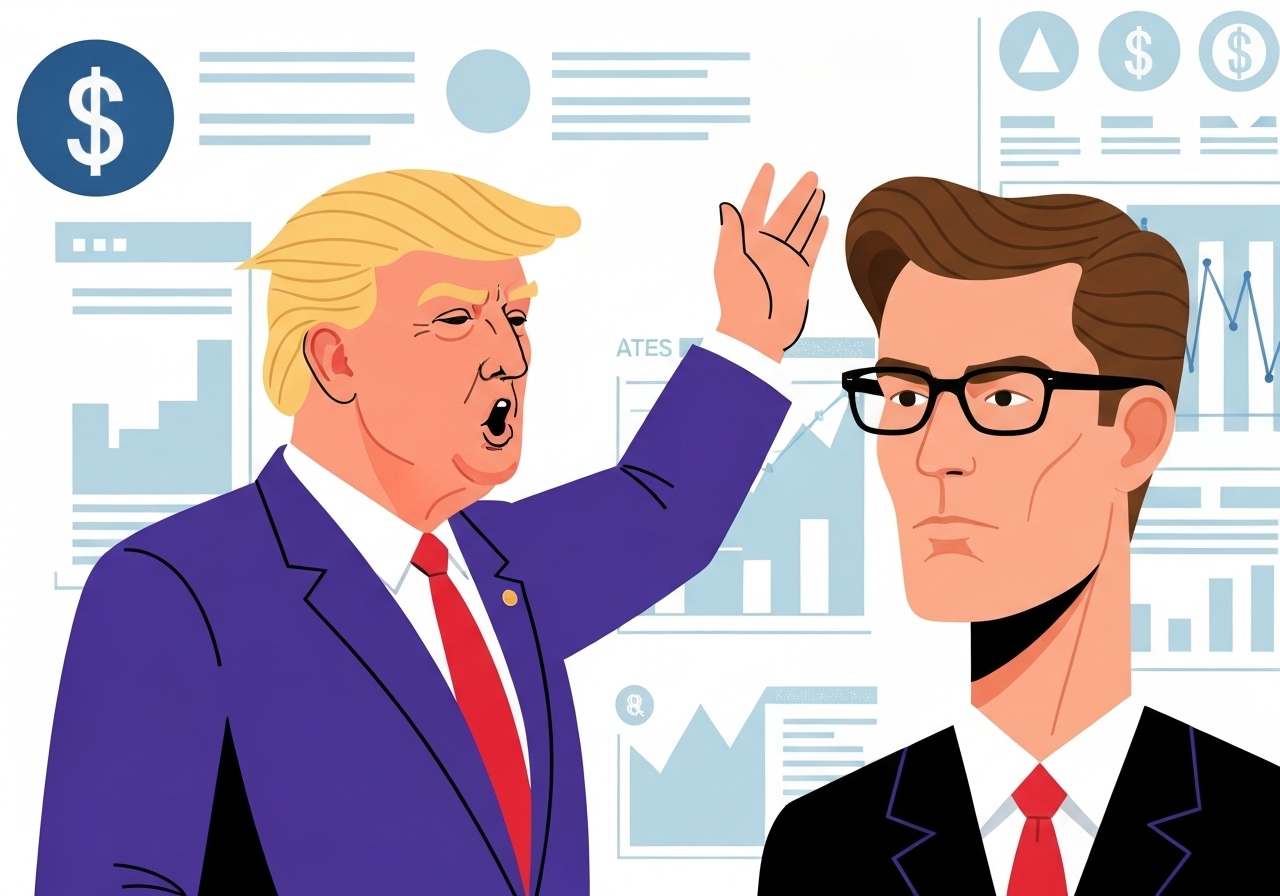
Lead: On Friday, President Donald Trump told the Wall Street Journal that former Fed governor Kevin Warsh has moved to the top of his shortlist to succeed Jerome Powell as Federal Reserve chair. Trump said the change followed a recent meeting and interviews, and he reiterated that the Fed chair should consult the president on interest-rate decisions. Markets and prediction odds shifted after the report, while other contenders — including NEC Director Kevin Hassett and several current Fed governors — remain under consideration. The development adds a fresh political dimension to the coming vacancy in the Fed chairship, whose term expires in May.
Key Takeaways
- Trump told the Wall Street Journal that Kevin Warsh has climbed to the top of his list for Fed chair following a recent meeting and interviews.
- Prediction markets moved after the report: Kalshi cut Kevin Hassett’s odds from about 71% to 62% and put Warsh at roughly 36%.
- The Fed has cut its policy rate by three-quarters of a percentage point since September; the federal funds target range is now 3.50%–3.75% following a recent cut on Wednesday.
- Trump said the Fed chair should consult the president on rate decisions, asserting his view that the president is a “smart voice” that should be heard.
- Other candidates reportedly considered include Christopher Waller, Michelle Bowman, Rick Rieder and a wider list of 11 potential nominees; Treasury Secretary Scott Bessent has led the search but has publicly said he is not interested in the job.
- Jerome Powell was reappointed to the chair by President Joe Biden; his term expires in May, creating a window for a presidential nomination and Senate confirmation.
Background
Federal Reserve chair selection is a consequential presidential prerogative: the president nominates a candidate who must then be confirmed by the Senate. Since Jerome Powell’s 2017 nomination by President Trump and reappointment by President Biden, the chair’s decisions have been closely watched by markets and policymakers, particularly amid recent rate-cutting cycles. Trump has clashed with Powell in the past, publicly criticizing the pace and extent of monetary tightening and later the timing of cuts that followed.
Kevin Warsh is a former Federal Reserve governor with experience on the central bank’s policy-setting body. Kevin Hassett, director of the National Economic Council, was widely reported as an early frontrunner after a Bloomberg report; he has publicly said he would accept the job only if asked. The White House process reportedly involves Treasury figures — current Treasury Secretary Scott Bessent is leading the search — and a list of about 11 candidates has circulated in recent weeks.
Main Event
The immediate catalyst for the shift was a Wall Street Journal account published Friday reporting that Mr. Warsh had risen in the president’s estimation after meetings and interviews. Trump told the Journal, “Yes, I think he is,” when asked whether Warsh was at the top of the list. The president added that several other candidates are strong and that he has a favorite but remains cautious after saying he received a “bad recommendation” when he previously named Powell.
Trump also reiterated a longstanding view that the Fed chair should consult the president on interest-rate decisions. He said such consultation “used to be done routinely” and argued the president’s economic perspective should carry weight. That stance runs up against modern norms of central-bank independence and is likely to draw scrutiny during any confirmation process.
Markets reacted to the Journal account: prediction-market probabilities shifted and fixed-income investors reevaluated odds for policy direction under a potential Warsh nomination. The Fed’s recent easing — three cuts totalling 75 basis points since September, most recently moving the federal funds range to 3.50%–3.75% — provides the monetary backdrop for the nomination debate, with participants assessing which candidate would favor further easing.
Analysis & Implications
A Warsh nomination would be significant for both markets and the Fed’s institutional culture. As a former governor, Warsh brings policy experience and relationships inside the institution, and he is reported to share a predisposition toward lower rates. If that alignment holds, financial markets might price a higher probability of additional easing, compressing risk premia and altering bond yields.
But the president’s call for consultation with the Fed chair raises governance questions. Central-bank independence rests partly on insulating rate decisions from short-term political pressure; formal or informal consultation mechanisms that blur that line could prompt resistance from senators and policymakers who prioritize independence. Senators will likely probe any nominee’s willingness to preserve the Fed’s technical deliberative process during confirmation hearings.
Domestically, a nomination that appears politically driven could heighten partisan tensions around monetary policy. If the Senate perceives the nominee as too aligned with the White House’s interest-rate preferences, confirmation could be contentious. Internationally, markets watch Fed leadership decisions closely; a nominee seen as favoring aggressive easing could spur capital flows and exchange-rate responses across emerging and developed markets.
Comparison & Data
| Candidate | Kalshi Odds before WSJ | Kalshi Odds after WSJ |
|---|---|---|
| Kevin Hassett | ~71% | ~62% |
| Kevin Warsh | not favored | ~36% |
The data above reflect short-term prediction-market moves reported after the Journal story; Kalshi percentages capture traders’ aggregated probability estimates and can shift rapidly with new information. Separately, the Fed’s policy path has included three cuts since September totaling 75 basis points, most recently placing the federal funds target at 3.50%–3.75% as of Wednesday’s action.
Reactions & Quotes
White House and political actors responded quickly after the report. Below are representative statements and their contexts.
“Yes, I think he is.”
President Donald Trump, on whether Kevin Warsh tops his list
This short affirmative came during Trump’s interview with the Wall Street Journal and was quoted as signaling a shift in the president’s preference following meetings with prospective candidates. Trump coupled that endorsement with a broader insistence that the Fed chair should consult the president on rate choices.
“I worried he would appoint a ‘sock puppet’ as Fed chair to do his bidding.”
Sen. Elizabeth Warren (D-Mass.), on CNBC
Sen. Warren voiced concern about politicization of the Fed in an interview on CNBC, reflecting Democratic skepticism about a White House-influenced nomination. Her comment underscores partisan scrutiny that any nominee perceived as too close to the president would face during confirmation.
“I really want to turn this job over to whoever replaces me … with the economy in really good shape.”
Jerome Powell, at a recent news conference
Powell, asked about his legacy, emphasized his desire to leave the Fed and the economy in a strong position for his successor. That framing sets a high bar for nominees and provides context for senators evaluating candidates’ commitments to stable monetary policy.
Unconfirmed
- Whether Trump will formally nominate Kevin Warsh remains unconfirmed; the president said Warsh is at the top of his list but did not announce a nomination.
- Claims that Warsh will strictly follow the president’s direction on rates are not substantiated; public records show policy preferences but not operational commitments.
- The final short list of candidates and the timeline for a nomination have not been officially released by the White House or Treasury.
Bottom Line
The Wall Street Journal report that Kevin Warsh has risen to the top of President Trump’s Fed chair list marks an important moment in the selection process for a seat that will shape U.S. monetary policy. Trump’s public insistence that the Fed chair consult the president intensifies debate over the appropriate boundary between elected officials and central-bank decision-making. Markets and senators will watch closely: prediction markets shifted quickly after the report, and confirmation hearings could become a forum for testing nominees on independence and policy judgment.
Looking ahead, the nominee selection — and the Senate’s response — will be judged against near-term economic readings and the Fed’s recent easing cycle. For investors, policymakers and international counterparts, the key questions are whether a nominee favors additional rate cuts and whether the Fed’s institutional autonomy will be preserved. Those outcomes will determine market expectations and the political tenor of U.S. monetary policy through the next administration chapter.
Sources
- CNBC (news report summarizing White House comments and market reaction)
- The Wall Street Journal (news report cited by the White House interview)
- Kalshi (prediction-market platform for nomination odds)
- Bloomberg (news report referenced earlier regarding Kevin Hassett)