
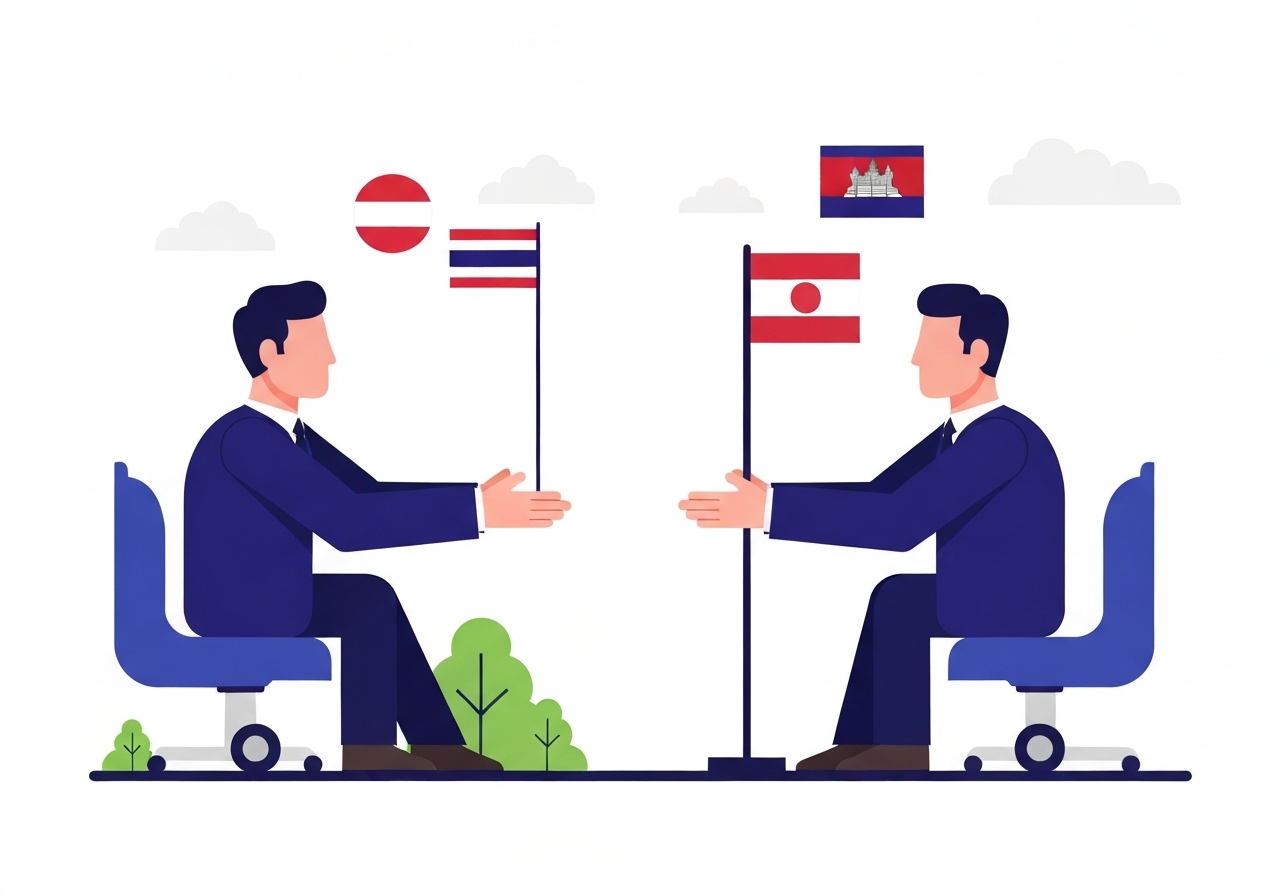
Lead: President Donald Trump announced on Friday that Thai and Cambodian leaders have agreed to restart a ceasefire after several days of deadly cross-border clashes that threatened to unravel a truce brokered earlier this year. Trump said the agreement followed phone calls with Thailand’s Prime Minister Anutin Charnvirakul and Cambodia’s Prime Minister Hun Manet and credited Malaysian Prime Minister Anwar Ibrahim with helping secure the deal. Thai and Cambodian officials did not immediately confirm the announcement. The renewed stand-down was reported to take effect the same evening, according to Trump’s social media post.
Key Takeaways
- President Trump announced a renewed ceasefire on Friday after calls with PMs Anutin Charnvirakul (Thailand) and Hun Manet (Cambodia).
- The truce was said to take effect the evening of the announcement and aims to return both sides to the previous peace accord arranged earlier this year.
- Malaysia’s Prime Minister Anwar Ibrahim was credited by Trump with playing a mediating role in the agreement.
- Thai forces have employed jet fighters in airstrikes; Cambodia used BM-21 rocket launchers with a 30–40 km range.
- ThaiPBS reported at least six Thai soldiers killed by rocket shrapnel during the recent flare-up.
- The Thai army reported damage to residential areas near the border and said it destroyed a crane near the Preah Vihear temple complex due to alleged surveillance equipment.
- Earlier ceasefire arrangements were brokered in July and further formalized in October at a Malaysian regional meeting attended by Trump.
- The Great Lakes ceasefire between the Democratic Republic of Congo and Rwanda was also noted as under strain by international observers.
Background
The Thailand–Cambodia border dispute has deep historical roots tied to colonial-era maps and contested territorial claims. A 1907 map produced during the French protectorate over Cambodia remains a focal point of disagreement, and a 1962 International Court of Justice ruling on the Preah Vihear area continues to provoke nationalist sentiment in Thailand. Periodic skirmishes have persisted for decades, punctuated by rounds of diplomacy and occasional international mediation.
This year, Malaysia brokered an initial ceasefire in July under regional pressure, and negotiators codified further details at an October meeting in Malaysia attended by high-level officials. Despite accords, both sides have continued information campaigns and limited cross-border strikes, sustaining an environment where local incidents can rapidly escalate. The dispute involves not only military forces but also political audiences sensitive to perceptions of sovereignty and national prestige on both sides.
Main Event
According to President Trump’s post, calls between him and the two prime ministers culminated in an agreement to resume the earlier peace accord and immediately halt shooting. Thai and Cambodian officials offered no simultaneous public confirmations of that timeline, and reporting indicated that communications were still being clarified late on Friday. Prior to Trump’s posting, Thailand’s PM Anutin told the U.S. president that Thailand’s position was to continue operations until Cambodia no longer posed a perceived threat to Thai sovereignty, reflecting unresolved security concerns.
On the battlefield, Thai forces reportedly used jet fighters for strikes on what they described as military targets; Cambodian forces deployed BM-21 multiple-rocket launchers with an estimated 30–40 kilometer (19–25 mile) range. ThaiPBS data cited in government statements identified at least six Thai soldiers killed by rocket shrapnel in recent clashes, and the Thai army reported damage to some residential areas near the border. Separately, Thailand said it destroyed a tall crane at a hill near the Preah Vihear temple, alleging the structure housed electronic and optical systems used for command-and-control.
Trump framed the intervention as part of a broader diplomatic push, asserting that Malaysia’s Anwar Ibrahim was instrumental in getting both sides to recommit to the earlier accord. The U.S. president has repeatedly spotlighted foreign policy deals since returning to office, including claims about negotiating multiple conflict resolutions; those assertions are politically salient but are assessed separately from the concrete mechanics of the Thailand–Cambodia talks. Observers noted that the immediate effect of any announced ceasefire will depend on verification on the ground and steps to de-escalate forces.
Analysis & Implications
The announcement illustrates how third-party mediation—here involving Malaysia and publicized U.S. engagement—can produce short-term pauses in violence, but not necessarily durable resolution of underlying territorial disputes. The historical and legal entanglements around Preah Vihear, combined with nationalist politics in both capitals, create incentives for domestic leaders to appear resolute rather than conciliatory. Unless political leaders invest in a sustained verification and confidence-building process, localized incidents or propaganda escalations can reignite hostilities.
Militarily, the use of long-range rocket artillery like the BM-21 and airpower increases the destructive footprint of clashes and raises risks to civilians in border communities. The Thai army’s statement about destroying a crane above the Preah Vihear site signals mutual mistrust over military use of culturally sensitive terrain, complicating any purely military-to-military deconfliction. For neighboring countries and regional organizations, the conflict underscores the limits of ad hoc truce agreements without institutional monitoring or robust incident-resolution mechanisms.
Economically, renewed escalations threaten trade and cross-border livelihoods in provinces bordering the frontier, and they can deter tourism to culturally important areas such as Preah Vihear. Politically, public attribution of credit—most visibly by President Trump—may shape diplomatic narratives but does not substitute for on-the-ground verification by impartial observers. International actors that helped broker previous agreements may be asked to expand monitoring roles to ensure compliance and transparency.
Comparison & Data
| Item | Thailand | Cambodia | Note |
|---|---|---|---|
| Recent weapons reported | Jet fighters (airstrikes) | BM-21 rocket launchers | BM-21 range ~30–40 km (19–25 miles) |
| Reported battlefield deaths | At least 6 Thai soldiers (rocket shrapnel) | Official Cambodian military fatalities not specified | Casualty counts vary by source; some figures unconfirmed |
| Key site | Preah Vihear temple (hilltop area contested) | ICJ ruling (1962) remains a legal reference point | |
The short table highlights asymmetric capabilities and confirmed casualty reporting so far. Official tallies remain incomplete and may be revised as provincial authorities and independent monitors update their figures. Comparisons with prior ceasefire periods show that while formal accords lowered headline violence earlier in the year, small-scale cross-border incidents persisted. That pattern increases the importance of independent monitoring and mechanisms for rapid incident investigation.
Reactions & Quotes
Thai and Cambodian official responses were muted immediately after the U.S. president’s post, reflecting both diplomatic caution and the need to reconcile domestic political messaging with any agreement. Observers said rapid public announcements can help calm markets and front-line communities but require follow-through to be credible.
“They have agreed to CEASE all shooting effective this evening, and go back to the original Peace Accord…”
Donald J. Trump (social media post)
Trump’s public statement framed the outcome as a return to an earlier accord and credited Malaysia’s prime minister with mediation help. While the message signaled an immediate pause in hostilities, analysts cautioned that claims of agreement must be corroborated by both governments and, ideally, by independent observers.
“Thailand’s position was to keep fighting until Cambodia no longer poses a threat to its sovereignty.”
Anutin Charnvirakul, Prime Minister of Thailand (reported)
Anutin’s reported remark, made in a conversation with Trump prior to the U.S. president’s posting, underlines Thailand’s security concerns and the political pressure on Thai leaders to demonstrate firmness. That posture could complicate implementation unless concrete security guarantees and verification steps follow.
“We urge all sides to uphold their commitments and immediately de-escalate the situation.”
International Contact Group for the Great Lakes (joint statement)
International actors monitoring other regional ceasefires used the opportunity to reiterate the need for compliance and de-escalation, signaling that multilateral pressure remains an important backstop for fragile accords.
Unconfirmed
- Exact implementation details of the renewed ceasefire—such as verification mechanisms and withdrawal timelines—were not published at the time of the announcement.
- Specific casualty figures for Cambodian forces during the recent clashes were not available publicly and remain unverified.
- The precise role and bilateral agreements brokered by Malaysia’s prime minister were described by President Trump but lack independent, detailed confirmation from Malaysian officials in the immediate aftermath.
Bottom Line
The reported agreement to renew a ceasefire between Thailand and Cambodia provides a short-term reprieve from days of deadly clashes, but its durability depends on clear, verifiable measures on the ground. Historical grievances around Preah Vihear, differing domestic political incentives, and the use of long-range weapons raise the risk that incidents will recur unless impartial monitoring and dispute-resolution mechanisms are implemented.
International mediation—illustrated by Malaysia’s involvement and public U.S. engagement—can help secure pauses in combat, yet lasting stability will require steps that address sovereignty concerns and allow both sides political space to de-escalate without losing face. Observers and affected communities will be watching for independent verification, troop posture changes, and concrete timelines for confidence-building measures.
Sources
- Associated Press — news report (primary source on the announcement)
- ThaiPBS World — public broadcaster (data cited on soldier casualties)
- International Court of Justice (ICJ) — official archive (1962 Preah Vihear judgment)