
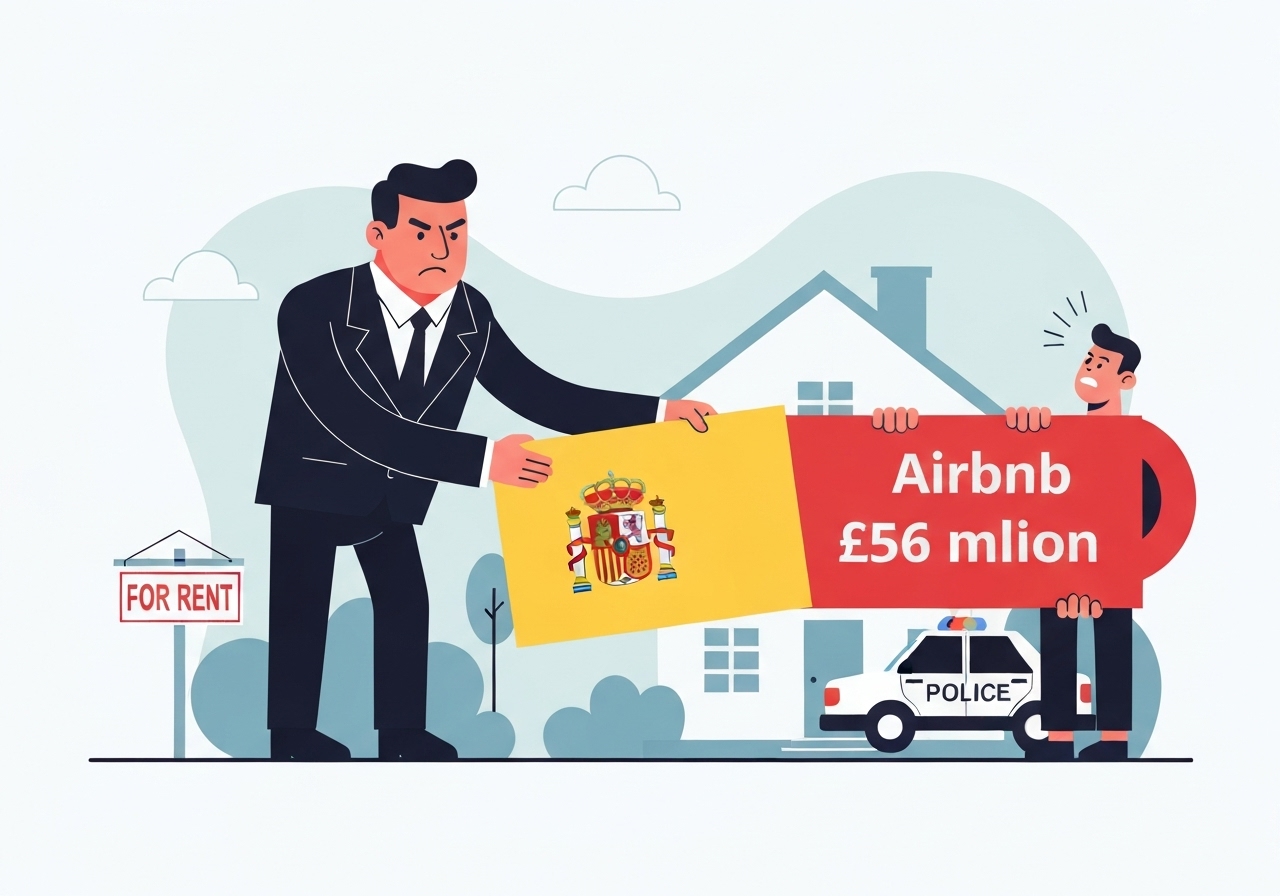
Lead: Spain’s government has imposed a €64m (£56m) penalty on Airbnb for advertising properties without valid rental licences, ordering the adverts removed and the fine to stand without appeal. Officials said 65,122 listings breached consumer rules, including promotion of homes banned from short-term letting. The move comes amid growing public concern that holiday lets are driving up housing costs and displacing local residents in major tourist destinations. The BBC has contacted Airbnb for comment.
Key Takeaways
- Spain fined Airbnb €64m (£56m); the sanction is final and cannot be appealed.
- Authorities identified 65,122 adverts on Airbnb that violated consumer rules or showed mismatched licence numbers.
- The ruling requires Airbnb to withdraw adverts for properties not authorised for short-term rental.
- Spanish officials highlighted housing pressure in tourist areas as a driver for the enforcement action.
- Complaints and demonstrations, including protests in May, preceded the government’s clampdown.
- Other global cities such as Barcelona, New York, Berlin, Paris and San Francisco also impose strict limits on short-term lets.
Background
Spain is one of the world’s most visited countries, and tourism is a major part of its economy. The surge in visitor demand has been linked by officials and housing advocates to rising rents and reduced availability of long-term homes for residents. Local governments and national regulators have increasingly focused on short-term holiday lets—platform-driven, often irregular rentals that can remove housing stock from conventional markets.
Since Airbnb’s founding in 2007 and its rapid mainstream growth around 2014, cities worldwide have wrestled with policy responses to short-term letting. Measures vary—registration systems, caps on listings, and outright bans in sensitive zones—but the common thread is a regulatory effort to rebalance housing availability with tourism. In Spain, those tensions translated into inspections, registry checks and, most recently, the large administrative fine announced by the consumer ministry.
Main Event
Spain’s consumer ministry announced a €64m fine after an investigation found tens of thousands of adverts that either lacked valid rental licences or displayed licence numbers that did not match official registers. The ministry said some units promoted on Airbnb were explicitly banned from being let to tourists under local rules. Authorities ordered Airbnb to remove the offending listings and said the sanction cannot be appealed.
Consumer rights minister Pablo Bustinduy framed the action as both a defence of local residents and enforcement of consumer law. He argued that business models relying on extensive short-term letting were exacerbating housing insecurity for families in affected neighbourhoods. The ministry published its findings after a compliance review of online adverts and registry cross-checks.
The announcement followed public pressure and protests ahead of Spain’s busy summer season. Local officials in several tourist hotspots have for years sought to limit the number of short-stay units, and national regulators stepped in where enforcement at municipal level was uneven. The ministry’s count of 65,122 problematic adverts became the central factual basis for the fine.
Analysis & Implications
The fine signals an escalated regulatory posture: Spain is using consumer protection and administrative penalties to compel platform compliance rather than relying solely on local ordinances. For Airbnb, the ruling carries financial cost and operational implications—platform processes for verifying licences and removing non-compliant adverts may need strengthening to avoid further sanctions. Markets with high tourist demand face particular scrutiny because a single platform can list thousands of units across multiple jurisdictions.
Economically, limiting unlicensed short-term lets can relieve some pressure on local housing supply and potentially moderate rent growth, but effects depend on enforcement scope and alternative housing policies. If non-compliant listings are withdrawn without parallel measures to increase long-term housing supply, displacement pressures may reappear in other forms. The ruling could also push some hosts into informal markets or into longer-term lettings, altering income flows for small-scale hosts.
Internationally, the fine may encourage other governments to adopt similar tactics—using consumer law, registration checks and heavy fines—to force rapid changes in platform behaviour. Cities that already restrict listings could cite Spain as precedent when negotiating compliance terms with platforms. Conversely, platforms may intensify lobbying for harmonised rules to avoid fragmented local regimes that complicate compliance at scale.
Comparison & Data
| City | Typical Regulatory Focus |
|---|---|
| Barcelona | Registration, licence checks, and area-based bans |
| New York | Limits on whole-unit short-term rentals and registration |
| Berlin | Strict controls on short-term whole-apartment lets |
| Paris | Registration requirements and penalties for non-compliance |
| San Francisco | Caps and local registration for short-term hosts |
The table summarises common regulatory approaches in major tourist cities; measures typically mix registration, caps and bans in sensitive areas. Spain’s headline figures—€64m fine and 65,122 adverts—position it among the more assertive national-level interventions to date. The social context (tourism-dependent economies and tight urban housing markets) explains why many jurisdictions converge on stricter oversight.
Reactions & Quotes
“There are thousands of families who are living on the edge due to housing, while a few get rich with business models that expel people from their homes.”
Spain consumer rights minister Pablo Bustinduy
This comment framed the decision as protecting residents from housing market distortions linked to short-term letting platforms. The ministry presented the fine as a response to documented breaches of consumer and housing rules.
“We’ll prove it as many times as necessary: no company, no matter how big or powerful, is above the law. Even less so when it comes to housing.”
Spain consumer rights minister Pablo Bustinduy
Mr Bustinduy used social media to stress the government’s determination to enforce rules against platforms that list non-compliant properties. The ministry’s statement made clear the penalty is final and requires immediate corrective action by Airbnb.
Unconfirmed
- The exact number of individual hosts or households affected by the 65,122 adverts is not specified in the ministry statement.
- The total number of nights or bookings that involved unlicensed units during the period under review has not been published.
- Any immediate operational changes Airbnb will implement in Spain (beyond removing listed adverts) remain unconfirmed pending the company’s response.
Bottom Line
Spain’s €64m (£56m) fine against Airbnb is a clear message that national regulators will take decisive action where platform listings undermine local housing rules. The sanction targets tens of thousands of adverts and requires their withdrawal, setting a precedent for using consumer and administrative law to enforce housing policy objectives.
For residents and policymakers, the ruling underscores the need for coordinated actions: enforcement can remove non-compliant listings, but lasting relief for housing affordability depends on broader housing supply, zoning and taxation policies. For Airbnb and similar platforms, the case signals that compliance systems and transparent licence verification will be central to operating in major tourist markets.
Sources
- BBC News — UK broadcaster, news report summarising Spain’s announcement and ministerial statements.