
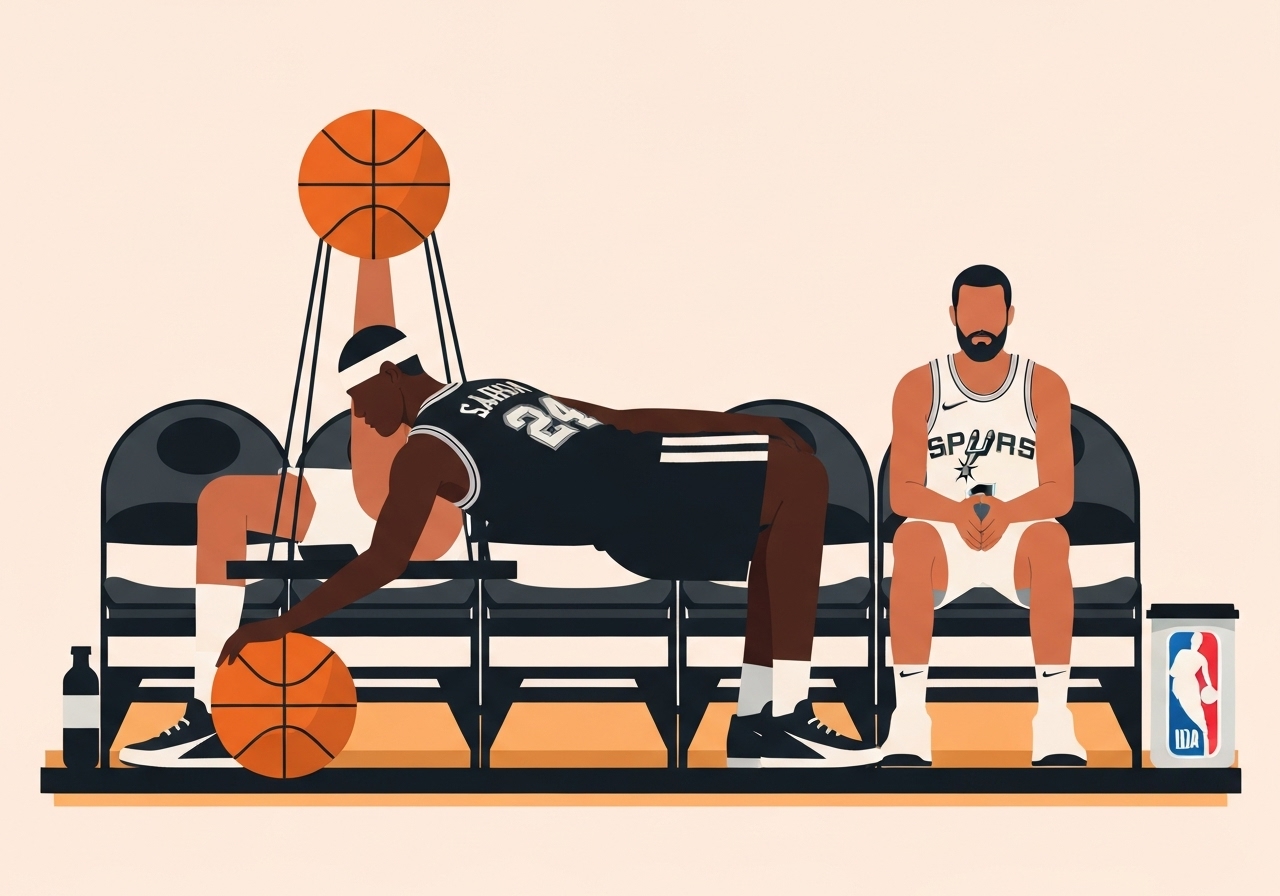
LAS VEGAS — The San Antonio Spurs are considering using Victor Wembanyama off the bench for Tuesday’s NBA Cup championship against the New York Knicks after the 7-foot-4 center returned from injury and logged limited minutes in Saturday’s semifinal. Wembanyama, who missed 12 games with a left calf strain, came off the bench in the win over the Oklahoma City Thunder, playing 21 minutes and scoring 22 points, including 15 in the fourth quarter. Coach Mitch Johnson said the club will continue discussions with Wembanyama and staff to balance short-term impact with long-term health, while players stressed trust in the plan. The decision will affect lineup rollouts and bench usage for a game that counts toward the NBA’s 65-game award eligibility rule despite not counting in regular-season standings.
Key Takeaways
- Victor Wembanyama returned from a 12-game absence on Dec. 13, 2025, and debuted off the bench in the NBA Cup semifinal in Las Vegas, logging 21 minutes and 22 points.
- Wembanyama scored 15 of his 22 points in the fourth quarter; the rest of the Spurs combined for 18 points in that period.
- The Spurs limited his first-half minutes to a little more than seven, then played him 13:20 after halftime to manage workload while maximizing impact.
- Coach Mitch Johnson emphasized the choice will be collaborative and must consider who plays with whom and the effect on team deployment.
- Guard Devin Vassell publicly supported the strategy, saying the staff had a clear plan and he trusted the coaching decisions.
- The NBA Cup final does not affect standings but counts toward the NBA’s 65-game rule for award eligibility, preserving Wembanyama’s candidacy despite missed games.
- Any change to Wembanyama’s usual starter role would shift minutes across the roster and alter matchups against the New York Knicks.
Background
Victor Wembanyama missed 12 games earlier in the season with a left calf strain, a setback that prompted the Spurs to adopt a cautious workload plan upon his return. The Spurs prioritized protecting a franchise centerpiece whose availability is central to long-term goals, including playoff positioning and individual award eligibility. The NBA Cup — a midseason tournament held in Las Vegas — does not affect regular-season standings but feeds into the league’s 65-game threshold used to determine award qualification, so minutes management in Cup games still carries consequence. San Antonio’s coaching staff and medical team have outlined a phased approach to reintroducing Wembanyama to full minutes, emphasizing short stints and monitoring recovery markers.
San Antonio’s roster construction amplifies the significance of a bench deployment: Wembanyama’s presence as a starter or reserve changes rotation pairings and defensive matchups, especially against teams with length and interior scoring like the Knicks. The Spurs have previously adjusted rotations for injury management, balancing competitive goals with player health. Across the league, teams increasingly use strategic minute limits and load management in situational games to protect high-value players across an 82-game season and tournament additions.
Main Event
In the NBA Cup semifinal against the Oklahoma City Thunder on Dec. 13 in Las Vegas, Wembanyama checked in at the start of the second quarter — the first time in his career he entered as a reserve — with the Thunder ahead by 11. He delivered immediate impact: three rebounds, a tip-in layup and an assist on teammate Dylan Harper’s 3-pointer within his first three possessions. Wembanyama finished the second quarter 2-of-3 from the floor for five points as the Spurs trimmed the deficit to three at halftime.
The coaching staff deliberately kept his first-half workload light — a bit more than seven minutes — then extended his run after intermission to 13 minutes and 20 seconds, totaling 21 minutes for the game. Wembanyama produced 22 points overall, with a decisive 15-point burst in the fourth quarter when San Antonio needed scoring while other starters were limited. Teammates credited the plan for preserving his effectiveness late in the game.
Coach Mitch Johnson said the team will continue to weigh multiple inputs in deciding whether to repeat the approach in the Cup final against the New York Knicks. Johnson framed the choice as complex: Wembanyama wants to start and play major minutes, but the staff must consider collective fit, opponent matchups and the player’s recovery trajectory. The Spurs face a tradeoff between maximizing immediate championship chances in the Cup final and guarding Wembanyama’s longer-term availability and development.
Analysis & Implications
Moving Wembanyama to a reserve role for a single high-profile game represents a tactical adjustment with layered implications. Shorter, impactful stints can preserve explosiveness and reduce cumulative calf stress, potentially lowering reinjury risk while maintaining late-game dominance — as seen when he scored 15 fourth-quarter points. However, altering his starter/bench designation affects lineup chemistry; opponents prepare differently for Wembanyama starting versus entering as a change-up, and his minutes distribution changes who closes games alongside him.
For the Spurs, the decision is also strategic in roster terms. If Wembanyama starts fewer minutes early, players who would normally play with him must adapt to increased responsibilities, which could expose defensive mismatches or open offensive opportunities. Conversely, planned reserve bursts might create favorable matchup windows late in games when opponents are set for other lineups. The coaching staff must model permutations to ensure the bench deployment complements rotation flow rather than creating gaps.
There are broader league-wide considerations: with tournaments like the NBA Cup added to the calendar, teams are testing controlled minutes for elite assets outside the regular-season standings. The Cup final’s inclusion in the NBA’s 65-game award rule creates an added wrinkle — minutes in these games count for award eligibility — so the Spurs must balance protecting Wembanyama’s health with preserving his statistical and voting case for postseason honors. How San Antonio handles this choice may influence other teams managing star workloads in non-standings competitions.
Comparison & Data
| Game Segment | Minutes | Points |
|---|---|---|
| First half (approx.) | ~7+ minutes | 5 points |
| Second half | 13:20 | 17 points |
| Total (Semifinal) | 21:00 | 22 points |
The split above shows the Spurs’ deliberate staging: limited early minutes to manage load, followed by an extended second-half stint that yielded most of Wembanyama’s scoring. That distribution allowed San Antonio to preserve his explosiveness late while keeping total on-court exposure constrained. Coaches will consider similar minute segmentation against the Knicks depending on matchup flow and in-game developments.
Reactions & Quotes
“It’s going to be a mix of different opinions. But I’m ready. Even I will have my own opinion [about what to do].”
Victor Wembanyama
Wembanyama framed the conversation as collaborative, acknowledging both his desire to play and the need to talk through options with staff.
“I trust in Mitch 100 percent. They had the perfect plan. … As soon as Vic came in, he had the impact that we needed.”
Devin Vassell, Spurs guard
Vassell endorsed the team’s approach, crediting a rehearsed plan for the successful semifinal execution and expressing confidence in the coaching staff.
“It’s hard. He wants to play. He wants to start. He wants to finish. … That decision can’t be made in a vacuum.”
Mitch Johnson, Spurs head coach
Johnson highlighted the broader roster and matchup considerations that make the starter-versus-bench question more than just an individual choice.
Unconfirmed
- Whether the Spurs will definitively name Wembanyama a reserve or starter for the Cup final remains undecided at the time of reporting.
- The exact minute cap or rotation plan for the final has not been released publicly and may be adjusted during the game based on performance and medical input.
- No team-issued long-term timetable tying Wembanyama’s minute management to future regular-season games has been disclosed beyond immediate cautionary statements.
Bottom Line
San Antonio’s possible decision to bring Victor Wembanyama off the bench in the NBA Cup final reflects a careful balancing act between winning a midseason trophy and protecting a franchise cornerstone returning from a 12-game absence. The semifinal showed the potential effectiveness of short, high-impact stints: Wembanyama delivered a late-game scoring surge while his total minutes remained limited.
Coaches and medical staff will continue to weigh the trade-offs — immediate matchup advantages in the final versus cumulative load and award-related considerations. Whatever choice the Spurs make, it will reshape rotation patterns against the Knicks and offer a window into how teams manage star minutes in a season with additional tournament obligations.