
Lead
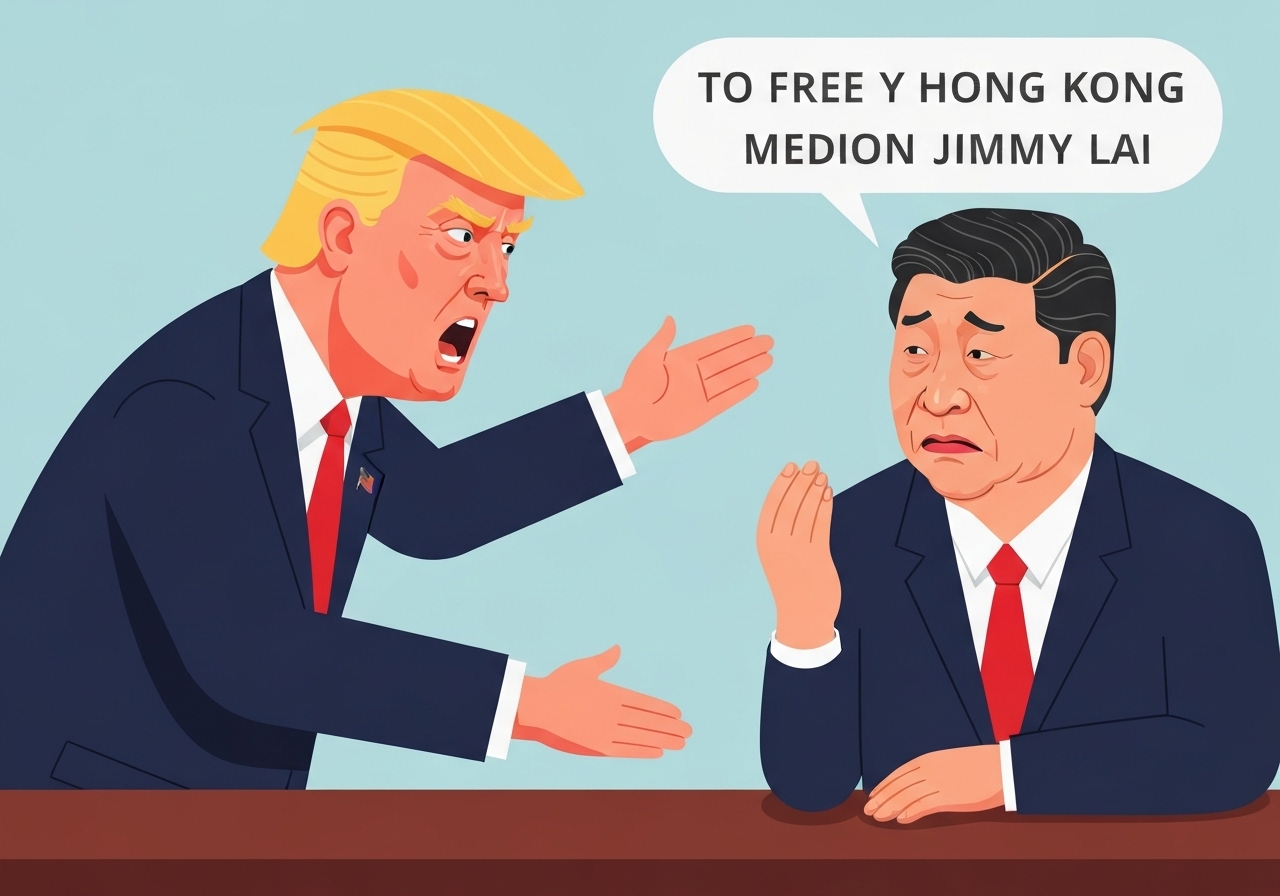
On Monday, President Donald Trump said he asked Chinese leader Xi Jinping to consider releasing Jimmy Lai, the Hong Kong pro-democracy media founder convicted on national security charges. Trump told reporters he felt ‘‘so badly’’ about Lai’s health and age and said he raised the matter during interactions with Xi. Lai, 78, a British citizen and founder of the tabloid Apple Daily, was found guilty on three charges and could face life imprisonment after being held since late 2020. The conviction is part of a wider post-2019 crackdown on dissent in Hong Kong.
Key Takeaways
- President Trump publicly asked Xi Jinping to consider releasing Jimmy Lai after Lai’s conviction on national security charges on Monday, 16 December 2025.
- Jimmy Lai, 78 and diabetic, has been detained since late 2020 and was convicted on all three counts in a national security trial; he faces the possibility of a life sentence.
- Senator Marco Rubio described the verdict as evidence Beijing is silencing free speech; Rubio noted reports that Lai has spent more than 1,800 days in prison.
- Lai is a British citizen and the founder of the pro-democracy tabloid Apple Daily, which has been targeted by Hong Kong authorities.
- Global governments, rights groups and institutions have condemned the conviction, framing it as part of a tightening of control following 2019 protests.
Background
The case of Jimmy Lai has been a focal point in the wider dispute over Hong Kong’s freedoms since the 2019 mass protests against an extradition bill and perceived erosion of civil liberties. After the 1997 handover, Beijing had pledged to maintain a separate system in Hong Kong; critics say the national security law introduced in 2020 has narrowed that autonomy. Lai built Apple Daily into a leading pro-democracy voice and was repeatedly targeted by authorities as the city’s political climate hardened.
Authorities arrested Lai in late 2020, and he has remained in custody through a series of prosecutions linked to national security and other charges. International campaigners, press-freedom groups and some Western governments have consistently flagged his detention as emblematic of shrinking space for dissent. Lai’s health and age—he is 78 and diabetic—have also become a humanitarian concern cited by advocates pressing for his release.
Main Event
On Monday, following Lai’s conviction, President Trump told reporters he had asked Xi Jinping to consider releasing the media tycoon, saying he ‘‘felt so badly’’ about the outcome and noting Lai’s poor health. Trump did not specify the exact timing of his request; U.S. officials say he raised the case during meetings that included an encounter with Xi in October in South Korea. The president framed his appeal as a humanitarian plea rather than a legal intervention.
The Hong Kong trial found Lai guilty on all three national security charges, a development that drew immediate international condemnation. Lai has been detained since late 2020 and his supporters warn that a life sentence would amount to a de facto end to his role as a public dissident. The convictions follow a pattern of prosecutions and restrictions that intensified after the 2019 protests, during which authorities moved to curtail demonstrations and press activities.
U.S. reactions were swift. Senator Marco Rubio called the verdict a sign Beijing intends to silence those defending free speech, and justice and human-rights organizations echoed that assessment. Lai’s daughter, Claire Lai, told reporters her father wants only to reunite with family and devote himself to faith if freed, appealing for humanitarian consideration rather than political reprieve.
Analysis & Implications
Trump’s public appeal to Xi transforms what might have been a bilateral human-rights note into a high-profile diplomatic signal. Asking a foreign head of state to consider the release of an individual imprisoned under another jurisdiction’s security law tests the limits of executive influence and highlights personal diplomacy as a tool in human-rights advocacy. The request is likely aimed both at securing a humanitarian outcome and at signaling commitment to press freedom to domestic constituencies who support Lai.
For Beijing, any decision on Lai is entangled with domestic politics and sovereignty claims. Granting release under external pressure could be seen as ceding authority over how the national security law is enforced, while refusing risks further international criticism. The outcome therefore has implications for how China balances global reputation management against its priority of controlling perceived threats to regime stability.
The conviction further complicates the legal and political environment for Hong Kong’s media sector and civil society. International businesses and governments are watching for whether this case will lead to additional sanctions, visa actions, or targeted diplomatic measures. At the same time, advocates warn that repeated high-profile convictions may chill remaining independent journalism and civic activism in the city.
Comparison & Data
| Event | Date / Measure |
|---|---|
| Arrest of Jimmy Lai | Late 2020 |
| Days in detention reported | More than 1,800 days (reported) |
| Conviction | 16 December 2025 |
| Age | 78 |
This timeline situates Lai’s current verdict within a five-year arc of legal actions since his 2020 arrest. The ‘‘more than 1,800 days’’ figure cited by U.S. voices underscores the prolonged nature of his detention; human-rights groups use such counts to stress cumulative hardship. Comparing pre- and post-2019 legal environments helps explain why many observers view this conviction as part of a broader structural change in Hong Kong’s governance and civic space.
Reactions & Quotes
U.S. officials and international advocates framed the verdict as a blow to press freedom, with calls for a humanitarian response. Below are representative statements with context and immediate reactions.
Before Senator Rubio’s remark, lawmakers and activists had already signaled alarm at the sentencing prospects and at reports about Lai’s health. The comment that Lai had spent over 1,800 days in detention framed the case as an extended hardship rather than a short-term legal matter.
‘Reports indicate that Mr Lai’s health has severely deteriorated during more than 1,800 days in prison.’
Senator Marco Rubio
After Rubio’s comment, rights groups amplified calls for release on humanitarian grounds and urged governments to press for consular access and medical care. Rubio’s framing tied the case to broader critiques of China’s handling of dissent and renewed diplomatic pressure.
President Trump’s public note asking Xi to consider release followed his remark that he felt ‘‘so badly’’ about Lai’s condition. This appeal was presented as a humanitarian entreaty rather than a demand or a policy threat.
‘I feel so badly. I spoke to President Xi about it, and I asked to consider his release.’
President Donald Trump
Trump did not provide a precise timeline for his appeal or a detailed plan for follow-up, leaving open whether any formal diplomatic channel will pursue the request. The statement nonetheless elevated Lai’s case in international public discussion and signaled presidential-level attention.
Family perspectives have emphasized personal and religious motives behind requests for clemency. Claire Lai appealed to humanitarian values and her father’s wish to prioritize family and faith if freed.
‘He just wants to reunite with his family. He wants to dedicate his life to serving our Lord.’
Claire Lai, daughter
Her comments reframed the legal case as a family and humanitarian question, which supporters say may broaden domestic sympathy for clemency or compassionate release.
Unconfirmed
- The precise date and context in which President Trump first raised Lai’s case with Xi Jinping have not been independently confirmed by an official White House transcript.
- Claims about the exact severity of Lai’s health decline are based on reports cited by politicians and advocates and have not been substantiated by a public medical release.
- Whether Beijing will consider humanitarian release for Lai in response to external appeals remains speculative and dependent on internal deliberations that have not been disclosed.
Bottom Line
President Trump’s public appeal to Xi Jinping places Jimmy Lai’s case at the intersection of human-rights advocacy and high-level diplomacy. While the request underscores international concern over press freedom in Hong Kong, it faces legal, political and sovereignty constraints that make an immediate or guaranteed outcome unlikely.
Observers should watch for concrete diplomatic follow-up, statements from Chinese authorities, any consular or medical access granted to Lai, and whether international pressure translates into humanitarian relief. Regardless of the immediate result, the conviction reinforces perceptions of a narrowed civic space in Hong Kong and will shape diplomatic and rights-based responses in the months ahead.
Sources
- The Guardian (news report)
- Associated Press (news reporting on family statements)
- Marco Rubio on X (senator social media)