
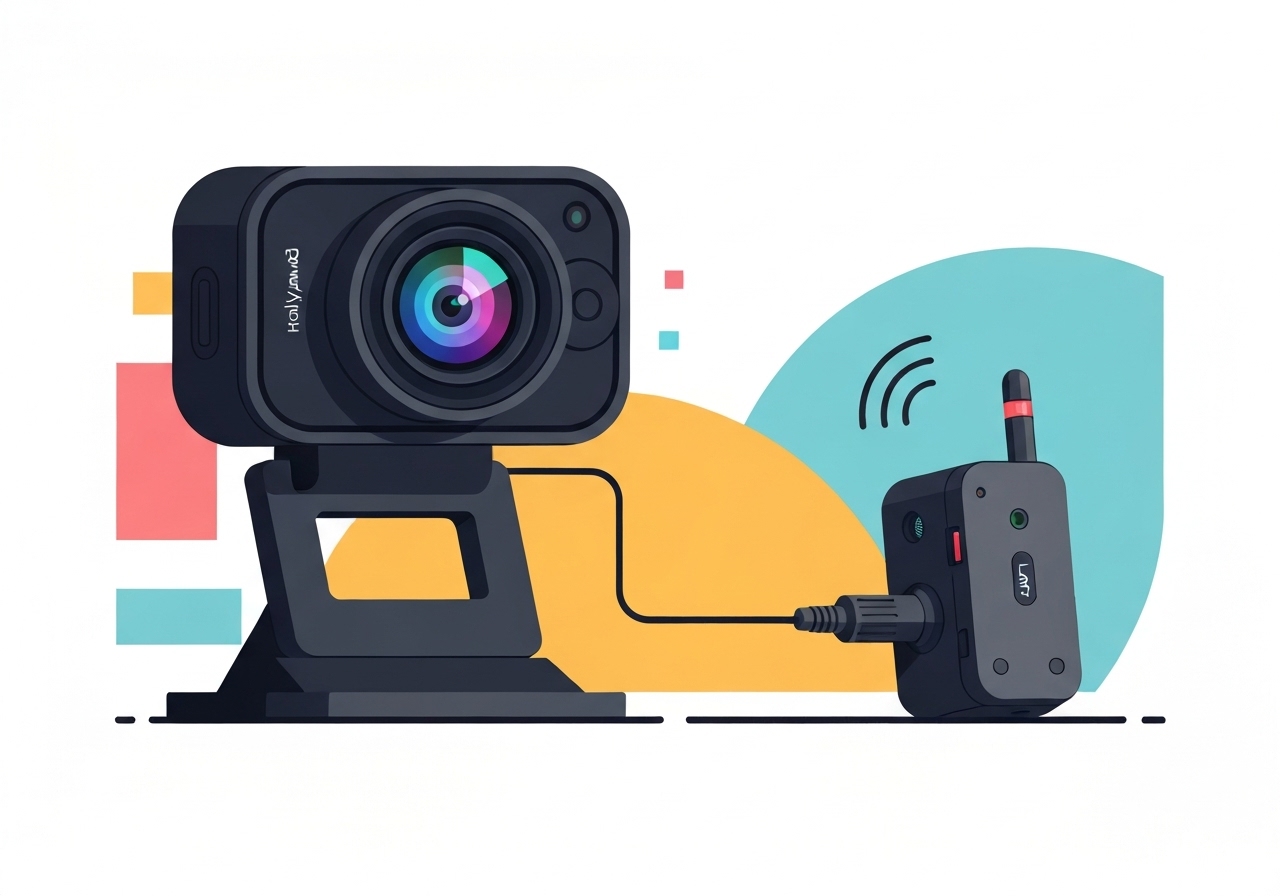
Hollyland has introduced the Lyra, a compact 4K webcam that integrates a built-in receiver for the company’s Lark A1 wireless lavalier microphone, aiming to lift both picture and sound for creators and remote workers. The Lyra records up to 4K at 30fps (or 1080p at 60fps) from a 1/1.5-inch sensor behind an f/1.8 lens, and ships through the manufacturer for $149 with an option to add a single Lark A1 mic for $10. Hollyland also bundles AI-driven noise reduction for the Lark A1 and software features that handle exposure, skin smoothing and virtual background removal. The device is positioned as an affordable upgrade to laptop cameras and separate mic setups for video calls, streams and recorded content.
Key Takeaways
- Price: Lyra standalone is $149 on Hollyland’s store; adding one Lark A1 costs an extra $10 at checkout.
- Mic integration: Lyra contains a native receiver for the Lark A1 wireless lav, and the A1 can be bought separately with a smartphone receiver for about $29.90.
- Image specs: 1/1.5-inch sensor, f/1.8 lens, up to 4K/30fps; 1080p mode supports 60fps for smoother motion.
- Audio processing: The Lark A1 pair includes AI-powered noise reduction to reduce background noise in real time.
- AI imaging: On-device algorithms adjust brightness, contrast and exposure automatically and offer a beauty mode and green-screen replacement.
- Mount and privacy: Lyra uses a magnetic clip-on mount and a rotating physical lens cover for privacy when not in use.
- Tracking: The camera can detect people and reframe to keep subjects centered, but it lacks a moving gimbal mechanism like some higher-end models.
Background
Webcams have become a focal product space as hybrid work and creator-driven video continue to expand. Hardware makers increasingly merge camera and audio ecosystems, moving away from separate microphones, capture interfaces and software patches toward integrated solutions that simplify setup for non-technical users. Hollyland built its reputation on budget-friendly wireless audio gear favored by streamers and independent creators, and the Lyra represents the company’s first formal entry into dedicated webcam hardware.
Higher-end competitors such as the Insta360 Link use motorized gimbals to provide smooth physical tracking and more sophisticated framing, while many laptops still ship with basic 720p–1080p modules and low-quality mics. Manufacturers have responded by adding larger sensors, faster lenses and on-device AI to simulate studio fixes—noise suppression for audio and computational adjustments for low light and color. For users who prioritize simplicity, a webcam that receives a wireless lav directly reduces the number of adapters and cables required to achieve acceptable audio quality for streams and meetings.
Main Event
Hollyland announced the Lyra as a small, magnetically mounted webcam with an integrated receiver for the Lark A1 wireless lavalier microphone. The company highlights the Lyra’s larger-than-laptop sensor and an f/1.8 lens to capture more light, and it specifies 4K/30fps as the maximum capture mode; when users switch to 1080p the camera can run at 60fps for smoother motion. Internally, Hollyland has added software that automatically tweaks exposure, contrast and brightness based on scene analysis, and a selectable beauty mode for those who want softer skin tones.
On the audio side, Lyra’s built-in receiver is compatible with Hollyland’s Lark A1 mic system, which the company promotes for its low cost and AI-based noise suppression. Hollyland positions the bundled $10 mic option as an economical way to improve voice clarity compared with typical laptop microphones. The Lark A1 system can also be purchased separately with a smartphone receiver for about $29.90, offering a cheap path to wireless audio for mobile recording.
The Lyra includes a proprietary algorithm for green-screen removal so users do not need third-party software for background replacement; Hollyland advertises this as a one-click solution. While the camera can detect people and reframe the image to keep subjects centered, it cannot pan or tilt on a physical gimbal when mounted on a monitor—tracking is accomplished by cropping and digital reframing of the sensor output. For privacy, the product employs a physical rotating lens cover to ensure users can block the camera without relying on software toggles.
Hollyland has priced the Lyra to compete in the mainstream creator and remote-work market rather than the premium segment. That positioning, combined with a native wireless lav receiver, is aimed at users who want better sound without buying separate wireless transmitters, adapters or a dedicated audio interface. Availability at launch is through Hollyland’s own website, and the manufacturer has offered bundled deals to lower the effective price of a starter kit with one microphone.
Analysis & Implications
Combining a camera and a wireless mic receiver inside one unit reduces complexity for many creators and remote participants. Users who previously needed a separate transmitter, receiver and camera can cut steps: pairing a Lark A1 directly to the Lyra removes the need for external dongles and some software routing. This convenience matters for small teams, solo creators and educators who prioritize speed of setup over absolute audio fidelity provided by higher-end XLR systems.
From a market perspective, Hollyland’s move signals broader convergence between audio and video peripherals. If other accessory makers follow, the next wave of webcams may commonly include integrated wireless audio compatibility, raising the baseline for out-of-the-box production quality. This could pressure companies to add more on-device processing—both for audio (noise suppression, echo cancellation) and for video (auto-exposure, skin retouching, virtual backgrounds).
There are trade-offs. Lyra’s reliance on digital tracking rather than a motorized gimbal means it cannot match the physical smoothness and range of devices like the Insta360 Link when subjects move widely. Similarly, the bundled Lark A1 is an entry-level wireless mic; its AI noise reduction may improve intelligibility, but it won’t replace the dynamic range and reliability of professional shotgun or lav systems used in broadcast environments. Buyers should weigh convenience and price against the performance needs of their workflows.
Comparison & Data
| Model | Sensor / Lens | Max Video | Mic Integration | Price (approx.) |
|---|---|---|---|---|
| Hollyland Lyra | 1/1.5″ sensor, f/1.8 | 4K/30fps; 1080p/60fps | Built-in Lark A1 receiver | $149 (+$10 mic bundle) |
| Insta360 Link | ~1/2.3″ equivalent | 4K/30fps; 1080p/60fps | No native wireless lav receiver | $299–$399 (varies) |
| Typical Laptop Camera | Small 1/4″–1/3″ | 720p–1080p | Built-in low-quality mic | Included with device |
The table contextualizes Lyra’s main selling points: a larger sensor and integrated wireless mic receiver at a lower price than some premium webcams. While Lyra undercuts price points for devices with physical gimbal tracking, it trades off mechanical movement for a simpler, integrated audio workflow. For buyers focused on cost-effective improvements in both sound and picture, Lyra closes a gap between low-end integrated webcams and higher-priced, modular setups.
Reactions & Quotes
Hollyland framed Lyra as a product meant to simplify setup and improve audio for creators who value compactness and affordability.
“Designed to deliver vivid color and clarity even in low light,”
Hollyland (manufacturer statement)
Independent creators have emphasized the appeal of pairing an inexpensive wireless lav with a camera that accepts the mic directly, but note that real-world performance depends on environment and competing RF devices.
“A direct receiver on the camera removes a frequent point of friction for casual streamers,”
Creator community feedback (early impressions)
Reviewers comparing Lyra to laptop cameras and pricier webcams point to the camera’s combination of sensor size and mic integration as its main advantage, while reminding readers about the limits of digital tracking.
“Better than built-in laptop cameras, though not a full replacement for pro gear,”
Independent reviewer summary (industry commentary)
Unconfirmed
- Long-term audio reliability: Field tests over extended sessions are limited; how the Lark A1 performs in crowded RF environments is not fully verified.
- AI processing limits: The exact algorithmic trade-offs for noise removal versus speech naturalness have not been independently benchmarked.
- Wider availability and pricing stability: Amazon and third-party retail prices may vary from launch-day pricing and regional stock could affect bundle options.
Bottom Line
Hollyland’s Lyra targets creators and hybrid workers who want a straightforward way to improve both picture and voice without assembling separate audio transmitters and camera rigs. Its integrated Lark A1 receiver and AI features make it a practical, budget-conscious option that notably upgrades the typical laptop experience for video calls and casual streaming.
However, buyers seeking broadcast-grade audio or mechanical tracking should temper expectations: the Lark A1 is an entry-level wireless mic and Lyra relies on digital reframing rather than a physical gimbal. For many users who prioritize ease of use and price, Lyra offers a compelling middle ground—simpler setup, better audio than a built-in mic, and improved sensor performance at a modest cost.