
Lead
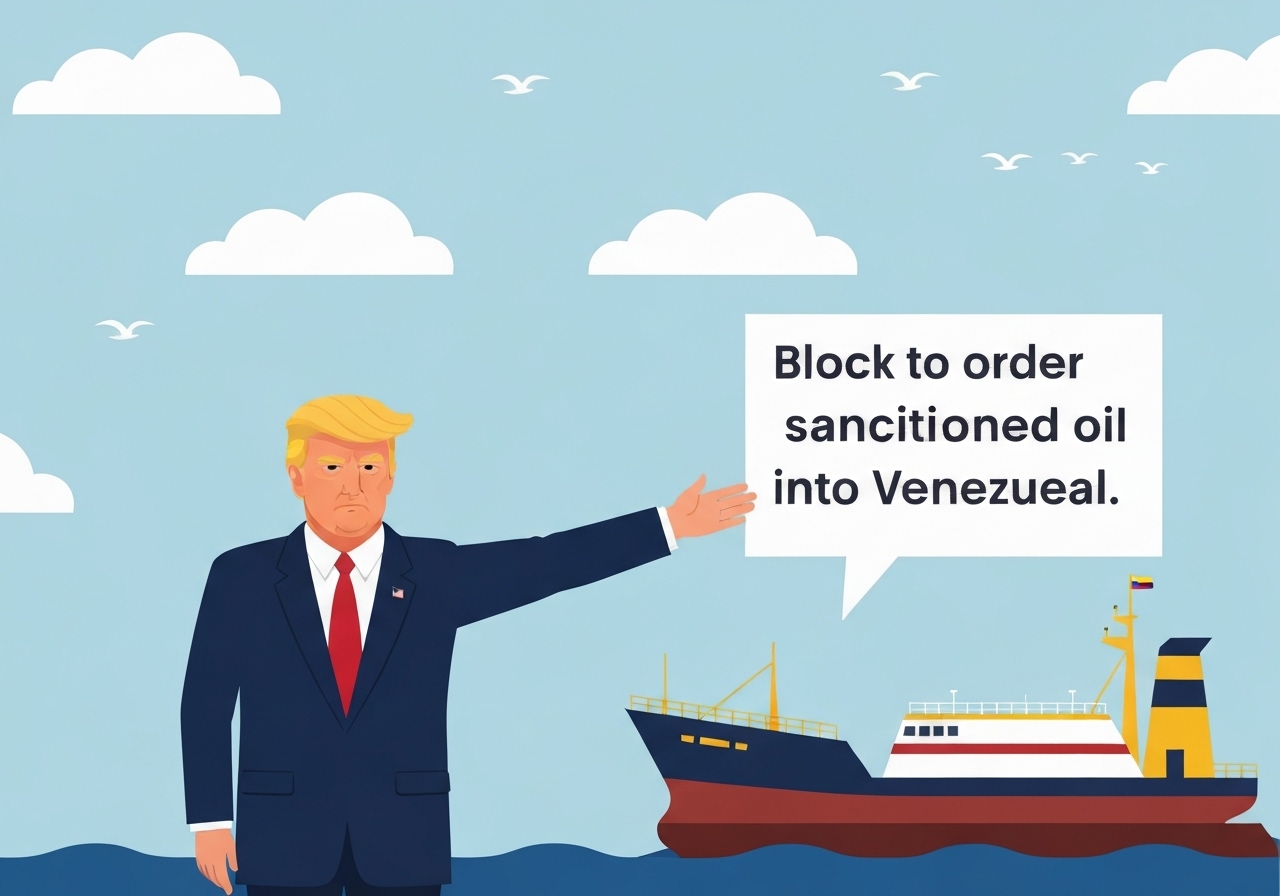
President Donald Trump announced a naval blockade of all “sanctioned oil tankers” bound for Venezuela, saying the step was intended to choke off revenue to Nicolás Maduro’s government. The declaration followed last week’s U.S. seizure of an oil tanker and a U.S. military buildup in the region. Trump framed the move as part of a campaign to stop drug trafficking and to recover what he called oil, land and assets taken from the United States. The Pentagon referred questions about the announcement to the White House, and Venezuela called the action a serious violation of international law.
Key Takeaways
- Trump announced a “TOTAL AND COMPLETE BLOCKADE OF ALL SANCTIONED OIL TANKERS” bound for Venezuela in a social media post; the White House was cited for operational questions.
- U.S. forces recently seized an oil tanker off Venezuela’s coast and have deployed 11 naval ships to the region, including an aircraft carrier and amphibious assault ships.
- Venezuela produces about 1,000,000 barrels per day; experts estimate roughly 850,000 b/d are exported, with about 80% going to China and 15–17% to the U.S. via Chevron.
- A U.S. maritime campaign of strikes has reportedly hit at least 25 vessels, killing at least 95 people, according to available tallies cited in reporting.
- The Trump administration has previously designated the Cartel de los Soles as a foreign terrorist organization and asserted broader measures to pressure Maduro, though Venezuela is not listed as a state sponsor of terrorism.
- Venezuela’s government said it will denounce the blockade to the United Nations and accused the U.S. of violating free navigation and international law.
- Senior U.S. officials, including an administration chief of staff, have publicly linked the campaign of maritime strikes to the objective of removing Maduro from power.
Background
Venezuela relies heavily on oil revenue; its proven reserves are among the world’s largest and oil has been central to state finances for decades. Since 2017 the United States has imposed a series of oil-related sanctions on Venezuela, largely targeting the state oil firm Petróleos de Venezuela S.A. (PDVSA) and key elements of the oil trade. Those measures have pushed Caracas to rely on a network of unflagged or shadow tankers to move crude into international markets, often at deep discounts.
The U.S. maritime campaign in recent months has involved strikes on vessels in international waters in the Caribbean and eastern Pacific, which U.S. officials describe as aimed at disrupting drug trafficking. Reported strikes—numbering 25 known incidents with at least 95 fatalities—have prompted scrutiny from lawmakers across the political spectrum about legal authority and operational oversight. The U.S. military presence in the region has included a mix of surface ships, patrol aircraft and shipborne aircraft, increasing Washington’s ability to monitor and interdict shipping.
Main Event
In a social media post Tuesday night, President Trump ordered a blockade of all “sanctioned oil tankers” going into or out of Venezuela and said the U.S. naval presence would grow. He accused Venezuela of using oil to fund drug trafficking and other crimes, and said the military buildup would continue until Venezuela returned “oil, land and other assets” he claimed had been taken from the U.S. The Pentagon redirected operational questions to the White House and provided no immediate operational plan for how the blockade would be enforced.
Venezuelan officials responded the same day with a formal statement accusing the United States of violating international law and free navigation and called the blockade a “reckless and grave threat.” The Maduro government said it would bring the matter before the United Nations. Venezuelan spokespeople rejected the president’s characterizations about U.S. claims to the country’s resources and described the announcement as an attempt to seize national wealth.
The U.S. has already conducted maritime strikes that the administration says target drug shipments; officials maintain those operations have prevented narcotics from reaching the United States. Critics, however, argue the strikes raise legal and humanitarian questions because they have been carried out in international waters and resulted in civilian casualties. Senior aides have framed the broader campaign as part of pressure on Maduro, linking maritime action and diplomatic isolation to an effort to force political change in Caracas.
Analysis & Implications
Legally, a naval blockade against a sovereign state is a grave step that traditionally requires clear authority under international law and a coherent operational framework to avoid escalation. The president’s wording raises questions about the legal basis for claiming Venezuelan oil or territory as U.S. property and whether a blockade would be implemented under domestic wartime authorities, United Nations mandates, or unilateral executive action. Absent explicit legal justification, allies and international courts could challenge or condemn such a move.
Economically, an effective blockade of Venezuelan oil shipments could further constrict global supply chains and deepen the humanitarian crisis inside Venezuela by reducing state revenue for imports and social services. Venezuela produces about 1,000,000 barrels per day, with roughly 850,000 b/d exported; disruptions to that flow would likely push up regional fuel and shipping costs and spur re-routing or substitution by buyers such as China.
Politically, the announcement is likely to harden domestic and international opposition in Caracas and complicate diplomatic efforts. Maduro’s government can use the blockade narrative to rally internal support and to seek international legal remedies or sympathetic votes at the United Nations. For the United States, the move risks alienating partners who prioritize legal multilateral responses over unilateral coercive measures.
Militarily, the presence of 11 U.S. naval vessels and organic air assets gives Washington capacity to monitor shipping lanes, but conducting a sustained blockade would tax logistics and rules of engagement and increase the risk of unintended clashes at sea. If the U.S. scales up interdiction beyond maritime patrol and seizures to sustained blocking operations, the potential for miscalculation with Venezuelan forces or third-party shipping increases.
Comparison & Data
| Metric | Figure |
|---|---|
| Venezuela crude production | ~1,000,000 barrels per day |
| Estimated exports | ~850,000 barrels per day |
| Share to China | ~80% |
| Share to U.S. (via Chevron) | ~15–17% |
| Reported maritime strikes | 25 known strikes; at least 95 killed |
| U.S. naval assets in region | 11 ships including an aircraft carrier |
The table above summarizes publicly reported production and export figures and the scope of recent maritime operations cited in reporting. Export patterns show China as the dominant destination for Venezuelan crude, which complicates pressure tactics because buyers can reroute purchases or exploit shadow shipping networks. The casualty and strike counts illustrates the human cost tied to the maritime campaign reported to date.
Reactions & Quotes
“Venezuela is completely surrounded by the largest Armada ever assembled in the History of South America.”
President Donald Trump (social media post)
Trump framed the naval presence as the largest assembly in South American history and tied it to demands for restitution of resources. The president also pledged the buildup would continue until Venezuela returned assets he said were taken from the United States.
“On his social media, he assumes that Venezuela’s oil, land, and mineral wealth are his property… He intends to impose… a supposed naval blockade on Venezuela with the aim of stealing the wealth that belongs to our nation.”
Venezuelan government statement (official)
Caracas denounced the announcement as both illegal and an attempt to justify expropriation, and said it planned to raise the matter at the United Nations. The government’s language emphasized violations of free navigation and international law.
“He wants to keep on blowing boats up until Maduro cries uncle.”
Susie Wiles, White House chief of staff (Vanity Fair interview)
A senior U.S. administration official was reported as linking the maritime campaign to the political goal of pressuring Maduro to step down, underscoring the interplay between military action and broader regime-change objectives.
Unconfirmed
- Whether the United States has established or will publish a specific legal justification or rules of engagement for a full blockade remains unconfirmed.
- It is unclear which tankers will be deemed “sanctioned” operationally and how third-country shipping flagged to non-Venezuelan owners will be treated.
- The precise operational role of the 11 U.S. ships reported in the region—beyond surveillance and patrol—has not been publicly detailed.
Bottom Line
The president’s announcement marks a significant escalation in U.S.-Venezuela tensions by publicly ordering a blockade of sanctioned tankers and expanding a U.S. maritime presence. The move blends counter-narcotics rationale with direct pressure on Maduro and raises legal, economic and geopolitical questions that could reverberate across the region and in global oil markets.
Absent clear legal authority, multilateral backing or a detailed operational plan, a full blockade risks international condemnation, possible legal challenges at institutions such as the United Nations, and unintended escalation at sea. Observers should watch for formal legal notices, coalition responses, and changes in shipping patterns that would signal whether the announcement will translate into sustained, enforceable action.