
Lead
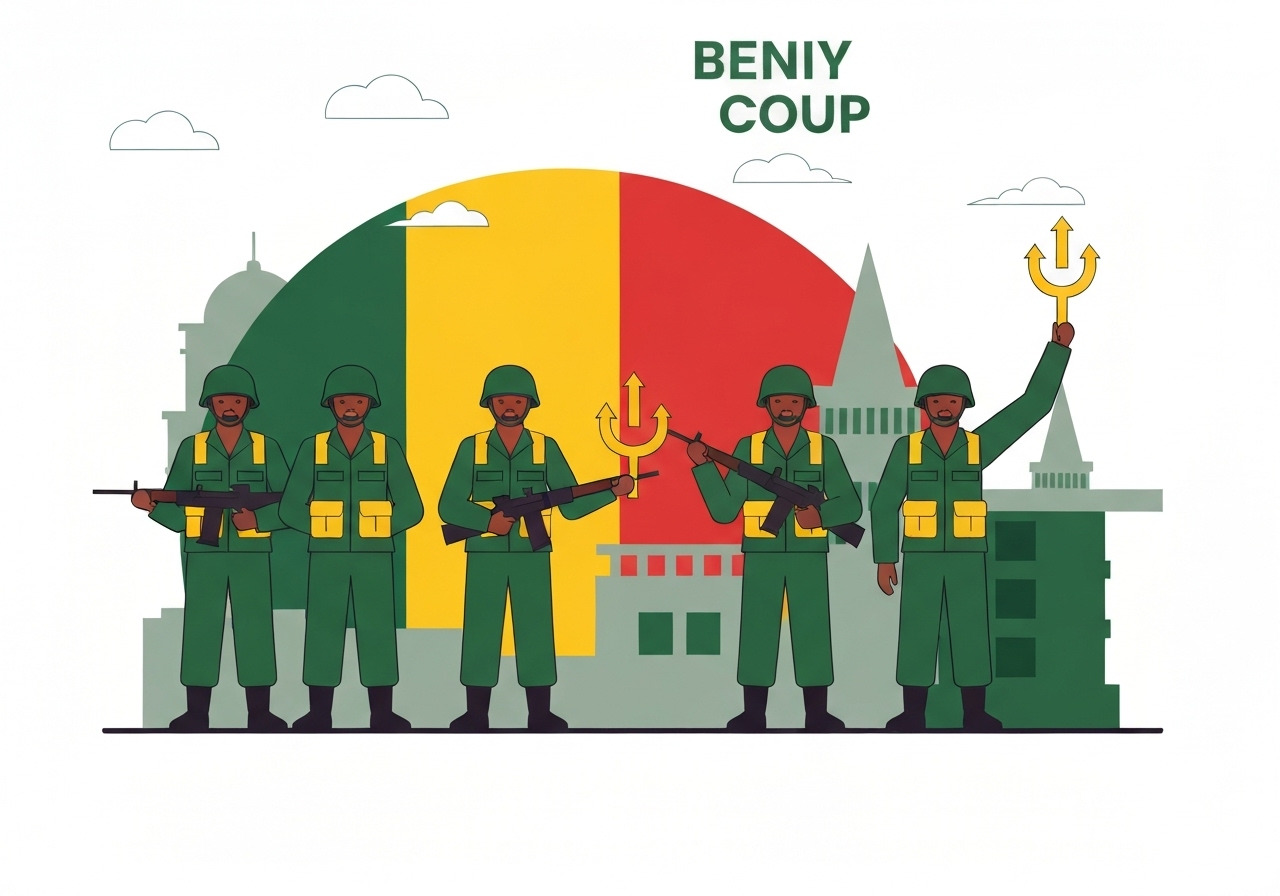
Soldiers appearing on state television in Cotonou on Sunday announced the dissolution of Benin’s government and the removal of the president, naming Lt. Col. Pascal Tigri as head of a newly formed Military Committee for Refoundation. The move came amid a contested political season: President Patrice Talon, in office since 2016, was due to leave after next April’s election. The announcement follows recent military takeovers elsewhere in West Africa and immediately raises questions about control of state institutions and the scheduled vote.
Key Takeaways
- A group calling itself the Military Committee for Refoundation announced on state TV that it had dissolved the government and state institutions.
- Lt. Col. Pascal Tigri was named president of the military committee by the soldiers who made the broadcast.
- President Patrice Talon has led Benin since 2016 and was due to step down after the presidential election next April.
- Romuald Wadagni, Talon’s party pick and former finance minister, had been widely viewed as the frontrunner in the upcoming election.
- Opposition candidate Renaud Agbodjo was rejected by the electoral commission for lacking sufficient sponsors.
- Last month Benin’s legislature extended the presidential term from five to seven years while retaining a two-term limit.
- The incident is the latest in a wave of coups in West Africa; a military takeover in Guinea-Bissau last week removed President Umaro Embaló.
Background
Benin gained independence from France in 1960 and experienced a period of political turbulence in the decades that followed, including multiple coups and changes of government. A return to multi-party politics and relative stability took hold after 1991 following the end of Mathieu Kérékou’s two-decade rule and the country’s renaming as the People’s Republic of Benin during his Marxist-Leninist period. Since 2016 Patrice Talon has been the central political figure; his administration has pursued economic reforms and a prominent role in the region.
Political tensions rose in the run-up to the scheduled presidential election next April. Talon’s anointed successor, Romuald Wadagni, emerged as the apparent favorite, while at least one opposition aspirant — Renaud Agbodjo — was blocked from the ballot by the electoral commission on technical grounds. In the weeks before the takeover, Benin’s legislature approved a change extending the presidential term from five to seven years, a move critics said could reshape the electoral calendar and governance expectations.
Main Event
On Sunday a group of uniformed soldiers appeared on state television in Cotonou to declare the dissolution of the government and all state institutions. They identified themselves as the Military Committee for Refoundation and announced leadership changes intended to replace civilian authorities. The broadcast named Lt. Col. Pascal Tigri as head of the committee; the soldiers provided no immediate public timetable for a transition or for restoration of civilian rule.
The state broadcast provided the main account of events; there were no verified independent confirmations at the time of the announcement about the status of President Talon, whether he had been detained, or the extent of military control outside the capital. Local officials and international bodies had not released detailed statements in the immediate aftermath, leaving many practical questions unresolved about governance, security forces’ cohesion and public services.
The takeover follows a recent pattern in the region: it came days after a military intervention in Guinea-Bissau removed President Umaro Embaló following a contested election. Regional concern has been growing over a string of seizures of power across West Africa in the past several years, sharpening diplomatic and economic anxieties in capitals and international institutions.
Analysis & Implications
Domestically, the announcement represents a sharp break from a decade of relative stability under constitutional transitions and scheduled elections. If the military maintains control, the immediate effects will likely include suspension or reconfiguration of electoral timelines, potential arrests or dismissals of senior civilian officials, and uncertainty for civil servants and institutions tasked with running the vote next April. The legislative change extending terms from five to seven years adds complexity to any roadmap the junta might propose.
Regionally, another coup in West Africa strains mechanisms intended to deter unconstitutional changes of government. Economic and security cooperation among West African states has been tested by recent takeovers, and international actors may respond with diplomatic pressure, targeted sanctions, or conditional aid adjustments. Such measures aim to deter military retention of power but can also deepen short-term economic distress for ordinary citizens.
For investors and markets, political upheaval typically prompts capital flight, currency volatility and pauses in development financing tied to rule-of-law benchmarks. Benin’s economy, though smaller than some neighbours, is integrated with regional trade corridors and could face disruption to ports, customs operations, and foreign direct investment until clarity returns.
Looking ahead, two main scenarios are plausible: a short-lived intervention that returns authority to a reconfigured civilian government, or a protracted military administration that attempts institutional overhaul. Each path carries different risks for political freedoms, regional diplomacy and the judiciary’s independence; credible international mediation and internal power-brokering will be critical determinants.
Comparison & Data
| Year | Country | Event |
|---|---|---|
| 2020 | Mali | Military coup ousted civilian government |
| 2021 | Mali | Second military takeover, leadership reshuffle |
| 2021 | Guinea | Military coup removed president |
| 2022 | Burkina Faso | Military coups and leadership changes |
| 2023 | Niger | Military seizure of power |
The table highlights a string of coups across the region since 2020. Those events have weakened regional norms against military interventions and complicated cooperative security initiatives. Benin’s announced takeover fits into this recent pattern, though the country’s trajectory will depend on internal cohesion, public reaction and international pressure.
Reactions & Quotes
“We have dissolved the government and all state institutions,”
Military Committee for Refoundation (state TV broadcast)
The military committee’s statement was delivered on state television; it named Lt. Col. Pascal Tigri as committee president and offered no detailed timeline for restoring civilian rule.
“He did not have sufficient sponsors,”
Benin Electoral Commission (on Renaud Agbodjo’s registration)
The electoral commission’s cited reason for excluding Renaud Agbodjo from the ballot has been part of the contested pre-election environment preceding the takeover.
Unconfirmed
- Whether President Patrice Talon was detained or remains under house arrest; official confirmation was not available at the time of the broadcast.
- The scope of military control beyond state television and central administrative buildings is not independently verified.
- The military committee’s intended timeline for elections or a return to civilian rule has not been announced.
Bottom Line
Soldiers’ announcement on state television marks an abrupt rupture in Benin’s political calendar and adds to a disturbing regional trend of military interventions. The naming of Lt. Col. Pascal Tigri as head of the junta provides an organizational face to the takeover, but many operational details — control of security forces, treatment of civilian leaders, and the future of the scheduled April election — remain unresolved.
The immediate priorities for observers and stakeholders are to secure verifiable information about the president’s status, the military’s control over key state functions, and any commitments from the committee about elections or transitional arrangements. International actors and regional bodies will likely weigh responses that balance pressure on the junta with concern for the humanitarian and economic well‑being of Benin’s population.
Sources
- Associated Press (news agency) — original reporting on the state TV announcement and immediate developments.