
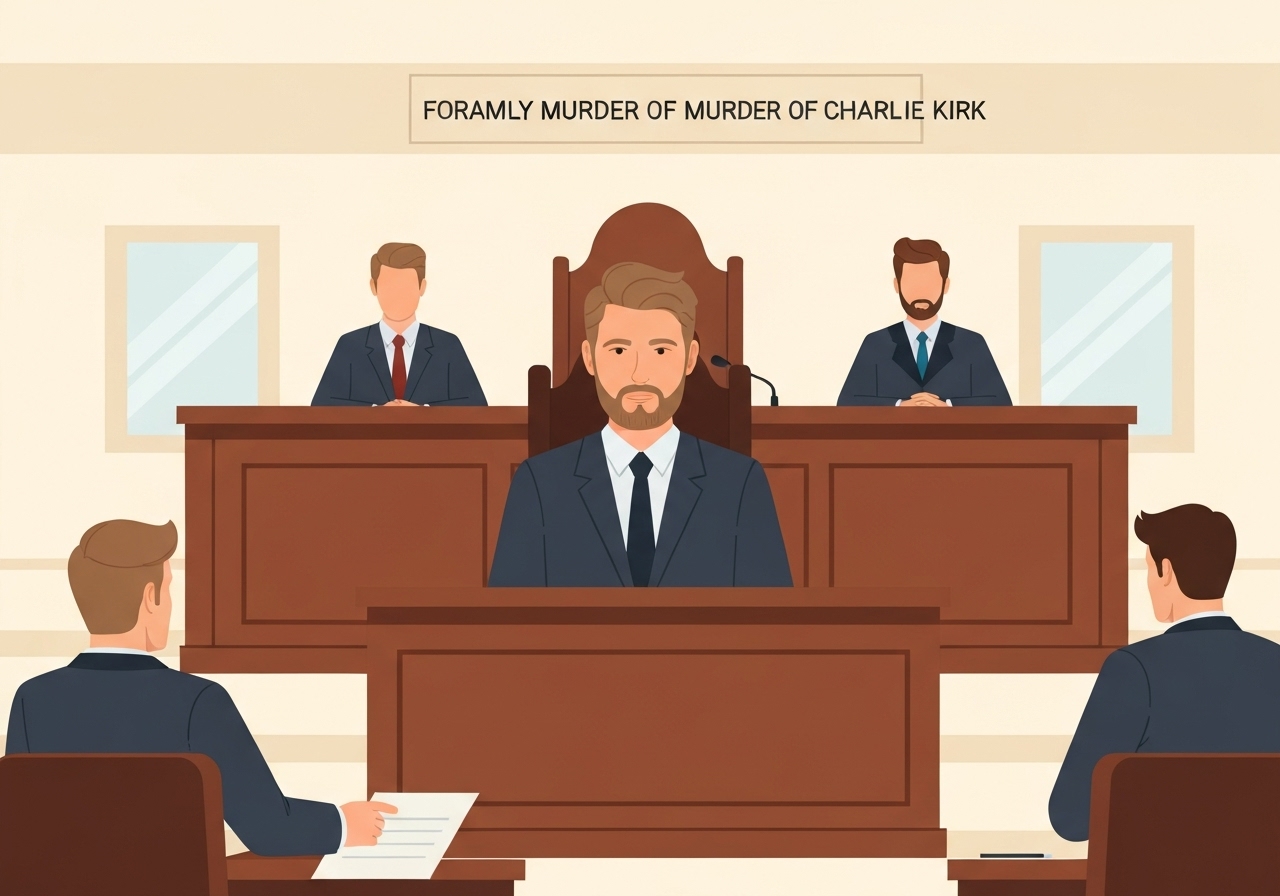
Tyler Robinson, 22, appeared in person at a Provo, Utah, court on Dec. 11, 2025, for the first time since his arrest in the Sept. 10 fatal shooting of conservative activist Charlie Kirk at Utah Valley University. Robinson is charged with seven state counts, including aggravated murder, an offense in Utah that can carry the death penalty; no plea was entered at the hearing. The proceeding focused on what information and records should be made public, and the judge moved portions of the session out of open view. Defense attorneys argued that restrictions are necessary to protect Robinson’s right to a fair trial; the court temporarily closed parts of the hearing while those issues are decided.
Key takeaways
- Defendant: Tyler Robinson, age 22, made an in-person court appearance in Provo, Utah, on Dec. 11, 2025.
- Charges: Robinson faces seven state criminal counts, including aggravated murder, which in Utah is eligible for the death penalty.
- Shooting: Charlie Kirk was shot on Sept. 10, 2025, at Utah Valley University; one bullet was fired from a roof roughly 150 yards from the speaking site.
- Proceeding scope: The hearing was held largely to resolve what records and proceedings can remain public; parts of the session were closed.
- Defense request: Robinson’s lawyers asked the court to limit public access to some documents and proceedings citing concerns about pretrial publicity and fair jury selection.
- Plea status: No plea was entered during the Dec. 11 hearing and the case remains in pretrial motion phase.
- Family presence: Robinson’s parents and a brother were present in court during the appearance.
Background
Charlie Kirk is a conservative activist and a prominent ally of former President Donald Trump; he was speaking at Utah Valley University on Sept. 10, 2025, when he was fatally shot. The attack occurred during a public speaking event on a college campus, intensifying national attention because of Kirk’s profile and the political context. Utah law treats aggravated murder as an especially serious charge, and prosecutors have the option to seek the death penalty in eligible cases, which adds procedural and constitutional layers to pretrial litigation. Public safety, campus security protocols, and the question of how to balance openness against potential prejudice in high-profile cases have become central issues for local officials and courts.
The accused, now in state custody, has been indicted on a menu of charges that state prosecutors say reflect the severity of the offense; defenses in such cases commonly press for restrictions on media access to minimize pretrial contamination of juror pools. Historically, courts weigh the First Amendment value of public proceedings against a defendant’s Sixth Amendment right to an impartial jury, producing varied outcomes depending on specific threats to fairness. Utah Valley University, law enforcement agencies, and local authorities have all faced scrutiny over event security and emergency response after the shooting. The case has instead moved quickly into procedural disputes about disclosure and courtroom access rather than into evidentiary hearings on guilt or motive.
Main event
On Dec. 11, Robinson entered the courtroom wearing a blue shirt, a pastel tie and khaki pants; courtroom video briefly showed him speaking and smiling with his attorneys before parts of the hearing were closed. Attorneys for both sides introduced themselves at the start of the session, and the judge indicated the need to determine what materials — filings, evidence lists, or testimony — should be available to the public. Defense counsel asked the court to limit disclosure and to restrict certain proceedings from public livestreams and records, arguing those steps were necessary to preserve Robinson’s right to a fair trial.
Prosecutors opposed wholesale sealing but acknowledged the court must balance transparency and fairness; the hearing was adjourned in part so the judge could issue rulings on access and redaction. No substantive evidentiary presentations were made at this initial appearance, and Robinson did not enter a plea. The court set further scheduling and pretrial briefing deadlines as lawyers prepared motions on disclosure and other procedural matters. Family members of both the accused and the victim were reported in the courthouse, underscoring the emotional stakes of the proceedings for local communities.
Analysis & implications
The hearing’s focus on public access underscores the tension between open courts and the need to protect a defendant’s right to an impartial jury pool in a case that has drawn national attention. High-profile defendants and victims raise the risk that pretrial publicity — from broadcasted hearings, social media and nationwide news coverage — could influence potential jurors, prompting defense teams to seek tighter controls. If the court grants substantial restrictions, the decision may set a local precedent about how Utah judges handle media in politically charged cases.
Legally, aggravated murder charges and death-penalty eligibility complicate the timeline: prosecutors must navigate additional procedural safeguards, and defense teams frequently deploy a broader set of motions aimed at excluding prejudicial evidence or limiting public disclosure. For prosecutors, assembling forensic evidence that ties a specific shooter to the rooftop position about 150 yards from the speaking site will be central to proving guilt beyond a reasonable doubt. The spatial details — distance, vantage point, and trajectory — will shape expert testimony, ballistic reconstruction and witness credibility assessments in future hearings.
Politically, the case arrives amid heightened concern about targeted violence at public events, and the national profile of the victim increases scrutiny on how law enforcement and campus administrators manage speaker security. A prolonged pretrial phase with repeated motions and sealed materials could extend the period of uncertainty for all parties and may shape national conversations about campus safety, violent rhetoric and the mechanics of protecting public figures without unduly restricting civic discourse. Ultimately, how the court rules on disclosure may influence both local practice and how other jurisdictions handle similar high-profile prosecutions.
Comparison & data
| Date | Event | Key detail |
|---|---|---|
| Shooting at Utah Valley University | Victim: Charlie Kirk; single shot fired from rooftop ~150 yards away | |
| First in-person court appearance | Defendant: Tyler Robinson, age 22; seven state counts, including aggravated murder | |
| Pretrial | Proceedings on disclosure | Hearing partly closed to decide public access to records and livestreams |
The table above distills the public chronology and the procedural posture as of Dec. 11, 2025. At this stage the case is primarily in a motions and scheduling phase rather than in evidentiary trial mode. The 150-yard distance cited by investigators will be a focal point for civilian witness statements and expert reconstructions; it also shapes the logistical challenges for both prosecution (linking evidence to the accused) and defense (challenging those links).
Reactions & quotes
Officials, legal representatives and local stakeholders responded cautioning about both transparency and fairness; the excerpts below capture the positions reported in court filings and public statements, with context provided.
“The defense requested that certain filings and portions of proceedings be shielded from public dissemination to reduce the risk of prejudicing future jurors.”
Defense court filing (as reported)
The note above summarizes the defense’s stated reason for seeking limits on access: the preservation of a fair trial process amid intense publicity.
“We will proceed based on the evidence and applicable law as the court directs.”
Prosecutor’s remarks in court (as reported)
Prosecutors emphasized that the office’s actions would follow evidentiary standards and court rulings while opposing unnecessary secrecy that would hinder public accountability.
“Our immediate concern is the safety and wellbeing of our campus community, and we are cooperating with investigators.”
Utah Valley University (official statement, as reported)
University officials framed their response around campus safety and cooperation with law enforcement while the criminal case proceeds through the courts.
Unconfirmed
- The precise motive for the Sept. 10 shooting has not been established publicly and remains under investigation.
- Details about whether Robinson acted alone or in coordination with others have not been confirmed by prosecutors in open filings.
- Specific forensic links tying Robinson to the rooftop firing position have been referenced by authorities but full evidentiary disclosures have not been made public.
Bottom line
The Dec. 11 appearance marked an early, procedural phase of a case that is likely to remain contentious and closely watched. With aggravated murder charges and death-penalty eligibility on the table, both sides have strong incentives to fight vigorously over how proceedings are conducted and what the public may see. The court’s forthcoming rulings on disclosure will shape the pace and transparency of the pretrial period, with implications for jury selection, evidentiary strategy and broader public debate.
As the case moves from preliminary hearings to formal pretrial motions and, eventually, trial preparations, the central questions will be evidentiary: whether prosecutors can tie the accused to the rooftop shot and whether the defense can introduce reasonable doubt. For observers, the episode highlights how high-profile violence in public forums strains the balance between openness and the protections essential to a just adjudication.
Sources
- The New York Times — media reporting on court appearance and filings