
Lead
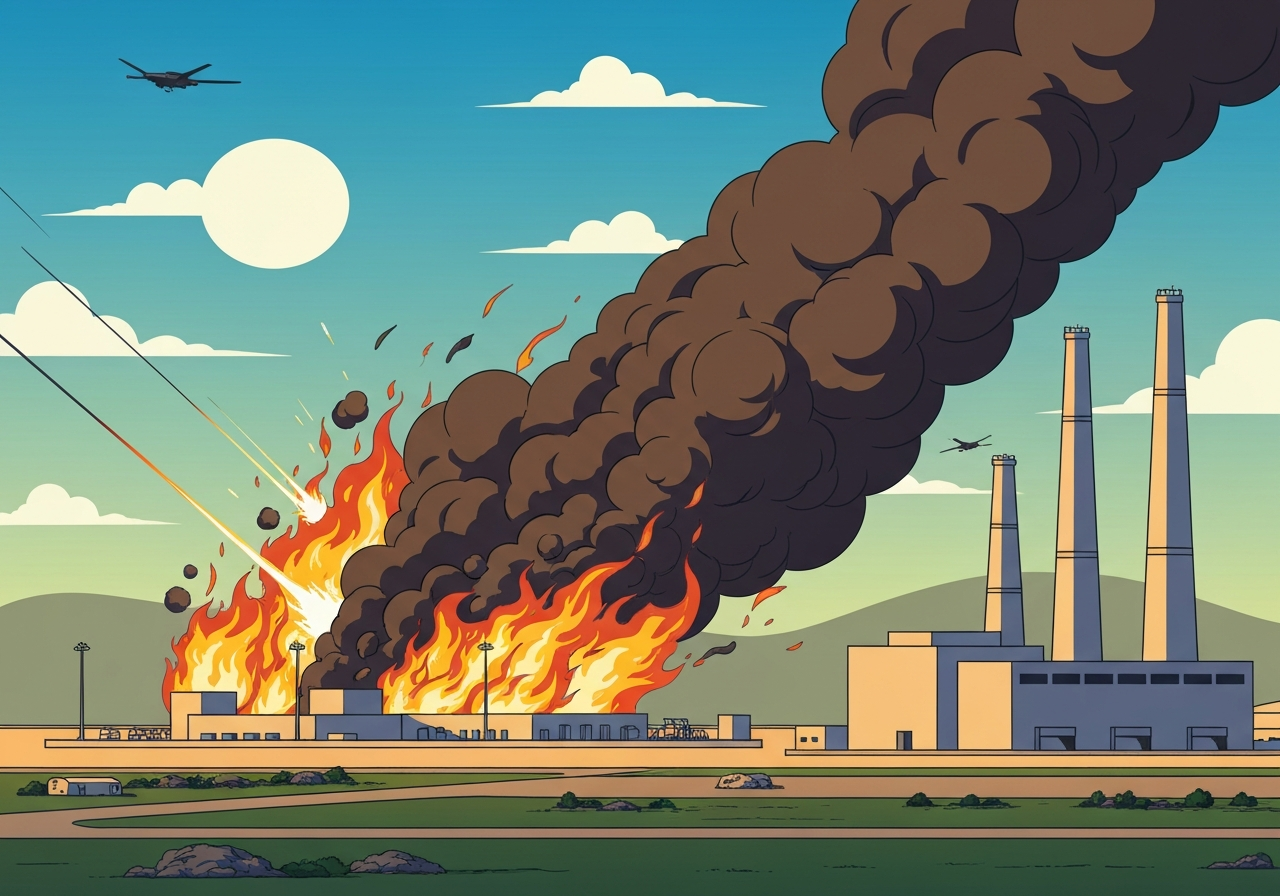
On Sunday a drone strike sparked a fire at the perimeter of the Barakah nuclear power complex in the United Arab Emirates, officials said, with no reported injuries or radiological release. The UAE described the incident as an “unprovoked terrorist attack” and said it intercepted two of three incoming drones. International agencies and the plant operator reported the blaze affected an electrical generator while one reactor briefly ran on emergency diesel. The episode intensified concern about a wider return to open hostilities as the United States and Iran signaled they were prepared to resume military action.
Key Takeaways
- Three drones approached the western UAE border; two were intercepted and one caused a fire at the Barakah site, according to the UAE Defense Ministry.
- Barakah, a four-reactor, $20 billion facility that began operations in 2020, supplies roughly 25% of the UAE’s electricity demand.
- The International Atomic Energy Agency (IAEA) reported a fire in an electrical generator and said one reactor was temporarily supported by emergency diesel generators; no radiological release was detected.
- The UAE said it is investigating the origin of the drones while noting prior drone and missile attacks it has attributed to Iran in the regional conflict.
- US and Israeli officials have discussed possible renewed operations; Iranian officials warned military readiness while domestic media displayed heightened rhetoric.
- This is the first confirmed hit on Barakah during the conflict; earlier 2017 claims by Houthi rebels about targeting the plant were denied by Abu Dhabi.
Background
The Barakah complex — built with South Korean assistance — opened in 2020 and is the Arab world’s only operational nuclear power station. The UAE agreed under a 123 agreement with the United States to forgo indigenous uranium enrichment and spent-fuel reprocessing, distinguishing its civilian program from Iran’s. Regional tensions have risen since a February 28 outbreak of open conflict between Israel and Iran, which has included attacks and counterattacks across the Gulf and Levant. Iran-backed militias and Houthi forces have periodically launched drones and missiles at Gulf Arab states, and the UAE has been part of broader regional security arrangements involving foreign air defenses and personnel.
Strategic chokepoints such as the Strait of Hormuz — vital for global energy flows — have become flashpoints for maritime interdiction and showings of force. The UAE hosts critical energy infrastructure and has cooperated with partners on air defense; nevertheless, the proximity of civilian nuclear facilities raises stakes for both military planners and international regulators. Previous claims of attacks on nuclear facilities in the region, including Iran’s assertions about Bushehr and earlier Houthi statements about Barakah during construction, have heightened sensitivity to any incident near reactors. The current episode therefore carries both immediate operational concerns and broader diplomatic implications.
Main Event
UAE authorities reported that three drones crossed the western border near Saudi Arabia; two were intercepted before reaching their target and one impacted near the Barakah site, producing a localized fire. Plant operators and the UAE nuclear regulator said there were no injuries and no release of radioactive material, and that all reactor units remained in normal operating condition following the response. The IAEA confirmed a blaze in an electrical generator and noted that one reactor was briefly powered by emergency diesel generators while plant systems responded as designed. UAE officials characterized the episode as an unprovoked attack and launched an investigation into the provenance of the drones.
Saudi authorities later said they intercepted three drones that entered from Iraqi airspace, adding a cross-border dimension to the incident. Regional actors have repeatedly exchanged accusations: the UAE has recently accused Iran of launching drone and missile strikes, and Iran and allied Shiite militias have conducted attacks on Gulf Arab states at various points in the conflict. Anwar Gargash, a diplomatic adviser to the UAE president, warned that whether the attack was direct or via proxies it represented a dangerous escalation for the region.
The timing coincided with explicit signals from senior figures in Washington and Tehran about readiness for renewed hostilities. U.S. President Donald Trump posted a message online after a call with Israel’s prime minister suggesting strong contingency options, while Iranian military advisers said armed forces remained prepared even as diplomacy continued. Israel’s leadership likewise stated readiness for any scenario regarding Iran, and reports indicated coordination between U.S. and Israeli officials about possible operations.
Analysis & Implications
A strike near a civilian nuclear facility raises the risk calculus in several ways: operationally it tests plant defenses and emergency procedures; politically it elevates public anxiety; and legally it touches on norms against attacking nuclear installations. Even when there is no radiological release, damage to electrical or cooling infrastructure can create cascading hazards, so regulators and operators treat such incidents with exceptional caution. The IAEA’s confirmation that emergency systems were used suggests the plant’s safety systems functioned, but the episode will likely prompt international scrutiny and calls for a robust, independent review.
Diplomatically, the incident complicates fragile ceasefire dynamics. Both Iran and the United States have signaled military readiness, and Israel has publicly maintained a posture of deterrence. That combination increases the probability of miscalculation: a localized strike or interception could be perceived as deliberate escalation and trigger further reprisals. Regional partners, including the UAE and Saudi Arabia, may intensify security cooperation with external actors to deter attacks, but that in turn can harden lines and reduce space for de-escalatory diplomacy.
Economically, any sustained threat to Gulf energy infrastructure or shipping lanes could reverberate through global markets. While Barakah itself is a power-generation asset rather than a hydrocarbon facility, damage to critical civilian infrastructure in the Gulf tends to amplify risk premiums on oil and gas, affecting trading and investor sentiment. For the UAE, which relies on Barakah for roughly a quarter of its electricity, preservation of the plant’s integrity is central to domestic energy stability and economic planning.
Comparison & Data
| Item | Value |
|---|---|
| Barakah reactors | 4 units |
| Online since | 2020 |
| Estimated construction cost | $20 billion |
| Share of UAE electricity | ~25% |
| Reported drones in incident | 3 (2 intercepted) |
These figures place Barakah as a strategic civilian asset for the UAE. Compared with other recent conflicts where nuclear facilities were threatened — such as reported incidents involving Ukraine and Russia since 2022 — the Barakah episode did not produce radiological consequences, but it joins a pattern of vulnerability for nuclear infrastructure in wartime. Observers will compare the operational response here with prior incidents to judge whether lessons on plant resilience and crisis communication have been learned.
Reactions & Quotes
UAE officials framed the strike as a dangerous escalation and called for accountability. That posture reflects both security concerns and the political imperative to project control after an attack near vital infrastructure.
“Whether carried out by the principal actor or through one of its proxies, this represents a dangerous escalation.”
Anwar Gargash, diplomatic adviser to the UAE president
Gargash’s comment underscores the UAE’s effort to place responsibility on those it sees as fueling regional proxy attacks, while leaving room for international investigation. The statement aims to rally diplomatic support and to justify heightened defensive measures.
U.S. and Iranian statements highlighted readiness rather than immediate intent to strike, an equilibrium that keeps pressure on diplomatic channels but also raises the risk of military encounters. Iranian military advisers emphasized preparedness even as they mentioned ongoing diplomacy.
“Our armed forces’ fingers are on the trigger, while diplomacy is also continuing.”
Mohsen Rezaei, military adviser to Iran’s supreme leader
Rezaei’s remark signals Tehran’s simultaneous posture of deterrence and willingness to engage politically. Such dual messaging complicates assessments about whether public comments are meant to deter, to reassure domestic audiences, or to prepare proxy groups.
Separately, Israeli leaders stressed vigilance and coordination with allies. That stance reflects Israel’s concern about threats from Iranian forces and proxies in the region and aligns with reporting that U.S. and Israeli officials were discussing contingency planning.
“Our eyes are also open… we are prepared for any scenario.”
Benyamin Netanyahu, Prime Minister of Israel
Netanyahu’s concise phrasing is consistent with a deterrent posture intended for both domestic and regional audiences; it also signals close consultation with partners involved in the theater.
Unconfirmed
- Attribution of the strike — while the UAE and others have pointed toward Iranian-backed actors in the past, definitive attribution for this specific drone launch has not been publicly confirmed by independent forensic analysis.
- Claims about the drones’ exact flight origin — Saudi and UAE statements referenced nearby airspace incursions, but open-source flight-path verification has not been released.
- Any direct orders from Tehran to target Barakah — available public statements and state media expressions of support do not constitute verified command-and-control evidence tying the Iranian government to the action.
Bottom Line
The drone impact at Barakah heightened geopolitical and operational concerns without producing radiological harm, but it represents a dangerous escalation in a tense regional conflict. The incident tested emergency systems and prompted an international response from regulators and partners; it will likely drive calls for greater protection around critical civilian infrastructure. Policymakers face a narrow margin: deterrence measures intended to prevent future strikes can simultaneously narrow diplomatic options and increase the odds of miscalculation.
Going forward, independent verification of attribution and a transparent technical review of the plant’s response will be crucial for managing escalation risks. Regional and global actors will need to weigh immediate security postures against the long-term imperative of keeping nuclear facilities insulated from conflict dynamics.