
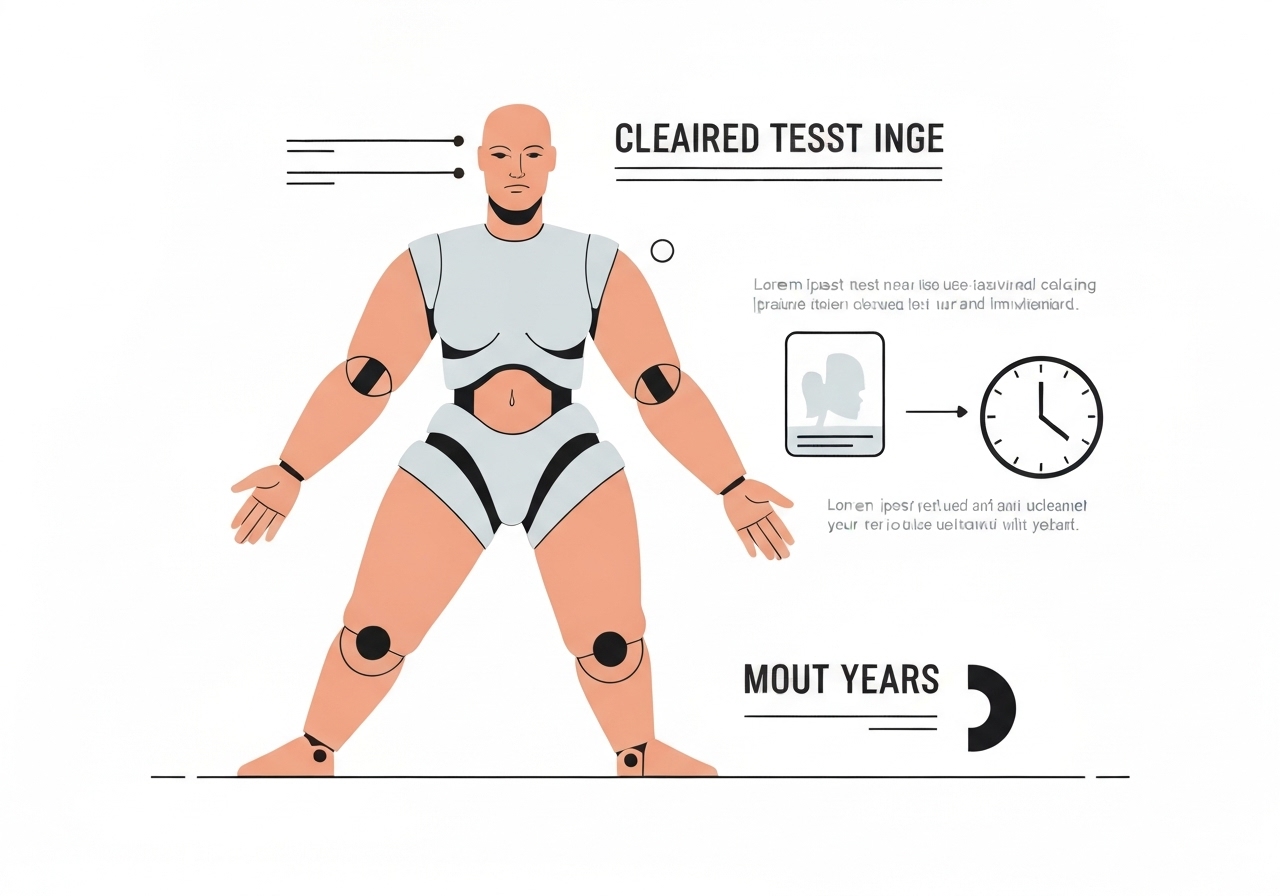
Federal regulators this week released technical specifications for a purpose-built female crash test dummy, a milestone advocates have pressed for decades. The device, known as the THOR-05F and modeled on a 5th-percentile female body, represents a shift from previously scaled-down male replicas. Officials stressed that publication of design documents is an initial regulatory step; formal adoption into federal tests and safety ratings will require further rulemaking and implementation. Industry and safety groups say actual deployment in government crash tests is likely still years away.
Key Takeaways
- The new dummy is the THOR-05F, a 5th-percentile female design meant to represent a very small adult woman and to capture anatomical differences from male models.
- NHTSA and manufacturer Humanetics worked for more than a decade on the design; individual advanced dummies can cost more than $1 million each.
- Earlier female representations were scaled-down male dummies with superficial changes; experts say those do not reflect pelvis, neck, or lower-leg differences.
- The Department of Transportation published technical documents this week but has not yet issued a final rule requiring the dummy in standard crash tests.
- Advocacy groups including Women Drive Too welcomed the step but said specification publication alone will not force real-world use; congressional action may be sought.
- Some safety advocates and researchers criticize the THOR-05F for representing an extremely small female body, not an average or larger female physique.
- European regulators have previously signaled plans to adopt the female THOR design in coming years, showing a patchwork of international adoption timelines.
Background
Calls for better female representation in vehicle safety testing date back decades, with Consumer Reports and other groups tracing public advocacy to the 1980s. Through the early 2000s, U.S. testing protocols added a small ‘‘female’’ dummy that was essentially a scaled-down male model with breasts added, a configuration many experts say failed to reflect true anatomical differences. Beginning in the 2010s, the National Highway Traffic Safety Administration engaged with Humanetics, a leading dummy manufacturer, to develop a purpose-built female test device intended to improve injury prediction for women.
Research has documented that, even when controlling for crash severity and vehicle size, women are more likely than men to suffer certain injuries in crashes, notably to the legs and pelvis. Engineers point to structural differences such as pelvic geometry, neck musculature, and lower-limb proportions as factors that affect how restraints and vehicle structures interact with bodies. The THOR-05F was designed to capture some of those differences, while recognizing it does not represent the full diversity of female body shapes and sizes.
Main Event
This week the Department of Transportation and NHTSA published technical specifications for the THOR-05F, formalizing the design that Humanetics has been developing and testing. The device is described as a 5th-percentile adult female, effectively representing a very small adult woman, and includes anatomical features intended to change how seatbelts and vehicle interiors interact with the body during a crash. NHTSA officials described the documents as an important regulatory milestone but emphasized that publication is not the same as mandating use in crash tests or safety ratings.
Industry representatives said building and deploying the new dummies will be expensive, because advanced anthropomorphic test devices involve complex instrumentation and materials. Humanetics and others have spent more than a decade refining the design through lab testing, sled tests, and early crash work to ensure Data from the device are meaningful. Despite that work, the agency still needs to issue a final rule and integrate the THOR-05F into specific test protocols before the dummy appears in routine federal testing.
Critics of the new design note that a 5th-percentile device captures only one end of the female size spectrum and may not reflect injury patterns for average- or larger-sized women. Some safety researchers argue that complementary approaches such as diverse computer simulations and a wider library of physical dummies will be needed to cover the population range. Advocates counter that without better physical data from dedicated female devices, simulation models will be limited by the inputs available.
Analysis & Implications
Publishing specifications for the THOR-05F addresses a long-standing technical gap in crash testing methodology but leaves open policy and practical questions. Translating a technical design into routine safety tests requires time-consuming regulatory steps including notice-and-comment rulemaking, updates to Federal Motor Vehicle Safety Standards, and revisions to the testing protocols used for consumer-facing safety ratings. Manufacturers, test labs, and automakers will also need to invest in acquiring devices and adapting test fleets and facilities.
Cost will be a central constraint. High-fidelity dummies often exceed $1 million apiece, and integrating multiple sizes and postures into testing matrices multiplies expenses. Smaller manufacturers or independent testing organizations may face financial barriers, potentially slowing broad adoption and concentrating data generation within well-resourced labs and agencies. That concentration could influence which vehicle types and crash modes are prioritized for testing with the new device.
The choice to represent a 5th-percentile female has technical defensibility for capturing certain injury modes, particularly those affecting smaller-bodied occupants, but it also highlights the limits of a single new device. To better protect the full population, regulators and researchers may pursue a mixed strategy: new anthropomorphic devices combined with validated computer simulations that can model bodies across percentiles. However, simulations require robust empirical data for validation, meaning real-world physical testing remains important.
Comparison & Data
| Feature | Scaled Female (early 2000s) | THOR-05F (published) | Typical 50th Male |
|---|---|---|---|
| Basis | Scaled-down male form | Anthropometry of 5th-percentile female | Average adult male dimensions |
| Pelvic geometry | Male shape scaled down | Rounded pelvis modeled for female anatomy | Different belt interaction patterns |
| Development time | Limited | More than 10 years collaboration | Decades of refinement |
| Unit cost | Lower | Often more than $1 million | Varies, often lower per device |
The table summarizes how the new THOR-05F diverges from earlier scaled approaches and from conventional male dummies used as the baseline in many U.S. tests. While the THOR-05F is designed to produce more accurate belt and pelvis interaction data for small female bodies, the device does not by itself resolve gaps relating to average- and larger-sized women. Policymakers will need to weigh the technical benefits against the logistical and financial burdens of adding more physical devices to the test matrix.
Reactions & Quotes
The development drew measured praise from regulators and tempered response from advocates wanting faster action.
The pelvis for a female is more rounded and does not hold the seatbelt the same way.
Chris O’Connor, CEO of Humanetics
Humanetics framed the device as an engineering improvement that changes how restraint loads and structural contacts are measured and interpreted for small female bodies.
This is a long overdue step toward the full adoption of this new dummy for use in our safety ratings and Federal Motor Vehicle Safety Standards.
Jonathan Morrison, NHTSA administrator
NHTSA emphasized that specification publication is an initial milestone and that further administrative steps remain before the dummy is mandated in federal tests.
We applaud this action, but by itself, it won’t be enough.
Women Drive Too, advocacy coalition
Advocacy groups reiterated calls for legislative or regulatory requirements to ensure the THOR-05F is actually used in crash testing rather than remaining a documented specification.
Unconfirmed
- Exact timeline for a final NHTSA rule to require THOR-05F in federal tests remains uncertain and has not been published.
- The total nationwide cost to retrofit government and private test fleets with THOR-05F devices is estimated but not publicly verified.
- Whether Congress will pass legislation to mandate the use of female dummies in federal testing is unresolved and depends on future political action.
Bottom Line
The publication of technical specifications for the THOR-05F is an important technical milestone that acknowledges long-standing gaps in how vehicle safety has been measured for female occupants. However, specification documents alone do not change testing practice; the agency must complete rulemaking, testing protocols must be revised, and manufacturers and labs must invest in devices and training.
For consumers, the change offers potential for safer vehicles over the medium term, especially for smaller women, but broad population protection will require additional devices or validated simulation approaches to capture average and larger body sizes. Policymakers and advocacy groups face a choice: accelerate adoption through regulation and funding or allow a slower, incremental transition that could leave gaps in real-world protection for years.
Sources
- NPR (news report summarizing the DOT announcement and public reaction)
- National Highway Traffic Safety Administration (NHTSA) (federal agency, official regulatory body)
- Humanetics (manufacturer, industry source)