
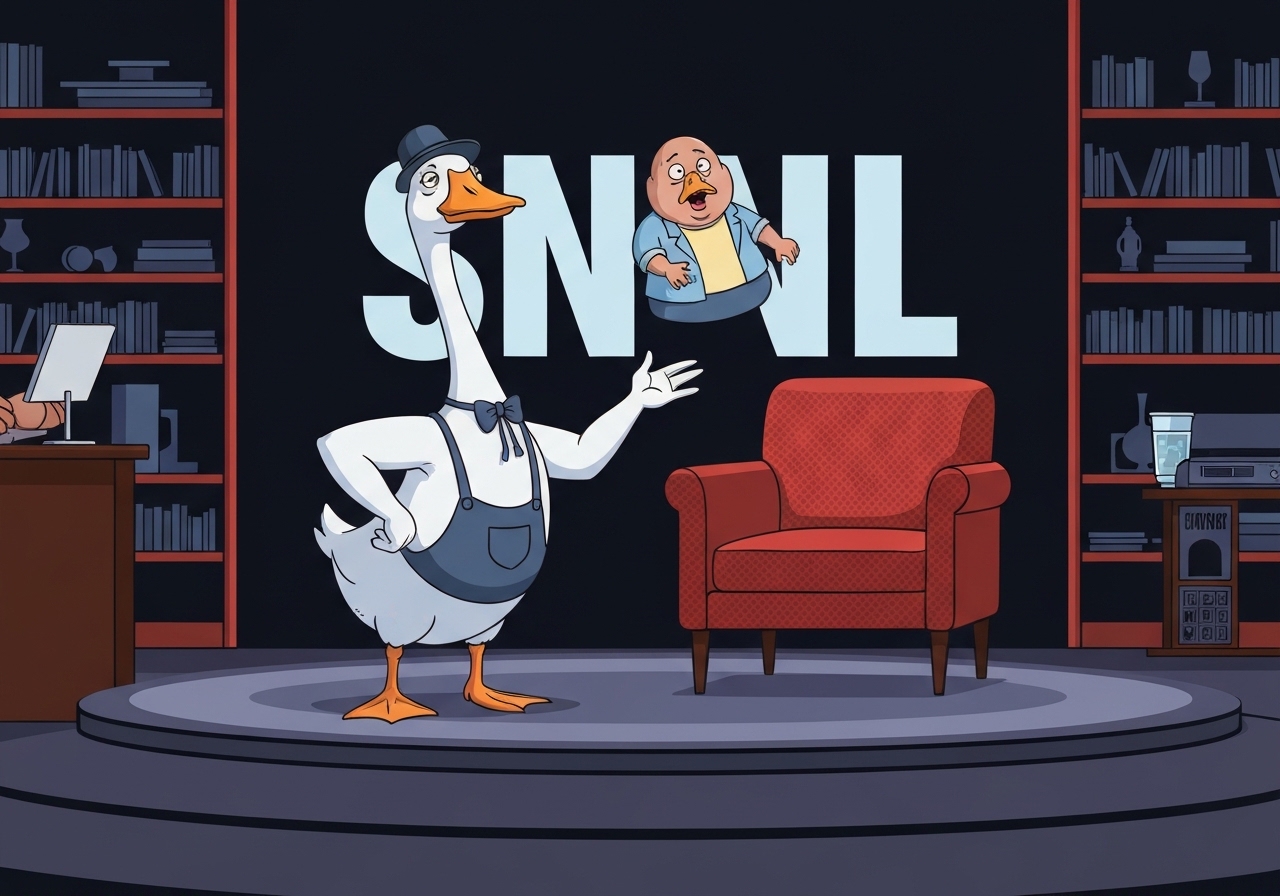
Lead: On Jan. 25, 2026, Brooklyn quartet Geese made their network television debut on Saturday Night Live, performing two tracks from their 2025 album Getting Killed. The appearance — on an episode hosted by Teyana Taylor — put the band’s off-kilter aesthetic before a mass audience and prompted sharply divided reactions in real time. One performance emphasized delicate, glacial dynamics while the other leaned into the group’s more aggressive textures, offering two distinct portraits of a band already central to 2020s rock conversations.
Key Takeaways
- Geese performed on Saturday Night Live on Jan. 25, 2026, appearing on an episode hosted by actress Teyana Taylor.
- The group played two songs from Getting Killed, the band’s 2025 album that followed releases in 2021 and 2023.
- Frontman Cameron Winter’s solo record Heavy Metal helped raise the profile of Geese ahead of their S.N.L. debut.
- One televised number, the ballad ‘Au Pays du Cocaine,’ highlighted Emily Green’s luminous guitar and Winter’s idiosyncratic vocal delivery.
- Reactions were polarized: some viewers praised the ambition, others found the set confounding; the performances generated significant online discussion.
- S.N.L. remains one of the few remaining network platforms for emerging bands to reach broad, nonstreaming audiences.
- Industry observers see the appearance as a milestone for Geese but differ on whether it will translate into mainstream breakout status.
Background
Geese formed in Brooklyn and rose through a mix of critical buzz and fervent fan discussion. The band’s first two albums, released in 2021 and 2023, built a reputation for restless songcraft; those records laid the groundwork for Getting Killed, their 2025 release that polarized listeners and critics alike. Cameron Winter, the group’s frontman, also issued a solo album titled Heavy Metal, whose unusual tone and lyrical oddities contributed to the wider attention on Geese.
Across the early 2020s, the music industry’s pathways to mass audiences narrowed as streaming algorithms and celebrity-driven platforms concentrated attention. Landmark network stages — late-night shows and variety programs — have become less accessible for emerging acts, making a Saturday Night Live slot particularly consequential. For bands like Geese, S.N.L. can reach viewers who might not encounter them on playlists or social feeds, compressing a year’s worth of exposure into a single performance night.
Main Event
On the Jan. 25 episode, Geese opened with a slow, shimmering rendition of ‘Au Pays du Cocaine.’ The arrangement emphasized restraint: Emily Green’s guitar chimed above minimal accompaniment while Winter’s voice unfolded in an unhurried, idiosyncratic cadence. The staging and pacing created a quiet focal point on network television, a contrast to the high-energy acts that typically dominate late-night slots.
The second set shifted tone and dynamic. The band delivered a more forceful, chaotic selection from Getting Killed that foregrounded driving rhythms and a denser sonic mass. Back-to-back, the two performances presented the band as unusually versatile — able to inhabit both austere balladry and abrasive rock intensity within a single broadcast window. The contrast generated immediate chatter among viewers and critics about which side of the band would stick with mainstream audiences.
Throughout the night, on-screen camera choices and mixing decisions influenced how the performances read to a broad audience. The quieter number required tight audio balance to carry Winter’s muttered lines and the guitar’s shimmering textures; the louder piece relied on frenetic stage energy to translate the album’s intensity. Producers’ staging decisions, combined with the band’s deliberate aesthetic, produced moments that some described as confounding and others as audacious.
Analysis & Implications
Geese’s S.N.L. appearance crystallizes a central tension for contemporary rock acts: how to translate niche critical acclaim into broader cultural traction. Getting Killed arrived in 2025 to both strong praise and vocal detractors; the S.N.L. slot exposes those divides to a mainstream audience where context is thin and first impressions matter. For a band whose appeal partly depends on cultivated mystique and gradual discovery, performing in a high-visibility, interruption-driven environment presents risks as well as rewards.
From an industry standpoint, the performance underscores the shrinking number of network-stage opportunities for emerging bands. With late-night and variety programming in flux, each remaining national appearance carries outsized potential to shape career arcs. If Geese converts a meaningful fraction of the S.N.L. audience into sustained listeners, the band could secure festival slots, radio attention, and playlist placement that compound over a year.
Artistically, the twin performances reinforced the band’s stylistic breadth. The delicate, melodic delivery of ‘Au Pays du Cocaine’ highlighted songwriting subtleties that can win over skeptical listeners when they have time to absorb nuance. Conversely, the more abrasive set dramatized Geese’s claim to rock urgency. How the market responds will depend on which image listeners adopt: a contemplative, songwriter-led act or a confrontational rock collective.
Comparison & Data
| Release | Year | Notable Signal |
|---|---|---|
| Debut album | 2021 | Initial critical attention |
| Second album | 2023 | Growing fan conversation |
| Getting Killed | 2025 | Breakthrough profile; polarized response |
The table above places Getting Killed in the context of Geese’s recent output and public trajectory. While exact streaming totals and sales figures are not publicly disclosed here, the sequence of releases and the high-profile S.N.L. appearance indicate an upward inflection in visibility. Industry observers will watch subsequent booking patterns, playlist adds, and festival lineups to judge whether the band’s momentum is enduring.
Reactions & Quotes
‘We wanted to present the songs in their truest forms for a large audience,’ a band representative said in a brief statement following the broadcast.
Band statement (official)
‘Seeing a group like Geese on a platform this big underscores how few opportunities remain for emerging acts outside streaming,’ a music industry analyst observed, noting the performance’s symbolic weight.
Industry analyst (comment)
‘The two sets felt like two different introductions to the band — one intimate, one confrontational,’ a critic wrote in a follow-up review summarizing the episode’s musical guests.
Music critic (press)
Unconfirmed
- Whether the S.N.L. appearance will produce sustained mainstream growth for Geese is not yet confirmed and depends on post-show metrics and bookings.
- Precise streaming increases, sales bumps, or radio adds directly attributable to the Jan. 25 broadcast have not been publicly released at the time of publication.
Bottom Line
Geese’s S.N.L. debut was less a tidy breakthrough than a public demonstration of the band’s contradictions: literate, theatrical, and deliberately vexing. By presenting two stylistically distinct sets, they gave mass audiences two competing entry points, which will shape how new listeners choose to engage. For fans and detractors alike, the moment crystallizes an important phase in the band’s ascent.
Looking ahead, the crucial measures will be downstream: festival bookings, playlist placements, media coverage cadence, and whether fans who discovered the band on S.N.L. stick around. In an era of few common cultural stages, the appearance matters — but it alone will not determine the band’s long-term standing.
Sources
- The New York Times (news reporting) — review and coverage of Geese’s S.N.L. appearance, Jan. 25, 2026.
- Saturday Night Live (NBC) (official program page) — show information and episode listings for S.N.L.