
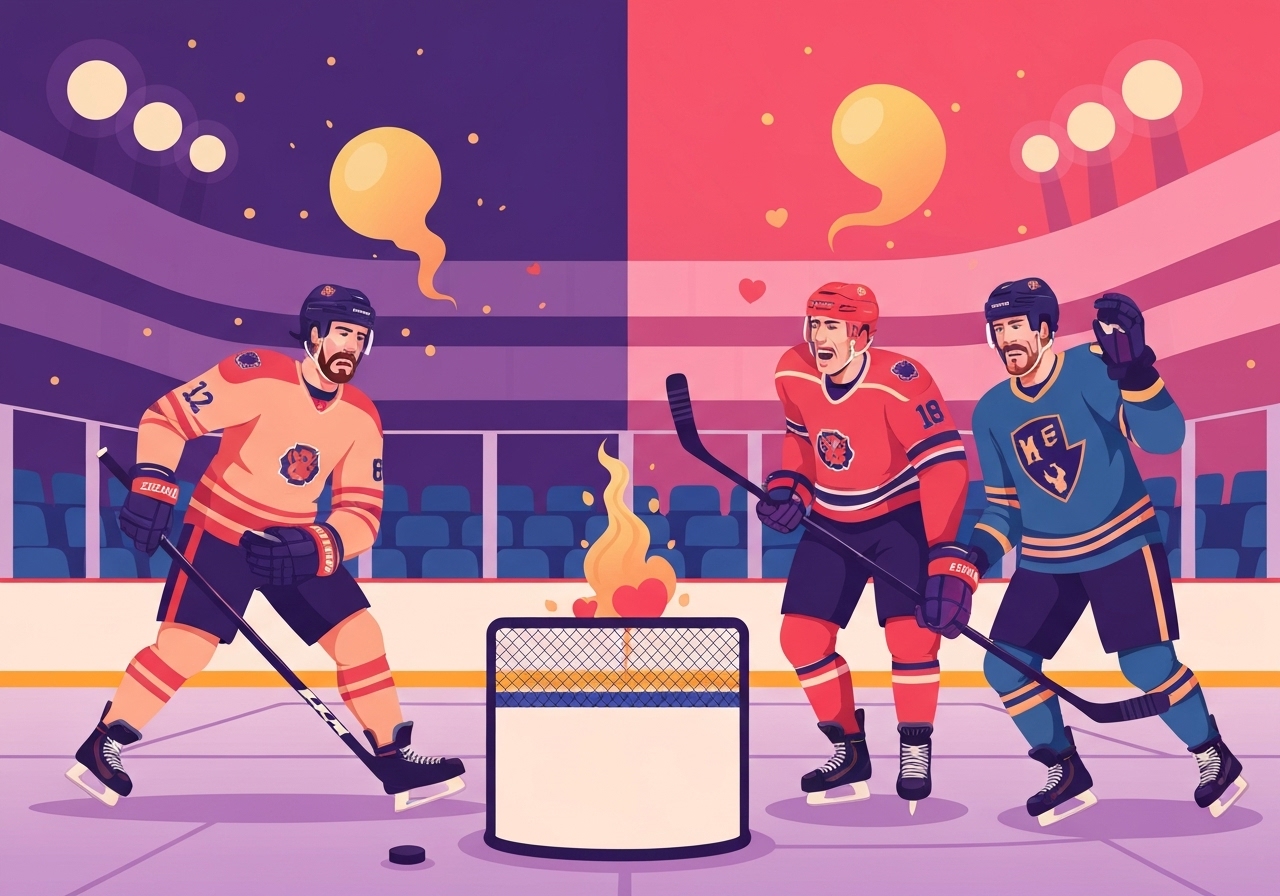
Lead: Since its Thanksgiving-weekend debut, the television adaptation of Rachel Reid’s Game Changers novels, Heated Rivalry, has become a breakout hit. The series, developed and directed by Jacob Tierney, follows Canadian Shane Hollander and Russian Ilya Rozanov through a decade-long secret relationship that blends slow-burn emotion with explicit scenes. Originally produced for Crave and picked up by HBO, the show climbed to No. 1 on HBO Max as its first season approached the finale on Friday, and it has already been renewed for a second season. Fans and creators say the program’s mix of authentic hockey detail, queer joy and carefully cast leads helped drive its rapid growth.
Key Takeaways
- Heated Rivalry premiered over Thanksgiving weekend and quickly rose to the No. 1 series on HBO Max as the season approached its Friday finale.
- The show adapts Rachel Reid’s Game Changers novels (first published 2018); the six-book series has sold about 650,000 copies, per publisher Harlequin.
- Jacob Tierney developed, wrote and directed the TV version and cited the project’s “pure queer joy” as a core attraction.
- The central relationship follows Canadian Shane Hollander and Russian Ilya Rozanov across a secret, decade-long romance that mixes slow-building yearning with explicit scenes.
- Heated Rivalry was originally developed for Crave, landed a distribution deal with HBO, and has been renewed for season two.
- Fans and critics credit leads Connor Storrie and Hudson Williams for chemistry that anchors emotional beats beyond the show’s erotic content.
- The series has boosted interest in hockey-themed romance and queer sports fiction, drawing attention to diversity gaps in a genre historically dominated by straight, white characters.
Background
Sports romance—especially hockey-centered stories—has been growing as a subgenre of romance fiction. Writers and editors say readers are attracted when the sports setting feels authentic rather than a superficial backdrop; that authenticity is frequently cited as central to engagement. Rachel Reid’s Game Changers books, which began in 2018, are notable within that niche for foregrounding queer relationships inside hockey culture. Harlequin reports roughly 650,000 cumulative sales for Reid’s six-title series, underscoring a substantial readership for this specific angle.
Television interest in romance properties has increased as streaming platforms seek built-in audiences; Heated Rivalry began life as a Crave project in Canada before attracting HBO’s attention and a broader distribution deal. The creative team positioned the adaptation as intentionally romantic and explicit, prioritizing a happy ending and emotional depth. Casting choices—particularly finding actors who matched the characters’ backgrounds and chemistry—were central to the producers’ strategy, aimed at retaining core readers while expanding mainstream viewership.
Main Event
The adaptation tracks the clandestine relationship between Shane Hollander, a Canadian player, and Ilya Rozanov, a Russian counterpart, spanning about a decade. Episodes interleave the couple’s slow-burning emotional connection with on-ice action and sexual intimacy, mirroring the tone of the novels. Jacob Tierney, who led writing and direction, has said he was drawn by the series’ celebration of queer love and by the challenge of translating explicit romance to television with care.
After premiering over Thanksgiving weekend, audience response amplified across social platforms; clips, reaction videos and fan discussions helped push the series into HBO Max’s top ranking. The show’s creators and the novel’s author, Rachel Reid, pointed to casting as decisive: Connor Storrie and Hudson Williams were chosen after chemistry reads that convinced producers they embodied Shane and Ilya. Reid praised the performances and the attention to keeping Shane’s Asian heritage in the casting to preserve diversity from the books.
Beyond casting and performance, the series revived sales and interest in the source material and the broader hockey-romance niche. Retailers and small bookstores that specialize in romance reported increased queries for queer sports titles. The Ripped Bodice, a romance-focused bookstore, highlighted the commercial signal sent when Hollywood adapts and treats romance properties with respect, arguing it raises awareness of both cultural demand and buying power among romance readers.
Analysis & Implications
Heated Rivalry’s success foregrounds several industry dynamics: streaming platforms’ appetite for niche but fervent fandoms; the cultural visibility potential of well-executed queer stories; and the commercial payoff of faithful adaptations. For publishers and showrunners, the series demonstrates that keeping core elements—authentic sport detail, character identity and emotional stakes—helps retain book readers while persuading new viewers. That balance is often the difference between a fleeting trend and sustainable franchise potential.
Representation-wise, the show’s prominence pressures an industry where sports narratives have largely centered on straight, white protagonists. By featuring a lead character of Asian descent and a male-on-male romance, Heated Rivalry challenges genre conventions and expands the type of heroic narratives visible in sports entertainment. However, systemic change requires more than one high-profile title; production pipelines, agenting, and commissioning editors must follow with sustained interest in diverse projects.
Economically, the series could prompt publishers to reassess the market for queer sports romances. Harlequin’s sales figures (about 650,000 copies for Reid’s six-book arc) already indicate strong consumer demand in print; streaming exposure amplifies that effect through broader discovery. Still, industry observers caution that one hit does not guarantee a flood of similar mainstream adaptations—the conversion of fandom energy to production greenlights depends on risk appetite and perceived longevity.
Comparison & Data
| Item | Figure |
|---|---|
| Game Changers series sales (total) | ~650,000 copies |
| Origin | Crave development; HBO distribution |
| Streaming rank | No. 1 on HBO Max (as season neared finale) |
The table condenses the headline statistics: book sales reported by Harlequin, the show’s route from Crave to HBO, and its peak ranking on HBO Max. Those data points illustrate a feedback loop—strong book sales supported interest in a screen adaptation, and streaming prominence in turn boosts publishing and retail activity. The magnitude of commercial ripple effects will depend on season-two performance and whether other properties receive similar platform support.
Reactions & Quotes
“Unashamedly, when pitching, it was just like, this is a Harlequin romance. This has a happy ending.”
Jacob Tierney (developer/writer/director)
Tierney framed the adaptation as a faithful, celebratory romance that places queer joy at its center. The remark underlines the producers’ intent to keep the tone and promise of the source material intact.
“If I built the perfect actors in a lab, I could not have built better people to play these characters.”
Rachel Reid (author)
Reid’s reaction highlights the author’s satisfaction with casting choices; she and fans have pointed to nuanced performances—especially of Shane—as a key emotional driver beyond the series’ erotic content.
“Anytime Hollywood pays attention to, and respects, romance fans, they notice and show their appreciation.”
Leah Koch (co-owner, The Ripped Bodice, independent bookstore)
Koch’s comment links industry respect for romance audiences to measurable commercial and cultural recognition and frames the adaptation as a potential milestone for readers often overlooked by mainstream media.
Unconfirmed
- Exact HBO Max viewership numbers for Heated Rivalry have not been publicly released; platform ranking is confirmed but granular audience metrics are not.
- Whether the series’ success will prompt a sustained increase in mainstream TV adaptations of queer sports romance is uncertain and depends on commissioning and platform strategies.
- The release date and production timeline for season two have not been formally announced beyond the renewal confirmation.
Bottom Line
Heated Rivalry is more than a streaming curiosity: it is a case study in how faithful adaptations, intentional casting and genre authenticity can convert an existing readership into a broad, vocal viewing audience. The show’s climb to the top of HBO Max charts and the renewed interest in Rachel Reid’s books demonstrate a market for queer sports romance that industry players are unlikely to ignore.
That said, a single breakout does not automatically transform industry norms. For long-term change—more diverse leads, more queer-centered sports narratives and more screen adaptations—publishers, agents, streamers and producers must repeatedly invest in similar projects. For now, Heated Rivalry has opened a visible door; whether the entertainment and publishing industries walk through it remains to be confirmed.
Sources
- AP News (news organization; original report)
- Harlequin (publisher; sales data and author page)
- Crave (streaming service; original developer)
- The Ripped Bodice (independent bookstore; commentary from co-owner)
- HBO Max (streaming platform; distribution partner)