
Lead
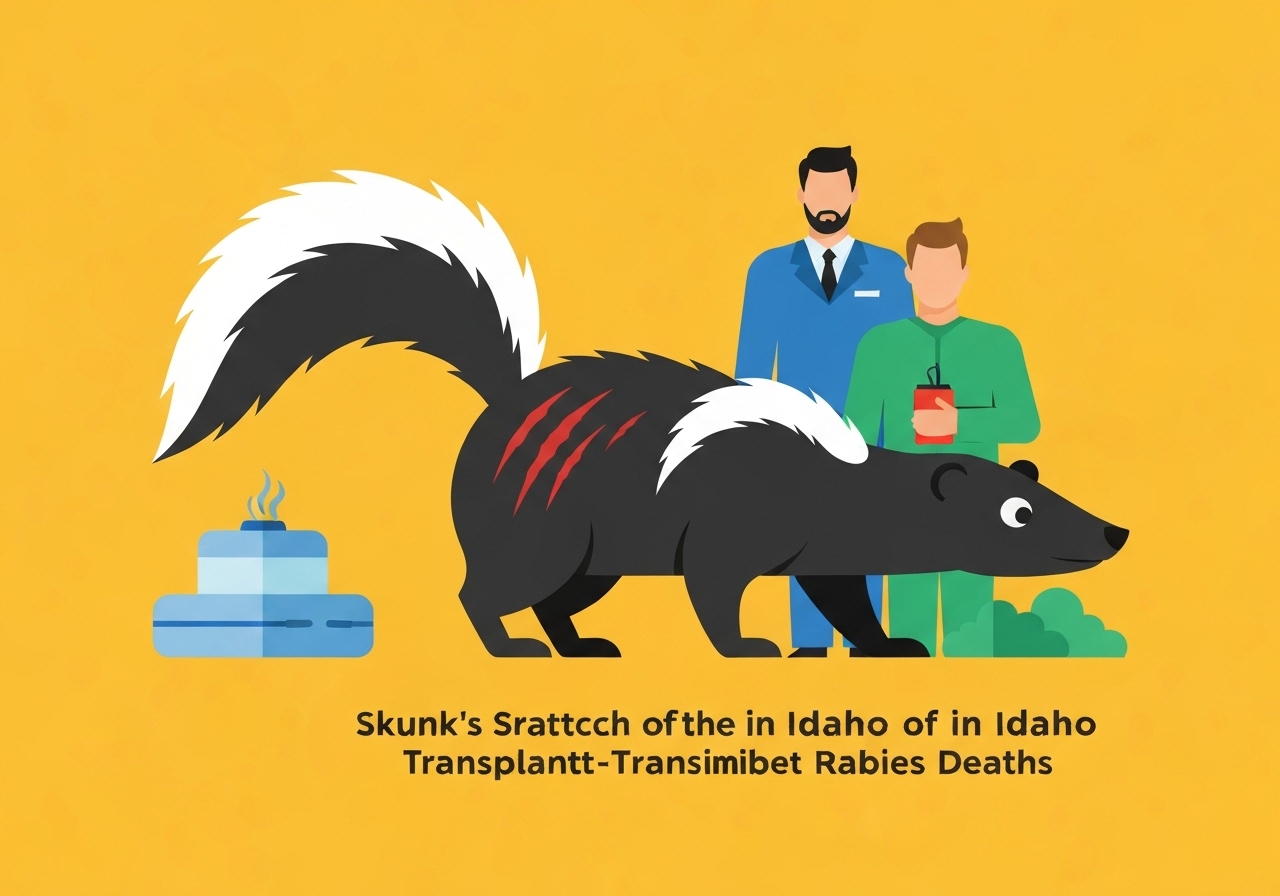
Late October 2024, a skunk scratch on a man in rural Idaho set off an uncommon and fatal chain of events that federal investigators say ultimately killed the original donor and a kidney transplant recipient in Michigan. The donor deteriorated over roughly six weeks with confusion, difficulty swallowing and walking, and hallucinations before dying; organs and corneas were recovered and distributed in December 2024–January 2025. The Centers for Disease Control and Prevention (CDC) now says the case likely represents the fourth transplant-transmitted rabies event in the United States since 1978 and has traced a probable transmission sequence from a bat to a skunk to the donor and then to the kidney recipient.
Key takeaways
- The incident likely represents the fourth U.S. transplant-transmitted rabies event since 1978, according to the CDC.
- Late October 2024: a skunk scratched the Idaho donor while he held a kitten on his rural property; the donor died about six weeks later.
- December 2024: the donor’s left kidney was transplanted to a Michigan man at an Ohio hospital; the recipient died about six weeks after transplant.
- Rabies virus RNA was detected in the deceased recipient’s saliva, nuchal skin, and brain tissue, per CDC testing.
- Donor corneas were distributed to three patients (California, Idaho, New Mexico); those three corneal grafts were later removed as a precaution and the fourth planned corneal transplant was canceled.
- The three cornea recipients were reported by officials to be asymptomatic at the time of the CDC report.
- Investigators identified details about the skunk scratch during follow-up interviews not captured in the initial donor risk assessment interview (DRAI).
Background
Rabies in the United States is rare in people but remains deadly when it occurs. The virus is most often associated with bats, raccoons, skunks and foxes; human cases typically follow direct exposure such as a bite or scratch and progress to fatal encephalitis if untreated. Because organ and tissue transplantation can transmit infectious agents, U.S. organ procurement organizations use the Donor Risk Assessment Interview (DRAI) and medical record review to screen donors for recent exposures or unexplained neurologic illness.
Even with screening, transplant-transmitted infections are possible because some pathogens have atypical presentations or long incubation periods. Corneal and solid-organ recipients are immunosuppressed and particularly vulnerable to donor-derived infections. When a donor dies from a rapidly progressive neurologic illness, public health authorities routinely investigate and may recommend precautionary measures to recipients and transplant centers.
Main event
According to federal investigators, in late October 2024 a skunk approached the Idaho donor while he held a kitten in an outbuilding on his rural property; the animal scratch was not initially captured in the DRAI. The donor developed progressive neurologic signs over roughly six weeks—confusion, trouble swallowing and walking, and hallucinations—and died after that clinical course. Corneas were recovered from the donor in December 2024 and distributed to three patients in California, Idaho and New Mexico; a fourth planned corneal transplant to a Missouri patient was canceled.
In December 2024 a Michigan man received the donor’s left kidney at an Ohio hospital. About six weeks after his transplant, the kidney recipient died; subsequent laboratory testing detected rabies virus RNA in saliva, nuchal skin and brain tissue samples from that recipient. The pattern of findings led CDC investigators to propose a likely multi-step transmission chain beginning with a rabid silver-haired bat infecting a skunk, that skunk infecting the Idaho donor, and the donor’s transplanted kidney then transmitting infection to the Michigan recipient.
As investigators continued work to identify exposed patients and mitigate further risk, the three cornea recipients underwent precautionary graft removal; officials reported they were asymptomatic at the time of the report. Public health teams coordinated with transplant centers across multiple states to notify recipients and to assess the need for testing, treatment or additional procedures.
Analysis & implications
This event highlights a persistent tension in transplantation: the urgent need for organs versus the low-probability but catastrophic risk of donor-derived infections. Organ screening relies heavily on interviews and documented medical history; exposures that occur in informal settings, or that are not recognized by families as relevant, can be missed. The revelation of the skunk scratch in follow-up interviews underscores how initial questionnaires can fail to capture key exposure details.
For transplant medicine, the case is likely to prompt renewed review of donor screening practices, especially when donors have recent unexplained neurologic decline. Options under discussion among clinicians and public-health officials typically include enhanced lab testing for donors with atypical encephalitis, more rigorous family interviews, and expedited specimen collection for unusual deaths. None of these measures is cost- or time-free, and each must be balanced against the urgent demand for organs.
Clinically, rabies remains almost invariably fatal after neurologic symptoms appear, so prevention through timely recognition and post-exposure prophylaxis (PEP) is critical. In the transplant context, rapid identification of a donor with possible rabies can trigger PEP or other interventions for recipients and health-care workers. At the health-system level, this incident may increase emphasis on cross-jurisdiction communication and standardized protocols for suspect donor infections across organ procurement organizations and transplant centers.
Comparison & data
| Metric | Data |
|---|---|
| U.S. transplant-transmitted rabies events (since 1978) | Believed to be 4 events |
| This incident timeline | Late Oct 2024: skunk scratch → Dec 2024: transplant → ~6 weeks later: recipient death |
Transplant-transmitted rabies is exceptionally uncommon in the U.S.; the CDC characterizes this as likely the fourth documented event since 1978. The table above situates this case in that sparse historical record and summarizes the operational timeline investigators compiled. Because the absolute count of events is low, single cases receive outsized attention and can influence policy changes disproportionate to frequency—particularly when standard screening tools miss a key exposure.
Reactions & quotes
“Investigation suggested a likely three-step transmission chain” from bat to skunk to donor to recipient, the CDC reported.
CDC (federal public health agency)
Officials noted that details about the skunk scratch emerged only during follow-up interviews and were not captured on the initial donor risk assessment.
State public health investigators (agency statement)
Public health and transplant officials emphasized coordinated notification of recipients and clinical teams across multiple states to manage potential exposures and to remove at-risk corneal grafts as a precautionary step.
Unconfirmed
- While CDC investigators describe a likely bat-to-skunk-to-donor chain, direct laboratory proof that a bat infected the skunk has not been published in the public report.
- It remains unconfirmed whether any other organ recipients besides the known kidney recipient were infected; ongoing investigations could modify case counts.
- The precise timing of the skunk’s infection and the donor’s exposure window are based on interviews and clinical timelines and could be refined by further testing.
Bottom line
This rare incident demonstrates how zoonotic exposures in informal rural settings can escape routine donor screening and lead to donor-derived infections with grave consequences. Although transplant-transmitted rabies is exceedingly uncommon, its lethality means any suspected donor case triggers wide-reaching public health actions, including recipient notification, precautionary graft removal, and multi-state coordination.
Expect renewed scrutiny of donor screening protocols, faster pathways for testing unexplained encephalitis in donors, and renewed messaging to families about reporting any wildlife contacts or unexplained animal exposures. Clinicians and transplant programs should watch for CDC updates and local public-health advisories as investigators complete laboratory analyses and refine recommendations.
Sources
- NBC News — news reporting summarizing CDC findings and interviews.
- Centers for Disease Control and Prevention (CDC) — official public health resource on rabies and related investigations.