
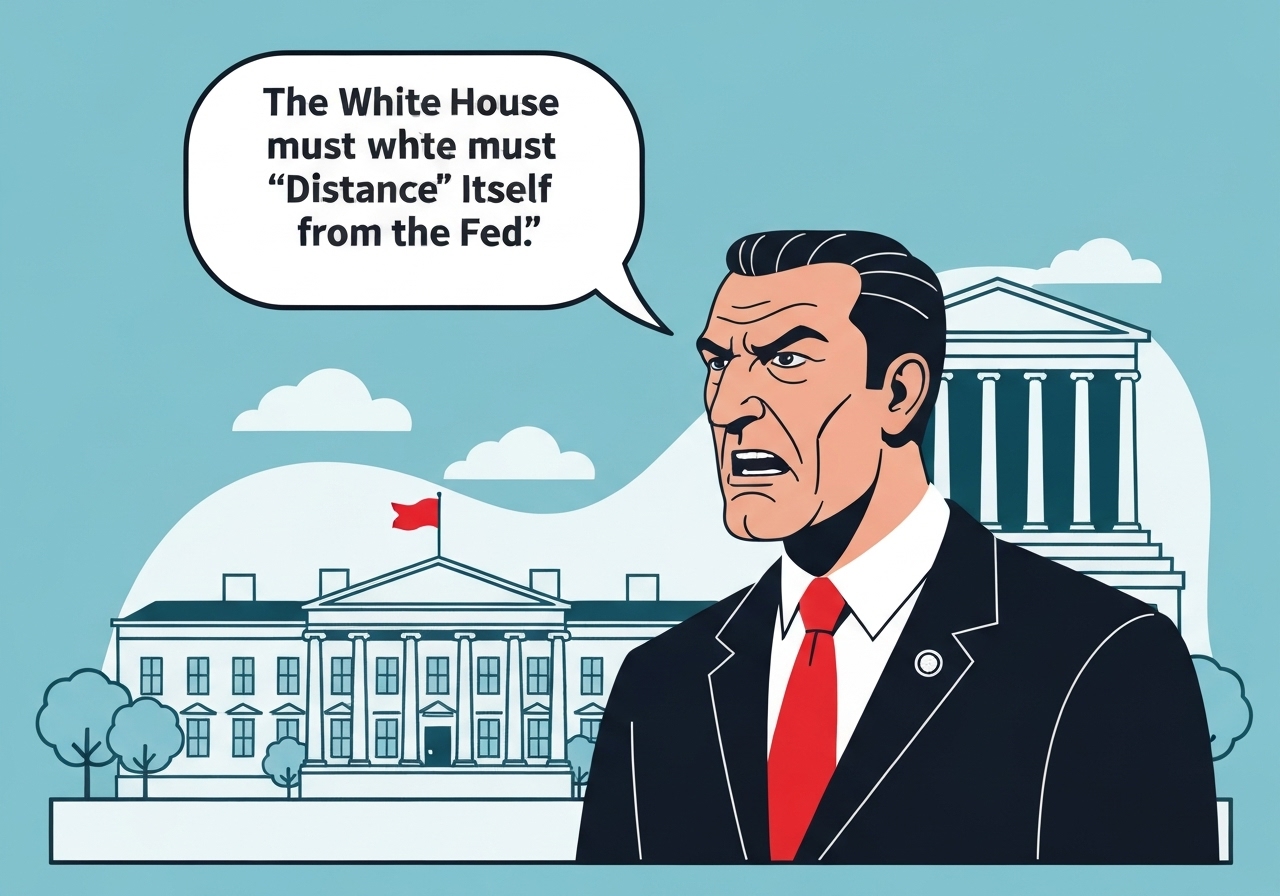
Ken Griffin, founder and chief executive of Citadel, told the Financial Times that the White House should publicly distance itself from the Federal Reserve to safeguard the central bank’s independence and market confidence. The remarks, made in an interview with the FT, prompted renewed debate about the boundaries between political actors and monetary authorities. Griffin framed the call as a defence of institutional credibility rather than partisan criticism. The comments have drawn attention from market participants and policy watchers concerned about potential political pressure on monetary policy.
Key takeaways
- Ken Griffin, Citadel founder and CEO, urged the White House to distance itself from the Federal Reserve in remarks to the Financial Times.
- The intervention argues that perceived White House influence could undermine the Fed’s independence and investor confidence in policy-making.
- Griffin positioned his appeal as protecting institutions rather than supporting a political faction, framing independence as essential for stable markets.
- Market observers noted the statement amid ongoing scrutiny of central-bank communication and fiscal-policy coordination.
- No formal response from the White House was available at the time of reporting; the Fed reiterated its institutional independence in past public statements.
Background
The debate over the line between elected officials and central bankers has intensified in recent years as inflation, interest-rate decisions and fiscal measures have placed monetary policy in the public spotlight. Central banks traditionally maintain operational independence to insulate technical interest-rate and financial-stability decisions from short-term political pressures. High-profile interventions or public comments from political leaders can fuel market volatility if investors judge policy to be politicised.
Private-sector voices have occasionally pressed for clearer demarcation. Large market participants, hedge funds and institutional investors rely on predictable central-bank behaviour to price risk and allocate capital. When senior market figures—such as heads of major trading firms—call for a clearer separation, it typically reflects concern about transparency, credibility and the contours of institutional accountability.
Main event
In the interview with the Financial Times, Griffin said the White House should make a visible effort to separate its rhetoric and actions from the Federal Reserve’s policy decisions. He argued that preserving an arm’s-length relationship helps maintain market participants’ trust that monetary policy is driven by economic objectives rather than political aims. The FT piece noted Griffin’s status as a prominent market figure and his history of commenting on economic governance.
The context for the remarks includes ongoing scrutiny of how fiscal and monetary policies interact, especially during periods of elevated inflation or financial stress. Griffin’s appeal was framed as a preventative measure: visible distance, he suggested, reduces the risk that markets misread signals or respond to perceived political interference. Market analysts said such interventions can magnify debate even when they do not change policy directly.
At the time of reporting, no direct policy shift followed Griffin’s comments. The Federal Reserve continues to publish its meeting minutes, statements and economic projections, while White House officials routinely emphasise support for the Fed’s independence in public remarks. However, statements from influential market figures can influence the tenor of public debate and prompt both policymakers and market participants to reiterate institutional roles.
Analysis & implications
Griffin’s call highlights the fragility of central-bank credibility: once investors suspect political influence, forward guidance and policy tools lose clarity. Central-bank independence is not absolute; institutional design, statutory mandates and political context shape how insulated a central bank can be. Public reminders from private-sector leaders act as a pressure valve, forcing political actors to restate commitments to procedural separation.
For markets, perceived politicisation raises the premium investors attach to uncertainty. If participants believe interest-rate decisions reflect political expediency, risk pricing adjusts — potentially elevating yields, widening credit spreads or increasing currency volatility. Even a brief erosion of confidence can make policy implementation costlier for governments and households alike.
Politically, the episode may push both the White House and the Fed to clarify public messaging. The White House faces a trade-off: engagement with economic institutions is necessary for coordinated policymaking, but too-close alignment can be portrayed as encroachment on central-bank independence. The Fed, for its part, must balance transparent communication with a firm signal that decisions follow its economic mandate.
Comparison & data
| Institution | Primary role | Independence |
|---|---|---|
| White House | Executive policymaking, fiscal proposals | Political authority (elected) |
| Federal Reserve | Monetary policy, financial stability | Operational independence (statutory mandate) |
| Citadel | Private market participant, asset management and trading | Private sector (market actor) |
The table summarises roles: the White House sets fiscal priorities, the Fed implements monetary policy under a statutory mandate, and private firms operate within markets. Distinguishing these functions helps clarify why calls for visible separation aim to protect institutional credibility. Market participants monitor signals across all three domains to form expectations about rates, liquidity and regulation.
Reactions & quotes
Official and market responses have been measured, focusing on the principle of institutional independence and the need for clear communication.
“The White House should visibly distance itself from the Federal Reserve to protect the latter’s credibility and prevent the politicisation of monetary policy,”
Ken Griffin, Citadel (statement to Financial Times)
“The Federal Reserve’s independence is central to effective monetary policy; its decisions are informed by economic data and statutory objectives,”
Federal Reserve (institutional stance)
“Prominent market voices highlighting institutional limits can prompt useful clarification, but they rarely change technical policy choices directly,”
Independent market analyst (comment)
Unconfirmed
- Whether Ken Griffin had recent private meetings with senior White House officials that informed his public remarks remains unconfirmed.
- Any immediate, internal White House decision to alter public messaging about the Fed following Griffin’s interview has not been confirmed.
- Claims that Griffin’s comments will prompt regulatory or legislative action to change institutional arrangements are speculative at present.
Bottom line
Ken Griffin’s public appeal to the White House reinforces an ongoing debate about the separation between political leaders and central bankers. His intervention is framed as a defence of institutional credibility rather than an explicit political attack, but it elevates market and public scrutiny of that boundary. For policymakers and market participants, the episode underscores the importance of clear, consistent communications to maintain confidence.
In practical terms, a reaffirmation of roles by both the White House and the Fed would likely calm short-term market nerves but would not, on its own, resolve deeper tensions about policy coordination during times of economic stress. Observers should watch for any changes in public messaging, legal proposals or high-level meetings that might alter perceptions of independence.
Sources
- Financial Times — media report and interview