
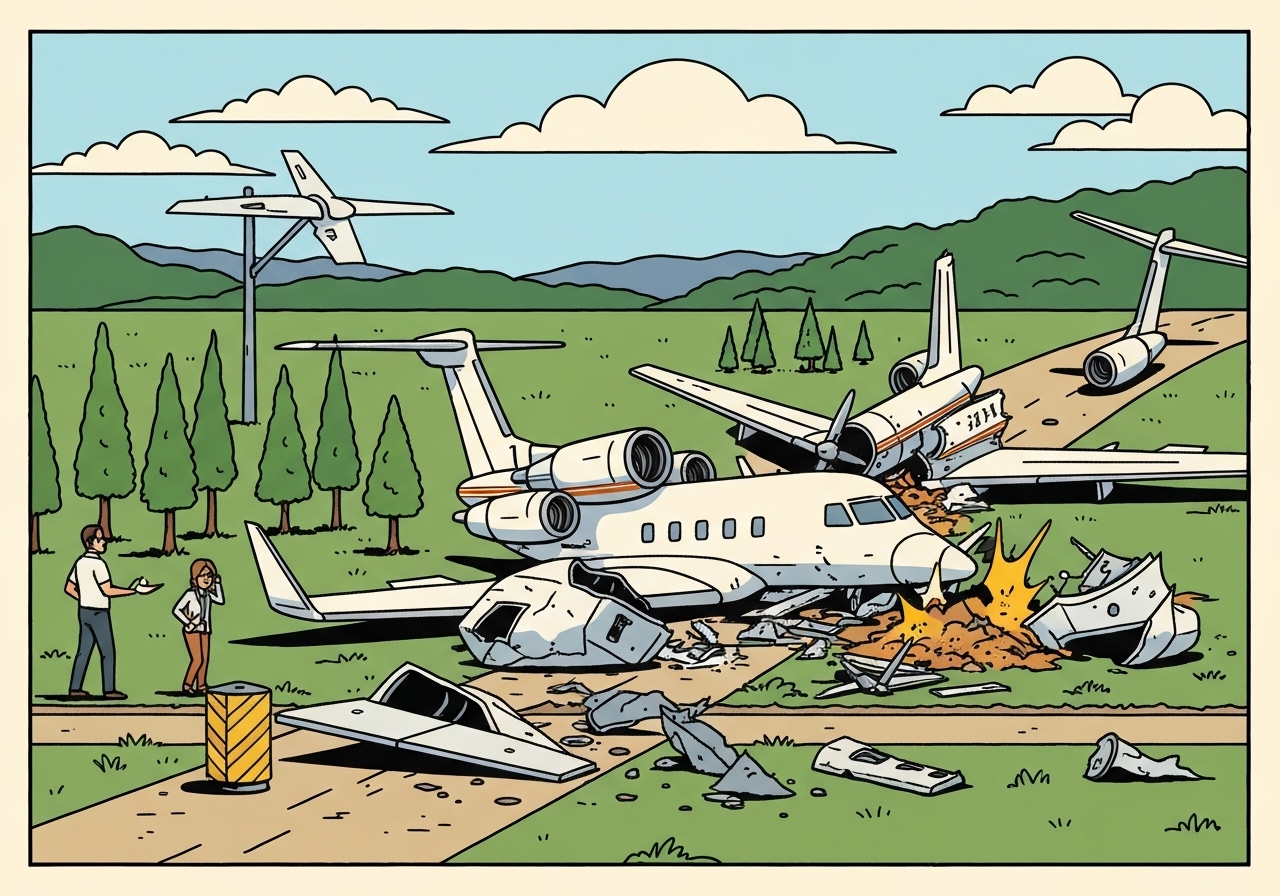
Several people were killed when a small private jet crashed near Statesville, North Carolina, on Thursday, Dec. 18. Local authorities say the accident occurred shortly after takeoff from Statesville Regional Airport in the late morning and that fatalities have been reported, though an exact count is not yet available. Federal investigators from the FAA and the National Transportation Safety Board will lead a formal probe into the crash, while local responders continue recovery and scene processing. Flight-tracking and weather reports are being reviewed as officials piece together the timeline.
- Crash timing: Local officials reported the accident occurred shortly after 10:15 a.m.; the FAA later said the aircraft impacted around 10:20 a.m. on Dec. 18.
- Aircraft: A Cessna Citation 550 (Cessna C550) was involved; FlightAware shows it departed around 10:00 a.m. from runway 10 at Statesville Regional Airport.
- Flight path and altitude: Flight tracking indicates the jet traveled roughly five miles, turned back toward the airport almost immediately, and did not exceed 2,000 feet altitude.
- Casualties: Several fatalities have been reported by local law enforcement; the precise number of deaths and occupants has not been confirmed.
- Investigation: The FAA confirmed the NTSB will lead the formal investigation; both agencies are collecting data and will issue updates.
- Airport context: Statesville Regional is an uncontrolled field about 45 miles north of Charlotte that supports corporate and motorsports aviation activity.
- Weather: An automated station logged low clouds, light rain, and under three-mile visibility about 80 minutes after the crash; investigators have not confirmed weather at the moment of the accident.
Background
Statesville Regional Airport serves a mix of corporate aviation and private traffic, including facilities used by Fortune 500 firms and racing teams. The field is uncontrolled, meaning pilots communicate position and intentions on a common frequency rather than through an air-traffic control tower. Uncontrolled airports are common for general and business aviation; they rely heavily on pilot self‑separation and standard arrival and departure procedures.
The aircraft type involved, the Cessna Citation 550 (sometimes referenced as Cessna C550), is a mid-size business jet used widely in corporate travel. While Citation series jets have established safety records overall, like all small-jet operations they are sensitive to pilot decisions, weather, maintenance status, and airport environment during critical phases of flight such as takeoff and landing. Federal investigations of accidents involving similar aircraft typically examine maintenance logs, flight-data sources, pilot records, and air traffic or radio communications.
Main Event
According to Iredell County officials, the accident occurred shortly after the aircraft lifted off from runway 10. Iredell County Chief Deputy Bill Hamby told local media that the crash happened soon after 10:15 a.m., and emergency responders were dispatched immediately to the scene. Early flight-tracking reconstructions show the Cessna Citation 550 departed roughly at 10:00 a.m., proceeded about five miles away from the field, then executed a near-immediate left turn back toward the airport.
FlightAware data indicates the jet did not climb above 2,000 feet during that interval, which investigators will correlate with any available on-board recordings and radar returns. The FAA issued a brief statement confirming the aircraft impacted while on approach to Statesville Regional Airport at approximately 10:20 a.m. on Dec. 18 and that the NTSB will lead the investigation. Local first responders and county officials secured the crash site while FAA and NTSB teams prepared to deploy.
Witnesses and airport staff described emergency vehicles on scene and an active response by local fire, EMS, and law enforcement. Recovery and evidence‑gathering activities typically include documenting wreckage distribution, mapping impact points, photographing the scene, and collecting maintenance and flight planning records. Officials have not released a passenger manifest or the final casualty count pending notification of next of kin.
Analysis & Implications
In the immediate aftermath, investigators will prioritize determining the sequence of flight controls, powerplant performance, and any communications between the flight crew and other entities. The short duration between departure and return to the airport footprint—about five miles and below 2,000 feet—suggests the event unfolded during the initial climb and early departure phase, a period often associated with mechanical or performance issues as well as spatial disorientation risks in marginal weather.
Weather is a key variable under review. An automated station recorded low clouds, light rain, and sub-three-mile visibility roughly 80 minutes after the crash; whether similar conditions prevailed at the moment of takeoff will be established from archived METARs and pilot reports. If adverse weather existed at departure, investigators will examine how it may have affected climb performance, pilot situational awareness, or instrument departure procedures.
The fact that Statesville is an uncontrolled airport adds operational context but does not alone indicate fault. Pilots departing uncontrolled fields follow published procedures and standard traffic advisories; investigators will review radio calls, transponder data, and local traffic to see whether a conflict or miscommunication occurred. Maintenance history and recent inspections of the specific Cessna Citation 550 will also be central to identifying any mechanical contributors.
Finally, the crash will have local and industry repercussions. Statesville serves corporate and motorsports aviation; a high-profile accident there will prompt reviews of local emergency response, airport operating procedures, and possibly calls for infrastructure or procedural changes if investigators identify systemic contributors. The NTSB’s findings, when available, will guide any regulatory or operational recommendations.
| Item | Reported Detail |
|---|---|
| Departure time | ~10:00 a.m. (Dec. 18) |
| Crash time | Shortly after 10:15 a.m.; FAA cited ~10:20 a.m. |
| Distance from airport | ~5 miles before turning back |
| Max altitude reported | Did not exceed 2,000 ft |
| Weather (post‑crash) | Low clouds, light rain, visibility <3 miles (80 min later) |
The table summarizes publicly reported timeline points and flight-tracking metrics that investigators will verify against radar, ATC (where applicable), and on‑board data. These items guide early hypotheses but are not conclusive on cause. The NTSB’s on-site examination and subsequent laboratory analysis typically provide the definitive evidence used in final determinations.
Reactions & Quotes
Local leadership and federal agencies responded quickly with public statements and commitments to investigate. The immediate tone from officials emphasized coordination and the need for careful technical examination rather than speculation about cause.
“The crash happened shortly after 10:15 a.m.,”
Iredell County Chief Deputy Bill Hamby
Chief Deputy Hamby’s statement established the local timeline and confirmed that multiple fatalities had occurred, prompting the county’s emergency response and victim notification processes.
“A Cessna C550 crashed while landing at Statesville Regional Airport in North Carolina around 10:20 a.m. local time on Thursday, Dec. 18. The FAA and the National Transportation Safety Board will investigate. The NTSB will lead the investigation and provide any updates,”
Federal Aviation Administration (official statement)
The FAA’s announcement clarified federal involvement and the NTSB’s lead role in the investigation. Such federal participation ensures standardized procedures for evidence collection, record preservation, and eventual safety recommendations.
Unconfirmed
- The exact number of people on board and the final confirmed fatality count have not been released by authorities.
- Whether the marginal weather reported after the crash was present at the moment of takeoff remains unconfirmed.
- There is no public confirmation yet of a mechanical failure, bird strike, or pilot incapacitation as causal factors.
- It has not been confirmed whether the crew issued a distress call or declared an emergency before the turn back toward the airport.
Bottom Line
This crash produced multiple fatalities and triggered a multiagency federal investigation led by the NTSB; early public data indicate the event occurred within minutes of departure and at low altitude. Flight-tracking metrics, airport character, and weather reports supply important initial clues but do not establish cause. Investigators will methodically gather wreckage evidence, maintenance and flight records, and any available recorder or radar data to determine sequence and causal factors.
For the public and local community, attention will center on casualty confirmation, next-of-kin notifications, and the timeline for releasing findings that could point to safety recommendations. The NTSB’s final report—often months away—will be the authoritative source for cause and recommendations; in the interim, officials are likely to publish periodic updates as key evidence is processed and analyzed.
- CNN — Media report with local official statements and timeline (news)
- Federal Aviation Administration — Official FAA statement confirming crash and investigation (federal agency)
- National Transportation Safety Board — Investigative lead agency (federal agency)
- FlightAware — Flight-tracking data and recorded track (private flight-data service)
- Iredell County Sheriff’s Office — Local law enforcement source and on-scene coordination (local government)
- City of Statesville — Airport information and community context (municipal website)