
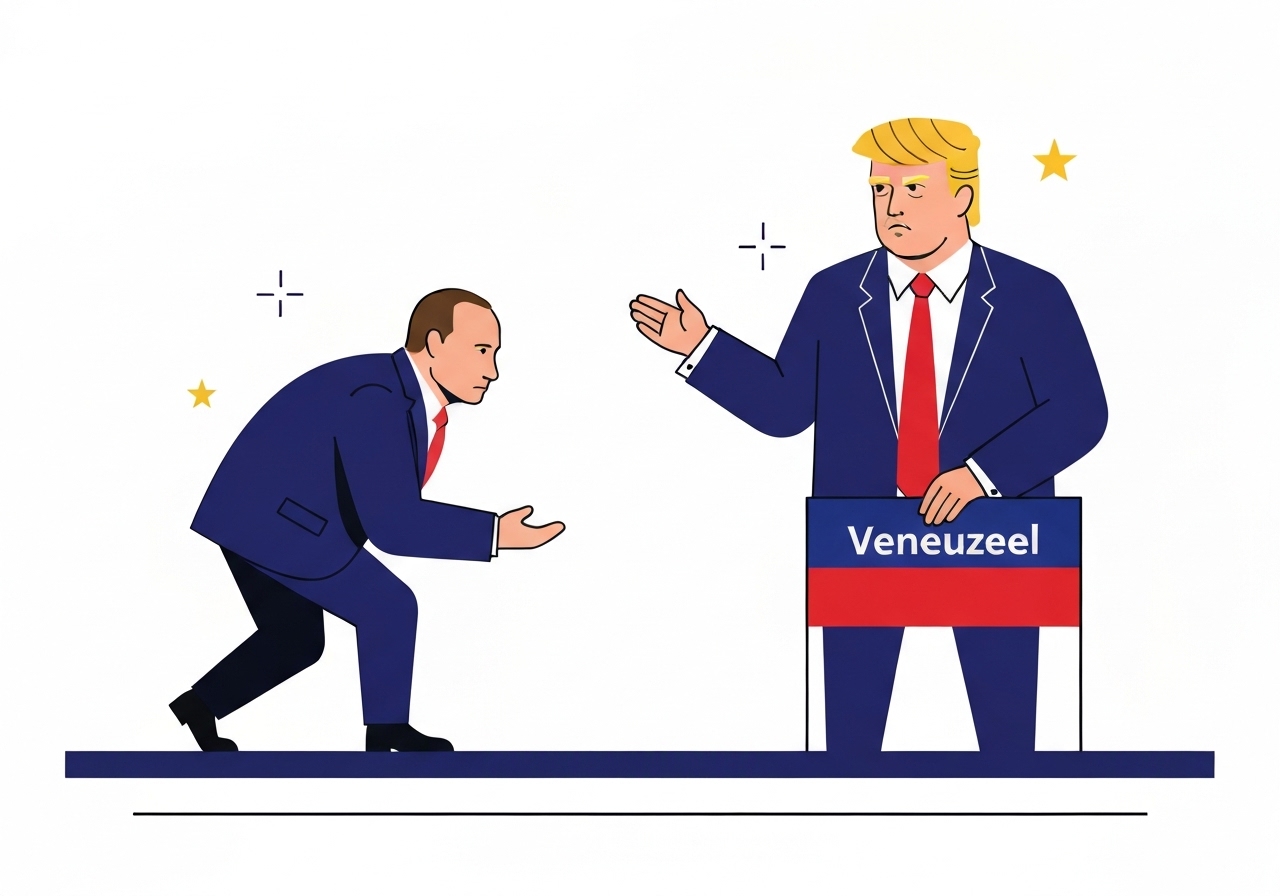
Russian President Vladimir V. Putin has remained publicly muted after a U.S. operation that removed Venezuelan leader Nicolás Maduro from Caracas and placed him in a federal detention center in Brooklyn. The raid, ordered by President Donald J. Trump and carried out on Jan. 3, 2026, took Maduro roughly 4,700 miles from Caracas to New York. Eight months earlier, in May 2025, Maduro had praised a deepening relationship with Moscow during a Kremlin visit. Moscow’s limited public reaction — including a brief three-paragraph response from the Ministry of Transport after a related tanker seizure on Jan. 7, 2026 — underscores a deliberate restraint by the Kremlin as it seeks leverage in the Ukraine conflict.
Key Takeaways
- On Jan. 3, 2026, U.S. forces captured Nicolás Maduro in a raid and transferred him to a federal detention facility in Brooklyn roughly 4,700 miles from Caracas.
- The New York Times account was published Jan. 10, 2026, noting that Vladimir Putin offered no public rebuke in the week after the raid.
- Russia issued a short, three-paragraph statement through its Ministry of Transport after the U.S. seized a tanker flying a Russian flag on Jan. 7, 2026, signaling unusually muted language.
- Analysts interpret the restraint as a strategic choice by Moscow to avoid antagonizing Washington while negotiating over Ukraine’s future and related sanctions.
- Putin’s silence follows months of calibrated engagement with the United States, despite prior episodes when Russia responded forcefully to perceived U.S. moves.
Background
Relations between Moscow and Caracas deepened in recent years as Russia cultivated allies across Latin America, supplying military hardware, financial support and diplomatic backing. Nicolás Maduro’s May 2025 visit to the Kremlin illustrated that relationship: he publicly praised Russia as a partner and signaled continued cooperation. That bond has also had practical implications, including Russian-flagged or Russia-affiliated vessels and financial channels that Washington has targeted with sanctions.
Washington has pursued a more assertive approach toward Venezuela, citing corruption, sanctions evasion and regional security concerns. The Trump administration escalated pressure through sanctions and, in one instance, a military operation that removed Maduro from Venezuelan custody on Jan. 3, 2026. Historically, such U.S. actions have prompted sharp responses from Moscow, which views Latin American influence as part of its global posture.
Main Event
On Jan. 3, 2026, U.S. forces executed a raid in Caracas that resulted in Maduro’s transfer to a federal detention center in Brooklyn. U.S. officials characterized the operation as targeted and carried out under presidential authority; official public statements emphasized enforcement of sanctions and national security considerations. Maduro arrived in the United States under custody and was housed in a high-security facility described by officials as overcrowded and violent.
The Kremlin’s public handling of the episode diverged from earlier patterns. Rather than immediate denunciations or threats, Russian state channels issued limited commentary. After a subsequent U.S. seizure of an oil tanker that had flown a Russian flag while fleeing the U.S. Coast Guard across the Atlantic on Jan. 7, 2026, Moscow’s official reaction was confined to a succinct three-paragraph release from the Ministry of Transport.
Critics and observers in Moscow and abroad noted that the muted response included no public statement from President Putin in the week following the raid. That absence of a presidential reply — unusual given previous instances where the Kremlin publicly condemned U.S. actions — has attracted attention in capitals tracking Russia’s diplomatic calculus.
Analysis & Implications
Moscow’s restraint appears to be a calculated choice tied to its priorities over Ukraine. Kremlin strategists face a trade-off: press the United States on incidents like Maduro’s capture and risk jeopardizing delicate channels for negotiating ceasefire terms, prisoner exchanges, sanctions relief or other steps in a protracted Ukraine diplomacy, or stand down publicly to preserve leverage at the negotiating table. Current signals suggest Moscow prefers the latter.
Domestically, Putin must balance hardline nationalist expectations against pragmatic state interests. A forceful public reaction could satisfy domestic constituencies and allies in Latin America, but it might also provoke escalatory measures from Washington that would complicate Ukraine negotiations and economic stability in Russia. Restraint allows the Kremlin to keep options open while pursuing parallel diplomatic outreach.
Internationally, the choice to avoid overt confrontation over Venezuela may recalibrate perceptions of Russian foreign policy flexibility. Allies and adversaries alike will test whether this measured posture is temporary — a tactical pause — or a longer-term adaptation to a more constrained Russian toolkit amid sustained Western sanctions and military opposition in Europe.
Comparison & Data
| Year | Event | Public Russian Response |
|---|---|---|
| 2018 | Skripal poisoning, U.K. | Strong diplomatic expulsions, public denunciations |
| 2022 | Full-scale invasion of Ukraine | High-profile military rhetoric and mobilization |
| 2026 | U.S. raid on Maduro; tanker seizure | Brief ministry statements, no public presidential response |
The table highlights a visible shift in tone: events that once provoked immediate, forceful public responses from Moscow have, in early 2026, elicited shorter, lower-profile communications. This does not necessarily indicate a withdrawal from global influence but suggests a tactical recalibration in messaging and escalation management.
Reactions & Quotes
U.S. officials framed the Maduro operation in law-enforcement and sanctions terms, stressing legal authority and security concerns. They sought to emphasize rule-based action rather than geopolitical posturing, while noting the operation’s contribution to disrupting sanction-evasion networks.
“We acted to enforce sanctions and deny illicit networks the use of U.S. ports and services,”
U.S. Department of Defense (summary of official statement)
In Moscow, state organs limited public commentary to institutional channels rather than presidential denunciations. Observers said the terse messaging signaled containment of the immediate diplomatic fallout while leaving room for private channels of communication.
“The ministry issued a brief technical statement regarding the tanker; no wider foreign ministry escalation followed,”
Russian Ministry of Transport (official release, Jan. 7, 2026)
Independent analysts and regional experts cautioned that public silence does not equal inaction. They pointed to likely behind-the-scenes consultations and warned that future episodes could change the calculus depending on developments in Ukraine or U.S.-Russia diplomacy.
“Public restraint can mask intense, confidential diplomacy; the absence of loud rhetoric is not the same as indifference,”
Independent foreign policy analyst
Unconfirmed
- Whether behind-the-scenes talks between Moscow and Washington took place immediately after Jan. 3, 2026, and what concessions, if any, were discussed remains unverified.
- Reports that Russia quietly curtailed certain operations in Venezuela as a bargaining chip in Ukraine negotiations are plausible but not corroborated by public documents.
- Allegations that other third-party states provided intelligence enabling the U.S. raid have circulated; independent confirmation has not been published.
Bottom Line
Putin’s public silence after the U.S. operation that moved Nicolás Maduro to Brooklyn reflects a strategic reticence rather than absence of interest. Faced with high-stakes negotiations over Ukraine, the Kremlin appears to prioritize preserving diplomatic space with Washington over immediate public reprisals elsewhere.
That posture carries risks and benefits: it may help Moscow extract concessions or avoid escalatory cycles, but it also creates uncertainty for allies who expect vocal support. Moving forward, observers will watch whether restraint endures or whether a future incident compels Russia to revert to more assertive public responses.