
Lead
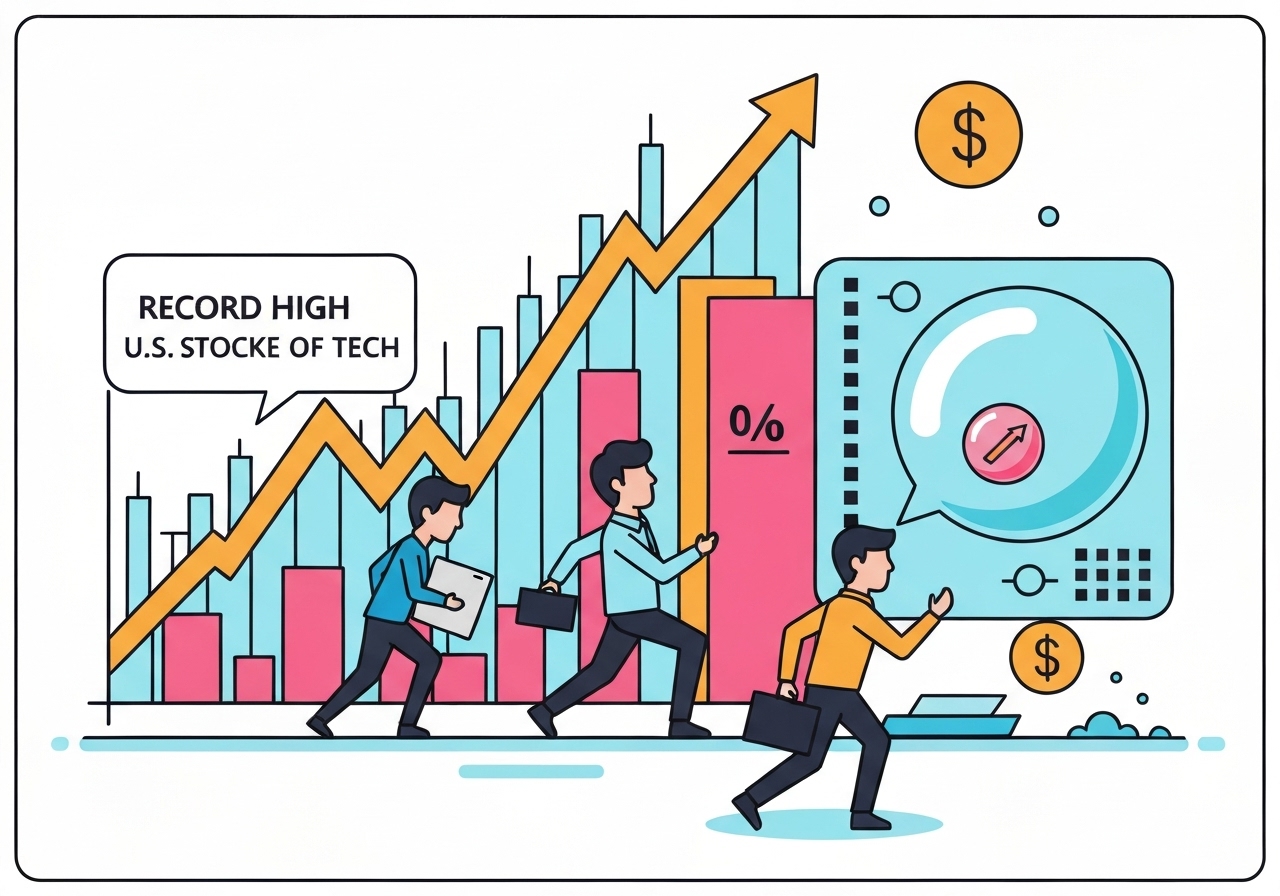
U.S. equity benchmarks closed at fresh highs on Thursday after investors digested a Federal Reserve quarter-point interest-rate cut announced on Wednesday. The S&P 500 and the Dow Jones Industrial Average each reached new closing records, while the tech-heavy Nasdaq lagged, weighed down by a steep drop in Oracle shares. Small caps also rallied: the Russell 2000 finished the session at a new high. Market breadth signaled a shift away from AI-heavy technology names into financials and other cyclical sectors.
Key Takeaways
- The S&P 500 and Dow Jones Industrial Average posted fresh closing records on Thursday following the Fed’s 25 basis-point cut on Wednesday.
- The Nasdaq Composite fell 0.26%, largely dragged lower by Oracle, which plunged nearly 11% after releasing weak revenue and higher capital and lease commitments.
- Broadcom beat Q4 expectations and saw net income nearly double year-over-year, but shares slid about 4.5% in extended trading amid customer-concentration and margin worries.
- The Russell 2000 also closed at a new high, signaling strength among smaller-cap and domestically focused companies.
- Financial stocks led parts of the rally: the S&P financials sector closed at a record, helped by gains in Visa and Mastercard.
- Asia-Pacific markets advanced Friday, with several major indexes up at least 1%, reflecting follow-through buying overseas.
- Corporate moves included Disney’s $1 billion investment and licensing agreement with OpenAI and Reddit’s legal challenge in Australia to a new social-media ban for under-16s.
Background
The Federal Reserve’s decision to cut rates by 25 basis points on Wednesday marked a notable policy pivot intended to balance inflation progress with growth concerns. Fed officials also conveyed confidence in the U.S. economy’s resilience, which encouraged investors to revisit cyclical and interest-sensitive sectors. That statement helped underpin the broader market rally and supported hopes for a more constructive earnings backdrop into 2026.
Markets have been navigating a multi-quarter rotation: after AI and megacap technology led returns earlier this year, investors have started trimming exposures where earnings or margin risks are concentrated. Concerns about customer concentration, rising capital expenditure, and supply-chain dynamics have put additional scrutiny on large enterprise software and chip stocks. At the same time, financials and smaller-cap names—more sensitive to domestic growth and consumer activity—have picked up steam.
Main Event
Trading on Thursday saw a divergence between headline index performance and the internals of the market. The headline S&P 500 and Dow reached record closes as broad sectors participated in the rally, but the Nasdaq Composite lagged, falling 0.26% by the close. The underperformance was tied to sharp moves in a handful of high-weight technology names.
Oracle plunged nearly 11% a day after reporting a quarterly revenue miss alongside higher capital spending and long-term lease commitments, which investors viewed as pressure on near-term margins and free cash flow. The stock’s slide rippled across the AI and enterprise-tech complex, contributing to declines in related suppliers and partners, including chipmakers and memory vendors.
Broadcom reported fourth-quarter results above Wall Street expectations and a near doubling of net income year-over-year, and disclosed that Anthropic is a large customer. Still, shares fell roughly 4.5% in extended trading as CEO Hock Tan’s comments did not allay investor fears that major cloud customers such as Google could accelerate in‑house chip production. Analysts also flagged rising memory prices and the nonbinding nature of certain customer deals as risks to future margin visibility.
By contrast, the financials sector—boosted by strong performances from payments names Visa and Mastercard—closed at a fresh record, illustrating the day’s rotation into stocks deemed more cyclical or sensitive to consumer and business activity. International markets broadly followed the U.S. lead, with several Asia‑Pacific indexes rising at least 1% on Friday.
Analysis & Implications
The market’s split performance underscores a familiar dynamic: headline indices can climb even as speculative concentrations in a few names face pullbacks. When a handful of high-cap tech stocks stumble—here driven by corporate‑specific disappointments and customer‑concentration questions—the broader market can still advance if participation widens across sectors. That appears to be the pattern this week, helped by the Fed’s policy shift.
For AI-linked equities, the episode highlights the difference between narrative-driven valuation and near-term fundamental scrutiny. Oracle’s report exposed execution and capital-allocation concerns that may weigh on investors’ willingness to fund elevated multiples without clearer revenue momentum. Similarly, Broadcom’s results show strong underlying profitability but leave open questions about customer diversification and cost pressures from memory markets.
The Fed’s quarter-point cut is likely to remain supportive of risk assets while economic data stay constructive. However, the pathway forward depends on corporate earnings and input-cost trends: rising memory prices, greater in‑house chipmaking by cloud giants, or broader margin compression would reduce investors’ tolerance for lofty tech valuations. Conversely, steady macro data and continued buybacks or M&A could sustain the rotation into cyclical and financial stocks.
Comparison & Data
| Index / Stock | Move (session) | Note |
|---|---|---|
| S&P 500 | New closing high | Broad-based gains after Fed cut |
| Dow Jones Industrial Average | New closing high | Led by cyclical, financial names |
| Nasdaq Composite | -0.26% | Weighted down by Oracle and other tech names |
| Russell 2000 | New high | Strength in small-cap, domestically focused stocks |
| Oracle | ~-11% | Post-earnings selloff on weak revenue and higher capex |
| Broadcom (extended) | ~-4.5% | Beat EPS/revenue; investor concerns on customer concentration |
The table summarizes session moves reported by market sources; percentage figures for individual stocks reflect the declines cited during and after regular trading hours. The data illustrate how headline index records can coexist with notable dispersion at the stock level.
Reactions & Quotes
Corporate and market leaders gave shorthand assessments of the day’s developments. Disney’s chief executive framed a major content-and-AI deal as a strategic investment, while a former U.S. intelligence chief used broader geopolitics to contextualize recent security messaging from Washington.
“We think this is a good investment for the company.”
Bob Iger, CEO of Disney (quoted on CNBC)
“The strategy was, in a way, going after the Europeans…some of the Europeans needed to be gotten after.”
Gen. David Petraeus, former CIA director (quoted on CNBC)
Market participants and analysts noted that company-specific disclosures—not macro headlines—were the proximate cause of the technology group’s underperformance. Several sell‑side analysts said they were reassessing price targets after Oracle’s earnings release.
Unconfirmed
- Whether Google will materially accelerate in-house chip production remains unconfirmed; company strategy statements are public but future intentions and timelines are not fully detailed.
- The long-term binding nature of Broadcom’s disclosed deals, and how they will affect future revenue, is not fully verifiable from the company’s initial disclosure.
- Predictions that rising memory prices will definitively compress margins across the chip supply chain are plausible but subject to supply, demand, and contract dynamics that are still evolving.
Bottom Line
Thursday’s market action combined a Fed rate cut with differentiated stock-level outcomes: headline indices made fresh highs while select technology names were punished for weaker-than-expected fundamentals. The result is a clearer market narrative of rotation—investors are trimming concentration in AI and enterprise tech and redeploying capital into financials, smaller caps, and other cyclical sectors.
For investors, the near-term outlook hinges on upcoming corporate earnings, memory-price trajectories, and whether major cloud customers materially change procurement strategies for chips. If economic data remain supportive and companies deliver on earnings, the rotation could extend and underpin a constructive end to the year; if sector-specific headwinds persist, expect higher dispersion and more selective positioning.
Sources
- CNBC — news report summarizing market moves and corporate developments.
- Federal Reserve — official press releases and policy statements.