
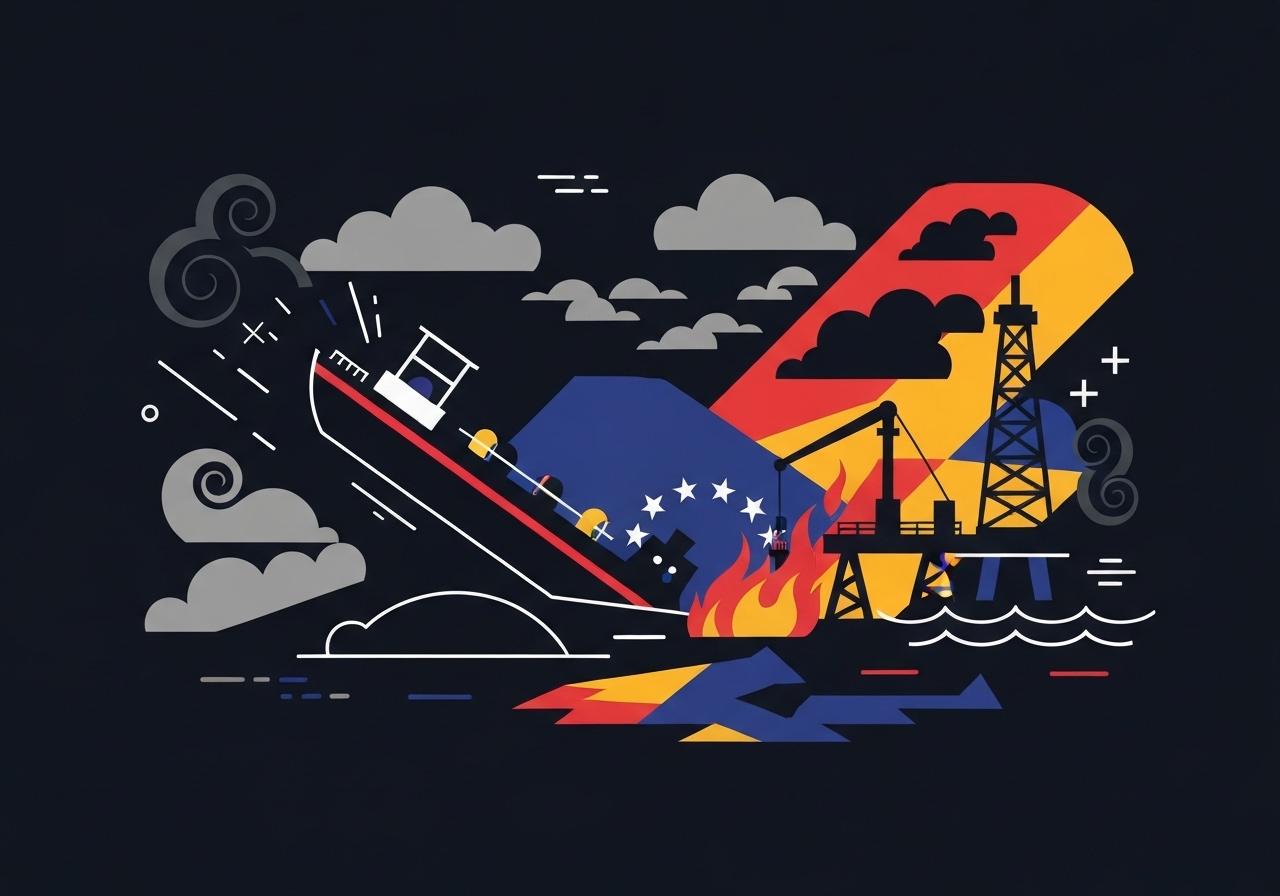
Lead: In the mid-2010s Moscow moved to deepen its foothold in Venezuela’s oil industry, sending state-backed companies, credit lines and technical teams to shore up production and secure crude supplies. The partnership, built around loans-for-oil deals and joint ventures, unfolded amid Venezuela’s economic collapse and mounting U.S. sanctions. By 2019–2020 the strategy had failed to reverse a long decline in output and became politically costly, prompting a partial retreat by Russian firms. The episode exposed the limits of energy diplomacy in the face of collapsing infrastructure, financial pressure and geopolitics.
Key Takeaways
- Russia used state-linked companies, most prominently Rosneft, to provide prepayments and credit to Venezuela in exchange for oil deliveries; a major Rosneft prepayment was arranged in 2016 for roughly $6 billion in future shipments.
- Venezuela’s oil production fell precipitously during the crisis years; it was below 1 million barrels per day by 2019, undermining the commercial basis for recovery-focused deals.
- Sanctions imposed by the United States from 2017 onward curtailed trade routes and raised compliance risks for third-party traders moving Venezuelan crude.
- To circumvent restrictions, traders and tankers increasingly used ship-to-ship transfers, opaque ownership chains and nonstandard documentation—raising costs and operational complexity.
- Operational problems—decades of underinvestment, skilled-labor flight, and damaged refining and lifting infrastructure—meant cash advances alone could not restore output to previous levels.
- By 2020–2021, public-facing Russian involvement waned: several assets and trading flows were scaled back or restructured as sanction risk and commercial losses mounted.
- The episode blurred lines between commercial pursuit of energy assets and geopolitical support for the Maduro government, increasing reputational and financial exposure for Russian firms.
Background
Venezuela entered the 2010s with the world’s largest measured crude reserves but a state oil company (PDVSA) weakened by politicization and falling investment. Years of underfunding and management changes left wells, pipelines and refiners poorly maintained. Moscow’s interest in Venezuela combined strategic and commercial motives: securing long-term crude supplies, expanding Russian companies’ global footprint and reinforcing a geopolitical partnership with Caracas.
Beginning in 2016, Russia moved from ad hoc support toward structured energy deals. State-backed credits and prepayments were exchanged for fixed-delivery windows and stakes in joint ventures. Those deals were framed as mutual relief: Caracas received liquidity; Russian firms gained access to heavy crudes and trading flows. But the contracts depended on functioning production and logistics that Venezuela no longer reliably provided.
Main Event
Rosneft and other Russian-linked entities started lifting Venezuelan crude and operating trading desks to handle shipments. Prepayment arrangements gave Caracas immediate cash but required sustained deliveries over multiple years. Initially, tankers and escorts moved oil to customers, sometimes via intermediate flags and transfers to mask provenance in response to increasing scrutiny.
The commercial model began to fray as Venezuela’s field depletion and equipment failures cut daily output. Shipments became irregular, creating disputes over deliveries versus loan amortization. At the same time U.S. sanctions expanded, targeting key PDVSA operations and firms that enabled Venezuelan exports, complicating payment channels and insurance for tankers.
Operational failures—well integrity problems, shortage of diluents for heavy crude, and refinery outages—meant cargoes were often smaller, delayed or blended to meet buyer specs. The cumulative effect was a mismatch between the scale of financing and the productive capacity available to honor it, producing mounting losses and legal friction between counterparties.
Faced with rising sanction and compliance risk, and losses on trading books, Russian firms reduced visible exposure. Some contracts were restructured, trading flows rerouted, and assets placed under different ownership arrangements. Public statements stressed commercial motives, but inside the market the episode was read as a costly experiment that delivered limited returns for substantial political and reputational capital.
Analysis & Implications
The Russia–Venezuela oil engagement shows how energy diplomacy can be undermined when host-country production collapses. Financial prepayments buy time but cannot substitute for steady field maintenance, skilled technicians, and long-term capital expenditure. In Venezuela’s case, the physical decline of wells and the disappearance of technical cadres were structural problems outside the control of short-to-medium-term lenders.
Sanctions amplified the commercial risk. Restrictions on PDVSA and on trading counterparties increased the cost of shipping, insurance and financing. They also pushed operators toward more opaque logistics, which raised legal and reputational costs for the firms involved. For Russia, the result was a high-risk exposure with limited upside: some crude was secured, but at the expense of complex trading arrangements and prize assets that produced disappointing cashflows.
Strategically, Moscow gained leverage—political and diplomatic—by sustaining Caracas during its crisis, but the long-term payoff is unclear. When market access is constrained by external pressure and physical production is falling, strategic energy tie-ups deliver limited economic return. The episode underlines that political support can be costly and difficult to convert into reliable, long-term energy supplies.
Going forward, investors and states contemplating similar arrangements will likely demand stricter conditionality, clearer governance mechanisms, and better contingency planning for operational failure. Expect heightened due diligence, alternative payment arrangements less vulnerable to sanctions, and greater use of intermediaries to shield parent companies from direct exposure.
Comparison & Data
| Phase | Characteristic |
|---|---|
| Pre-2014 | Relatively higher production; international partners engaged in large-scale projects |
| 2015–2019 | Sharp production decline; growing reliance on external financing and ad hoc shipments |
| 2020 onward | Reduced visible foreign exposure; restructuring of contracts amid sanctions |
The table above outlines the broad phases of Venezuela’s oil sector decline and Russia’s involvement. It is notable that the scale of financing extended by Russian-linked entities was large relative to the productive capacity then available, creating a structural mismatch that data on shipments and liftings subsequently confirmed.
Reactions & Quotes
“Our engagement with Venezuela was structured as commercial support to secure contracted volumes and protect investments.”
Rosneft (company statement)
Rosneft emphasised the commercial terms of its deals and repeatedly framed activity as a market-driven response to opportunity, while noting compliance with applicable law.
“Sanctions aim to deny the regime illicit revenue streams and enforce accountability for corruption and human rights abuses.”
U.S. Treasury (spokesperson summary)
The U.S. government framed restrictions as a policy instrument to pressure Maduro-era officials and to reduce the flow of funds that sustain state misrule, affecting third-party traders and insurers as well as PDVSA.
“Financial lifelines are not a substitute for decades of capital expenditure and intact field operations; that is what ultimately determines output.”
Independent oil analyst
Analysts observed that credit can stabilise cash flow short term but cannot halt decline without large-scale technical programs, spare parts, and trained staff.
Unconfirmed
- Precise commercial losses sustained by individual Russian trading desks remain subject to confidential accounting and have not been publicly reconciled.
- The full scale and legal structure of some asset transfers and re-registrations during 2019–2021 lack public disclosure and are not independently verified.
Bottom Line
Russia’s attempt to convert geopolitical alignment with Venezuela into a dependable energy supply chain delivered mixed results. While Moscow succeeded in maintaining a strategic relationship and lifted some volumes of crude, the combination of collapsing Venezuelan output, sanctions pressure and opaque logistics made the venture commercially fragile. The episode highlights the limits of transactional energy diplomacy when the partner country’s production base is structurally impaired.
For policy-makers and companies, the lesson is clear: underwriting energy security in fragile states requires more than financing and short-term operational fixes. It demands long-term commitments to maintenance, transparent governance and contingency plans for legal and reputational exposure in a sanctions-prone environment. Observers should watch for further restructuring and for whether any remaining assets are repurposed, sold, or re-integrated under different legal wrappers.
Sources
- Financial Times (media, paywalled)