
Lead
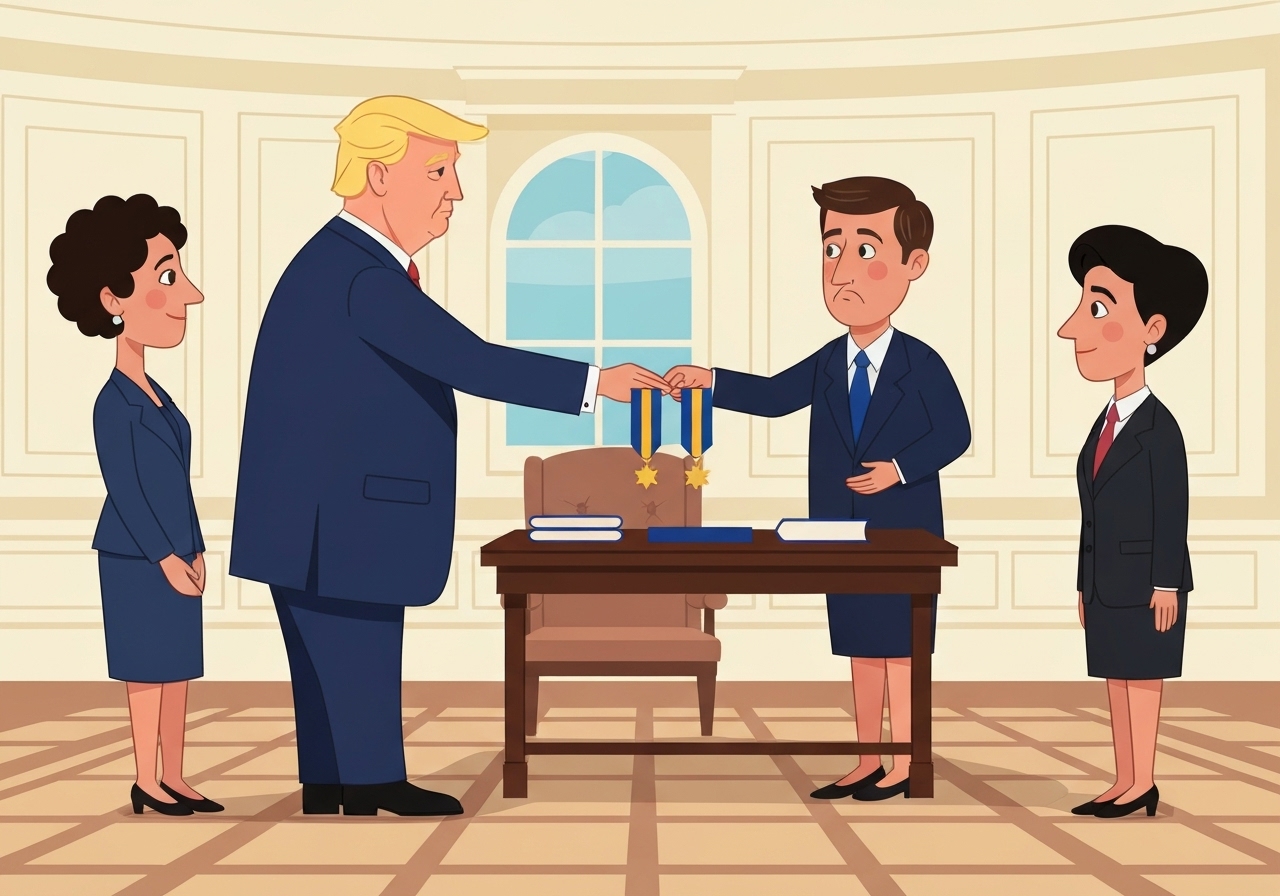
On Saturday in the Oval Office, President Donald Trump presented the 2025 Kennedy Center honorees with newly designed medals, praising the group as one of the most accomplished in the program’s history. The recipients — Sylvester Stallone, Gloria Gaynor, George Strait, Kiss and Michael Crawford — received gold medallions created and donated by Tiffany & Co. The presentation followed a series of changes at the Kennedy Center since Trump returned to office in January, including a reconstituted board of trustees. Trump said he played a central role in selecting this year’s slate and attended related events throughout the weekend.
Key Takeaways
- Five honorees received medallions on Saturday in the Oval Office: actor Sylvester Stallone; singers Gloria Gaynor and George Strait; rock band Kiss; and actor-singer Michael Crawford.
- The new medallion, a gold disc with the Kennedy Center image and rainbow colors, was designed and donated by Tiffany & Co. and hangs from a navy blue ribbon.
- Trump has reshaped the Kennedy Center since returning to office in January, ousting the previous board and installing trustees who voted him chairman.
- Trump said in August he was “about 98% involved” in choosing the honorees; the traditional bipartisan selection process was replaced under his leadership.
- The formal honors program will be taped at the Kennedy Center on Sunday for broadcast in December on CBS and Paramount+; Trump said he will attend and predicted unusually high ratings.
- Medals were presented in the White House rather than at the State Department dinner where such presentations have sometimes occurred in past years.
Background
The Kennedy Center Honors were established in 1978 to recognize lifetime contributions to American performing arts. Historically, honorees were selected by a bipartisan committee and announced by the Center; the medallions and ceremonial rituals have evolved but the awards retained a longstanding institutional process. Presidents have traditionally attended the televised honors program and sat with recipients in the audience, but none had served as host of the broadcast before.
Since returning to the White House in January, Trump has publicly criticized aspects of the Kennedy Center’s programming and appearance and moved to replace the institution’s trustees with allies who then made him chairman of the board. Those governance changes have coincided with alterations to how honorees were announced and the site and format for medal presentation this year. The White House and the Kennedy Center jointly described the new Tiffany-designed medallions and confirmed the jeweler’s donation.
Main Event
The Oval Office ceremony opened with music from honorees Gloria Gaynor and Kiss playing nearby as press waited outside the room. Trump placed the gold discs around each recipient’s neck; the reverse side bears the honoree’s name and the ceremony date. Country star George Strait, wearing a cowboy hat, was first to receive his medal and briefly interacted with the president about whether to keep it on.
Trump delivered extended remarks praising each honoree’s contributions to American culture. He described Michael Crawford as a leading Broadway figure for his role in Phantom of the Opera, called Gloria Gaynor a defining voice of disco, lauded Kiss as a global rock act and praised Sylvester Stallone as a major movie star and longtime friend. The president also joked about his ability to outshine late-night hosts while referencing Jimmy Kimmel.
The administration moved presentation of the physical medallions from a State Department dinner to the White House this year; Trump also attended that annual dinner. The taped Kennedy Center Honors program, which includes tributes and performances, is scheduled for recording at the Kennedy Center the following day for later broadcast on CBS and Paramount+.
Analysis & Implications
The decision to stage the medal presentations in the Oval Office and to foreground the president’s role in choosing honorees represents a substantive shift in the relationship between the Kennedy Center and the White House. Institutional practices that once emphasized a degree of separation between government and the arts are being reconfigured to reflect presidential authority over cultural recognition. That change raises questions about autonomy, expert input and the future of established selection norms.
Replacing the board of trustees and installing allies who then voted Trump chairman alters the governance framework for the nation’s premier performing-arts institute. For artists and cultural organizations, the shift could influence programming decisions, fundraising priorities and perceptions of editorial independence. Some stakeholders may welcome a direct White House connection; others may see it as politicizing an institution intended to celebrate a broad range of artistic achievement.
Trump’s claim that he was heavily involved in selecting the class, combined with his pledge to host and promote the televised program, suggests the administration intends to maximize public attention around the honors. That strategy may boost broadcast viewership in the short term, but its longer-term impact on the Honors’ reputation will depend on how the selection process and ceremony balance transparency, artistic merit and institutional tradition.
Comparison & Data
| Feature | Previous Honors Insignia | 2025 Medallion |
|---|---|---|
| Form | Large rainbow ribbon with three gold plates (worn on shoulders/chest) | Gold disc etched with Kennedy Center image and rainbow colors; navy blue ribbon |
| Designer/Donor | Traditionally provided by the Center’s suppliers | Designed and donated by Tiffany & Co. (Kennedy Center & White House) |
| First used | In use since the honors program began in 1978 | Introduced for the 2025 honorees |
The new medallion replaces the long-standing ribbon-and-plate insignia used since 1978. The change was presented as a donation from Tiffany & Co.; the White House and Kennedy Center explicitly confirmed the jeweler’s role. The shift in the physical token mirrors broader changes in ceremony location and selection practices under the current administration.
Reactions & Quotes
“This is perhaps the most accomplished and renowned class of Kennedy Center Honorees ever assembled.”
President Donald Trump
Trump used the remarks to frame the honorees as cultural icons whose work has united large audiences. He repeatedly linked his personal familiarity with several recipients to the decision to honor them.
“I was about 98% involved”
President Donald Trump
Trump said in August that he played a near-decisive role in assembling the 2025 slate. How final selections were made, and the role of any advisory group, was not publicly detailed.
“The medallions were designed, created and donated by Tiffany & Co.”
Kennedy Center / White House statements
The Center and the White House jointly described the new medals and their donor; both entities confirmed the design details and the inscription format.
Unconfirmed
- Specific details of how the 2025 honorees were chosen remain unclear; public statements did not disclose the full selection process or any advisory committee role.
- Trump’s prediction that the taped broadcast will achieve the “highest ratings” in the program’s history is a projection and unverified prior to airing and subsequent audience measurement.
- The long-term effects of the board changes on Kennedy Center programming and donor relationships are not yet established.
Bottom Line
The Oval Office medal presentation for the 2025 Kennedy Center honorees highlights both a ceremonial recognition of established performers and a deliberate reorientation of the Center’s relationship with the White House. New medallions by Tiffany & Co., the relocation of the medal ceremony to the White House, and governance changes at the Center together mark a notable departure from past practice.
In the short term, the move will raise public attention around the honorees and the televised tribute; in the longer term, observers will watch whether changes to selection and governance alter the Honors’ standing in the arts community. Transparency about selection criteria and the institution’s independence will be central to how stakeholders judge the enduring impact of this season’s changes.
Sources
- Associated Press (news report)
- The Kennedy Center (official site/awards & honors information)
- Tiffany & Co. (jeweler; corporate information)