
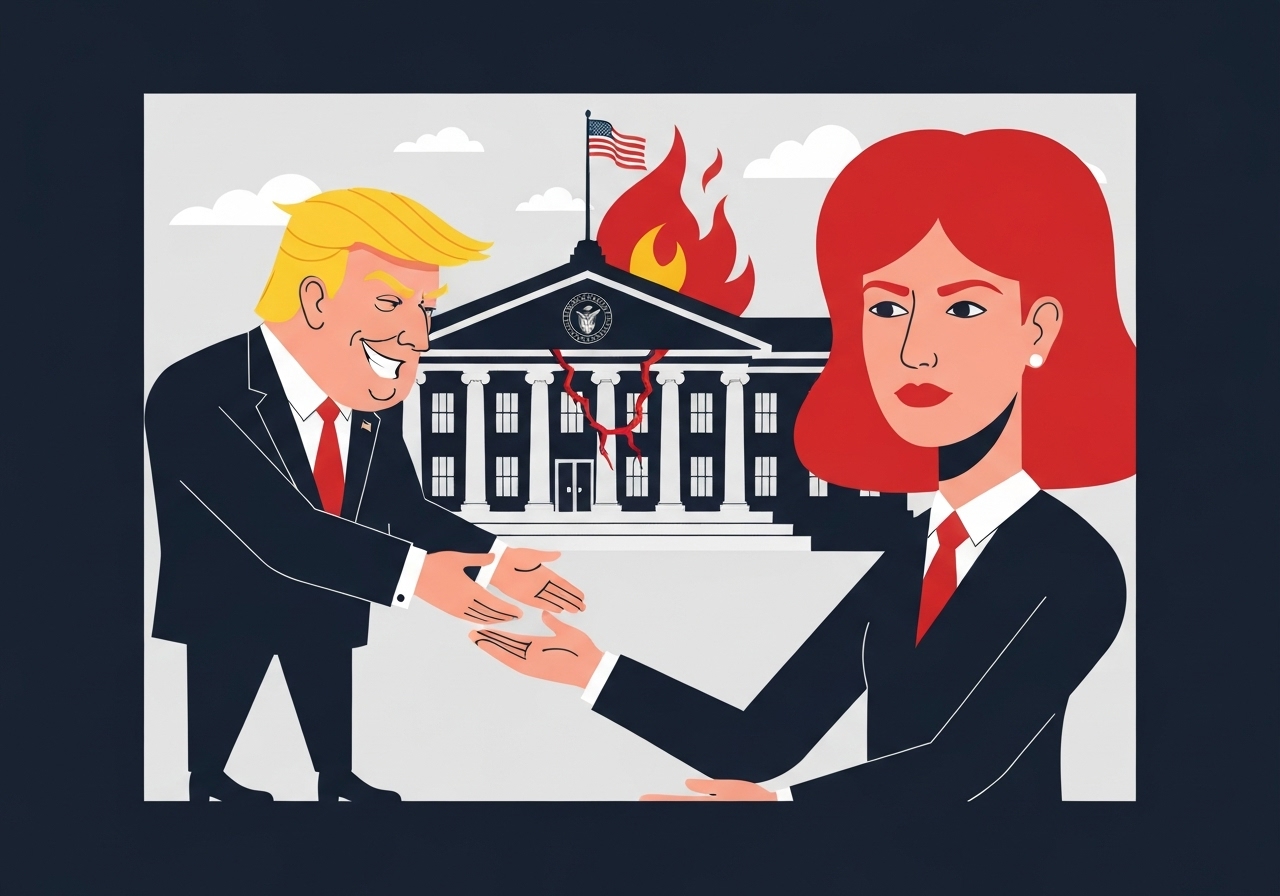
On Thursday, December 12, 2025, former President Donald J. Trump announced a “full pardon” for Tina Peters, the former Mesa County clerk serving a nine-year state prison sentence for tampering with county election equipment. Colorado officials immediately rejected the action as without legal effect, saying a presidential pardon cannot erase state convictions. The announcement, posted on the former president’s Truth Social account and amplified by a Department of Justice official on X, has raised legal and political questions about jurisdiction and the precedents for clemency used as a political signal. At publication, the Department of Justice’s public clemency listings had not been updated to include Peters.
Key Takeaways
- Tina Peters, a former Mesa County clerk and vocal 2020 election denier, is serving a nine-year sentence after a Colorado jury convicted her of tampering with county election equipment.
- On December 12, 2025, Trump posted that he was granting Peters a “full pardon” on Truth Social; the post repeated false claims about widespread 2020 election fraud.
- Presidential clemency covers federal offenses; Colorado officials, including Gov. Jared Polis and Attorney General Phil Weiser, said a presidential pardon does not apply to state convictions.
- Ed Martin, the Justice Department’s Pardon Attorney, reshared the announcement on X with the phrase “No one left behind,” signaling internal DOJ attention even as the agency’s public clemency list had no entry for Peters at the time of reporting.
- Colorado leaders characterized the move as an attempt at intimidation and a challenge to state judicial authority; legal scholars note it is largely symbolic unless followed by state action or a federal filing that affects state custody.
Background
Tina Peters rose to national attention after the 2020 election, positioning herself as a critic of election administration and promoting claims of widespread fraud. As Mesa County Clerk, she was later accused and convicted of actions that prosecutors said involved copying or tampering with county voting equipment—conduct that led to criminal charges in Colorado state court. Her nine-year sentence reflects the state court’s judgment after a jury trial and prosecution led by local authorities; Gov. Jared Polis noted the case was handled through ordinary state channels, including a Republican district attorney.
The use of presidential clemency has expanded in recent years as a political tool, with several high-profile pardons and commutations granted to allies and supporters. Federal clemency powers are derived from the U.S. Constitution and apply only to federal offenses; governors and state clemency boards generally control relief for state convictions. That institutional separation is the core legal reason Colorado officials assert a presidential pardon cannot vacate Peters’s state sentence.
Main Event
Trump’s December 12 announcement on Truth Social declared a “full pardon” for Peters, framing her case as a fight against alleged voter fraud and characterizing her prosecution as partisan targeting. The post reiterated long-discredited claims about the 2020 presidential election and described Peters as unfairly persecuted. The statement was reshared on X by Ed Martin, the Justice Department’s Pardon Attorney, using the phrase “No one left behind,” a line previously used when commutations or pardons were celebrated for political allies.
Legal observers and Colorado officials immediately flagged a jurisdictional gap: Peters’s conviction was in state court, and the president’s constitutional clemency power does not reach state prosecutions. Gov. Jared Polis pointed to the jury verdict and state-law convictions, while Attorney General Phil Weiser called the move “lawless” and an intimidation tactic that lacks a legal basis. The Colorado officials emphasized the state’s authority over its criminal justice system and said they would not treat a federal clemency statement as undoing Colorado’s judicial process.
At the time reporters checked the Department of Justice’s publicly available records of clemency actions, there was no entry listing Peters among Trump’s grants. That absence left open administrative questions—whether an internal clemency instrument had been filed, whether a formal certificate would be issued, and how federal or state authorities might react if a formal action appeared.
Analysis & Implications
Legally, a presidential pardon for a state conviction is largely symbolic: the president can only grant clemency for federal offenses. If the announcement remains only as a public statement without a corresponding federal filing affecting a federal charge, it cannot nullify Colorado’s judgment or remove Peters’s state sentence. That legal boundary is clear in constitutional practice, and Colorado’s elected officials have pointed to it in public statements.
Politically, the pardon announcement performs a different function. It signals continued support from a prominent national political figure to a base that views Peters as a martyr for election skepticism. Such signals can have downstream effects—energizing supporters, influencing fundraising, and affecting local political contests—without producing immediate legal change. They also raise questions about norms surrounding the office of the president and the use of clemency as partisan reinforcement.
Operationally, the discrepancy between a federal statement and a state conviction creates practical friction. Colorado could consider state remedies, including upholding the conviction, pursuing appeals, or seeking to reconcile conflicting legal claims if a federal action were somehow asserted. Legal experts say the typical path for resolving such tension would involve the state courts and possibly intergovernmental litigation if federal actors attempted to interpose themselves in state custody decisions.
Comparison & Data
| Authority | Can Pardon State Convictions? |
|---|---|
| U.S. President (Clemency) | No — applies only to federal offenses |
| State Governor / Clemency Board | Yes — authority varies by state law and procedure |
The table summarizes the basic legal division: presidential clemency is constitutionally limited to federal crimes, while relief from state convictions generally lies with gubernatorial or state clemency mechanisms. This institutional split explains Colorado officials’ insistence that the president lacks jurisdiction to erase a state sentence.
Reactions & Quotes
Colorado officials framed the pardon announcement as legally ineffective and politically aggressive. Below are representative, brief statements and their contexts.
No President has jurisdiction over state law nor the power to pardon a person for state convictions.
Gov. Jared Polis (X) — Colorado governor; statement on state jurisdiction and the Peters conviction
This is a lawless act. It’s an act of intimidation. It has no basis in American law.
Attorney General Phil Weiser (interview, 9News) — Colorado attorney general on limits of federal clemency
No one left behind.
Ed Martin, DOJ Pardon Attorney (X) — reshared the announcement signaling internal DOJ attention
Unconfirmed
- Whether a formal, documented clemency instrument for Peters will be filed with the Department of Justice or another federal repository remains unverified at the time of reporting.
- It is not confirmed that any federal charges related to Peters exist that would be subject to a presidential pardon; the conviction cited in public statements is a Colorado state conviction.
- Any future state response, including appeals or removal of custody, is prospective and not currently documented.
Bottom Line
The December 12, 2025 announcement that President Trump had pardoned Tina Peters creates a sharp legal and political divide: symbolically it ties a former president to a high-profile ally, but legally it does not, on its face, alter a Colorado state conviction or the nine-year sentence imposed by state courts. Colorado officials have pointed to the constitutional division of clemency power to assert that the announcement cannot nullify state proceedings.
Going forward, watch for two developments: whether a formal clemency instrument appears in federal records, and whether Colorado state authorities pursue any additional legal or administrative steps in response. The episode underscores how modern clemency can be simultaneously an executive action, a political message, and a catalyst for intergovernmental dispute.
Sources
- Forbes (news report) — reporting on the announcement, state reactions, and related details.
- Truth Social — @realDonaldTrump (official post) — the platform where the pardon statement was published.
- U.S. Department of Justice, Office of the Pardon Attorney (official government resource) — central repository for federal clemency information and procedures.
- 9News (NBC affiliate) (local news interview) — reported comments from Colorado Attorney General Phil Weiser.