
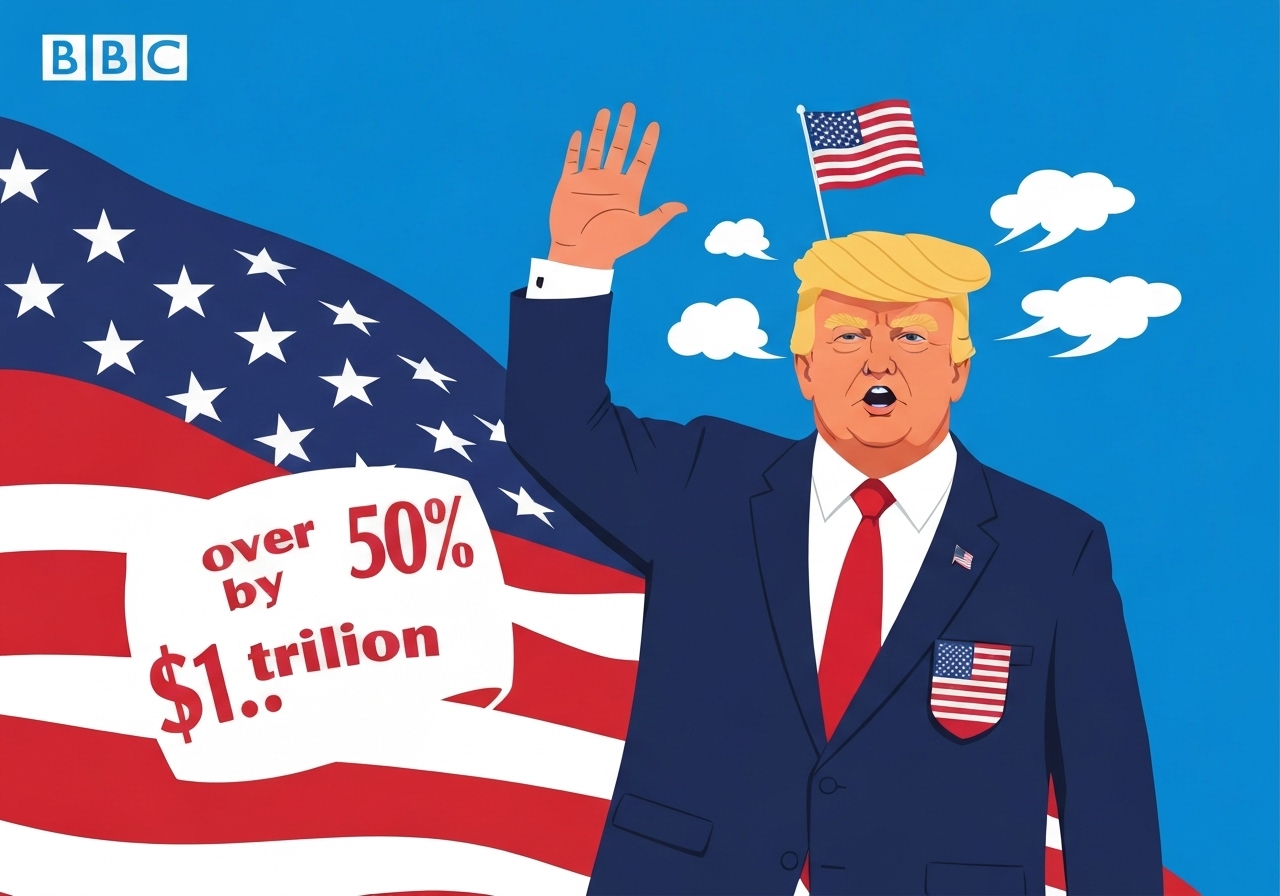
Former President Donald Trump on Wednesday urged US defence spending to be raised to $1.5 trillion by 2027, calling the move necessary for “these very troubled and dangerous times.” He proposed the increase from this year’s $901 billion budget, approved by Congress in December, and said higher tariffs could make the larger sum attainable. Trump also demanded faster production from major defence contractors and threatened limits on executive pay and shareholder payouts if firms failed to invest in new plants. Markets reacted quickly: shares of Lockheed Martin, Northrop Grumman and Raytheon climbed more than 5% in extended trading after his posts.
Key Takeaways
- Trump proposed raising US defence spending to $1.5 trillion by 2027, up from the $901 billion budget approved this year.
- The increase represents roughly a 66% rise over the current $901 billion figure, described by commentators as “more than 50%.”
- He pressed defence firms to accelerate deliveries and build new manufacturing facilities, singling out Raytheon as the slowest responder.
- Trump threatened to curb massive shareholder payouts and cap executive pay at $5 million unless companies reinvested in production.
- Major US defence stocks—Lockheed Martin, Northrop Grumman and Raytheon—rose over 5% in extended New York trading after the announcement.
- Trump claimed tariff revenue could “easily hit” the proposed budget level; economists have warned the spending-income gap is already unsustainable.
- The call comes amid rising geopolitical tensions, including recent US actions involving a Russian-flagged tanker and events tied to Venezuela and Chinese drills around Taiwan.
Background
Trump has advocated higher defence spending since his first White House term, repeatedly urging larger budgets for procurement, shipbuilding and munitions. The current federal defence appropriations, approved by Congress in December, set baseline funding at $901 billion for the year—already among the largest defence budgets globally. Administrations and Congress have long struggled to balance defence ambitions with fiscal constraints; many economists warn persistent deficits make further large increases politically and economically fraught.
Defence contractors have come under scrutiny for dividend payouts, stock buybacks and executive compensation in recent years, at a time when Pentagon officials and some lawmakers say production lines need expansion. Geopolitical flashpoints—in particular tensions with China over Taiwan, US actions involving sanctions enforcement, and instability in parts of Latin America—have sharpened public and political debate about readiness and industrial capacity. That context helps explain why a call for a dramatic budget lift finds an audience among some officials and investors.
Main Event
On social media Wednesday, Trump outlined a plan to increase US defence spending to $1.5 trillion by 2027, saying the rise was necessary to build what he called a “Dream Military” and to keep the country safe. He framed the ask as a response to a more dangerous international environment and tied it to domestic industrial policy, calling for new and modern manufacturing plants to speed deliveries of armaments.
He also issued public pressure on major defence contractors, accusing them of prioritising shareholder payouts and executive compensation over investment in capacity. Trump wrote that no executive should make more than $5 million and warned companies they risked losing Department of Defense business if they did not increase upfront investment in plants and equipment. He singled out Raytheon as “the least responsive” on boosting production.
Markets reacted almost immediately: shares in leading defence manufacturers—Lockheed Martin, Northrop Grumman and Raytheon—rose by more than 5% in extended trading following Trump’s posts. Administration officials and Capitol Hill lawmakers had not yet signalled a unified response to the proposal, leaving open questions about congressional willingness to approve such a large multi-year increase.
Analysis & Implications
A jump from $901 billion to $1.5 trillion would reshape US defence procurement and federal budgeting. At roughly a 66% rise, the proposal would require either sustained revenue increases, major reallocations within the federal budget, or higher deficits. Trump’s suggestion that tariffs could supply the revenue stream is politically charged: tariff receipts can be volatile and are typically insufficient to underwrite multi-hundred-billion-dollar, ongoing outlays without broader fiscal changes.
Operationally, directing contractors to expand plant capacity could shorten delivery timelines for munitions and platforms, but building new supply chains, hiring skilled workers and qualifying production lines takes years. If enforced, caps on executive pay and limits on buybacks could shift corporate strategy; however, taking such measures unilaterally risks legal challenges and might reduce private investment incentives unless paired with clear procurement guarantees or tax incentives.
Internationally, a large US defence build-up would have geopolitical ripple effects. Allies might welcome increased US capacity if it translates into higher burden-sharing or more rapid weapons deliveries. Conversely, adversaries could interpret a massive US increase as escalatory, potentially prompting regional arms responses. Fiscal trade-offs at home—education, infrastructure, entitlement programs—would be politically salient if Congress were to consider reallocations to meet higher defence targets.
Comparison & Data
| Line | Amount (USD) | Notes |
|---|---|---|
| 2024 US defence budget (approved) | $901 billion | Congress-approved baseline |
| Trump proposal (2027) | $1.5 trillion | Administration target proposed on social media |
| Nominal increase | $599 billion | Approximate difference between $1.5tn and $901bn |
| Percent increase | ≈66.5% | Calculated change from $901bn to $1.5tn |
The table shows the arithmetic behind the president’s statement that the proposal is “more than 50%” larger than the current budget; the precise increase is roughly 66.5%. Contextualising that jump requires comparing it to long-term defence spending trends, planned procurement schedules and projected federal revenues—factors that will shape feasibility debates in Congress and among fiscal watchdogs.
Reactions & Quotes
“This will allow us to build the ‘Dream Military’ that we have long been entitled to and, more importantly, that will keep us SAFE and SECURE, regardless of foe.”
Donald J. Trump (social media)
“No Executive should be allowed to make in excess of $5 Million Dollars which, as high as it sounds, is a mere fraction of what they are making now.”
Donald J. Trump (social media)
“A jump to $1.5 trillion would materially alter procurement timelines and federal fiscal projections; implementation details will determine its economic and strategic impact.”
Independent market analyst
Trump’s posts combined policy prescriptions with personnel and corporate pressure, prompting brisk market and analyst reaction. The BBC has sought comment from Raytheon; company comment was pending at the time of reporting. Economic commentators reiterated long-standing concerns that sustained defence growth on this scale would intensify fiscal deficits unless matched by durable revenue measures.
Unconfirmed
- How much additional revenue tariffs would actually generate for multi-year defence funding is uncertain and depends on future trade flows and tariff levels.
- Specific legal mechanisms for capping executive pay at $5 million within defence contractors—and how that would be enforced—have not been detailed.
- Any immediate plan to remove companies from Department of Defense contracts for failing to invest was stated as a warning by the president and has not been set out as a formal policy or action by Pentagon procurement authorities.
Bottom Line
Trump’s proposal to raise US defence spending to $1.5 trillion by 2027 would be a major expansion of American military budgets, altering procurement plans, corporate behaviour and the federal fiscal outlook. While the president framed the move as necessary for national security and industrial revitalisation, practical implementation would require detailed legislative and administrative measures that have not yet been presented.
Key questions remain: whether Congress would approve the scale of the increase, how the funding would be sourced without exacerbating deficits, and whether pressured industry responses—new plants, faster deliveries—can be achieved within realistic timelines. Expect intense debate in Washington and among global partners about the strategic and economic trade-offs of such a dramatic budget shift.
Sources
- BBC News — Media report (original story cited)