
Lead
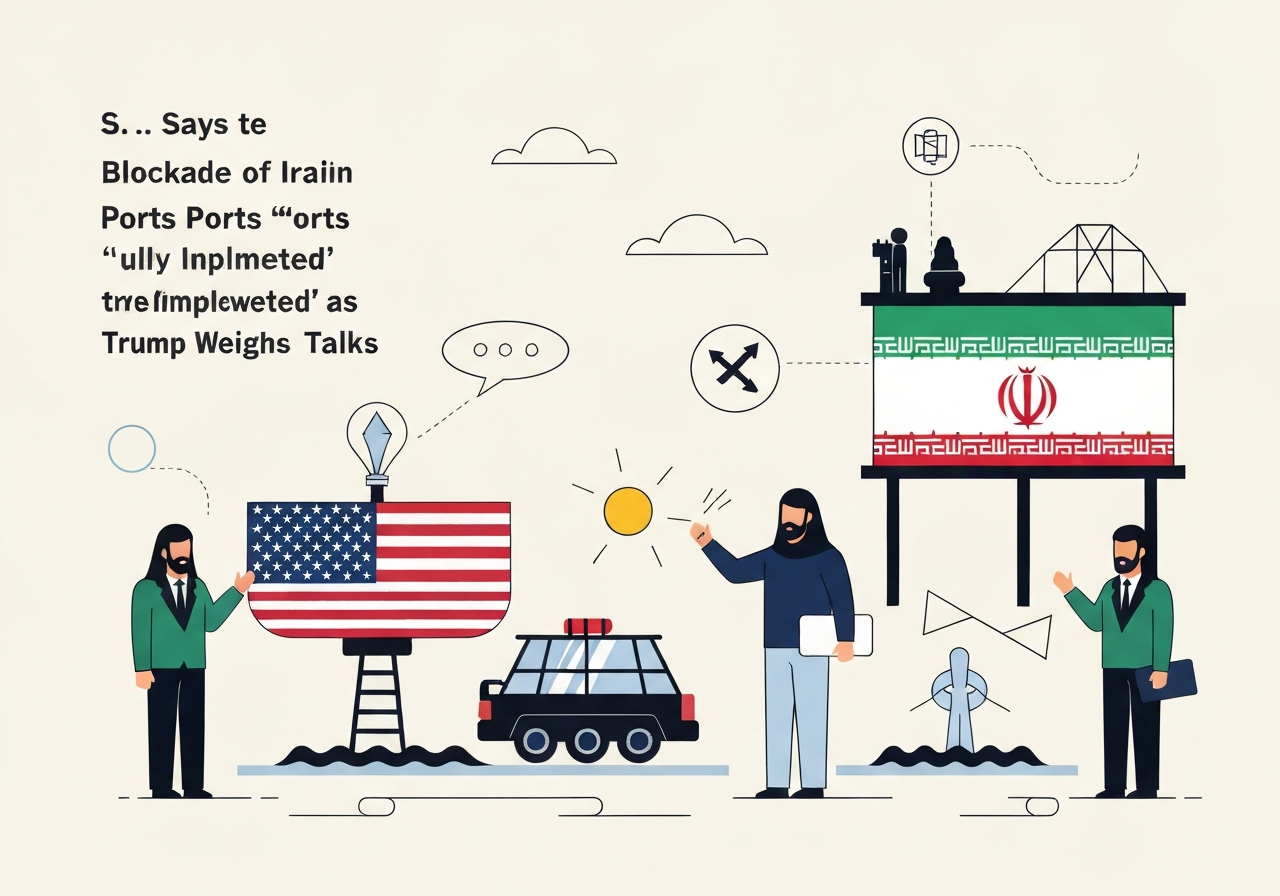
The United States on Tuesday said a naval blockade of Iranian ports has been “fully implemented” as President Trump weighs further negotiations with Iran. U.S. Central Command (CENTCOM) said the operation halted sea trade to and from Iran within 36 hours and that more than 10,000 service members are involved. Diplomatic activity continued in Pakistan and other capitals as officials pushed to resume talks before a fragile ceasefire may lapse. The move has immediate consequences for global energy flows and for stalled U.S.-Iran negotiations.
Key Takeaways
- CENTCOM said the blockade was “fully implemented” and asserted U.S. maritime superiority; it estimated that 90% of Iran’s economy relies on international sea trade.
- More than 10,000 U.S. service members, a dozen warships and over 100 surveillance and fighter aircraft are supporting the operation, CENTCOM said.
- In the first 24–36 hours, U.S. forces directed six merchant vessels to turn back; trackers show at least 3 Iran-linked ships nevertheless transited the Strait of Hormuz.
- The White House reported 103 empty tankers heading to U.S. ports to load oil; 54 are Very Large Crude Carriers with combined capacity near two million barrels.
- U.S. Central Command reported 399 U.S. service members wounded in the Iran war as of April 14, 2026; 354 have returned to duty and three are seriously wounded.
- The IMF cut its 2026 growth forecast for the Middle East and North Africa to 1.1%, warning Iran could shrink by 6.1% amid disrupted oil exports.
- Diplomatic shuttling continued: Pakistan’s prime minister planned visits to Saudi Arabia, Qatar and Turkey to press for another U.S.-Iran negotiating round.
Background
The United States and Israel opened a military campaign against Iran earlier this year; that confrontation has disrupted oil production and prompted a partial ceasefire brokered last week. Washington subsequently ordered restrictions on Tehran’s maritime commerce and then escalated enforcement by declaring a blockade of Iranian ports beginning at 10 a.m. ET on Monday. The U.S. frames the action as targeting shipments linked to Iran’s economy while preserving freedom of navigation for vessels bound to and from non-Iranian ports.
Iran has been using a mix of regular shipping and a so-called dark fleet to keep crude flowing to Asian buyers despite sanctions and wartime pressures. Tehran also has charged transit fees for passage through the Strait of Hormuz, a chokepoint through which roughly one-fifth of global oil normally transits. The current blockade and related fighting have intersected with diplomatic efforts: Pakistani-facilitated talks in Islamabad produced no final deal, and negotiators are attempting to reconvene before a tenuous ceasefire expires.
Main Event
CENTCOM issued a nighttime statement saying the blockade had been “fully implemented,” and Adm. Brad Cooper, CENTCOM commander, said U.S. forces “completely halted economic trade going into and out of Iran by sea” in less than 36 hours. Military officials described actions that included interdiction orders and directions for certain merchant ships to return to Iranian ports. The U.S. also reported that more than a dozen warships and some 100 aircraft were involved.
Maritime tracking firms and open-data providers showed mixed movement: Kpler and other trackers logged at least seven Iran-linked vessels transiting the Strait of Hormuz after the blockade began, while U.S. officials said six merchant vessels complied with orders to turn back. U.S. forces said they were allowing passage for ships transiting the strait bound for non-Iranian ports, enforcing a narrower blockade on Iranian coastal commerce primarily from the Gulf of Oman.
On the diplomatic front, Pakistan continued shuttle diplomacy: Prime Minister Shehbaz Sharif planned visits to Saudi Arabia, Qatar and Turkey to press for renewed U.S.-Iran talks. U.N. Secretary-General António Guterres said it was “highly probable” that talks would restart. Vice President J.D. Vance and other U.S. officials described progress in Islamabad but said Tehran still faces stiff U.S. red lines — including long curbs on enrichment and other nuclear-related constraints.
Analysis & Implications
Operationally, the blockade signals a willingness to apply economic pressure at sea rather than by targeting oil infrastructure ashore. CENTCOM’s claim that 90% of Iran’s economy depends on maritime trade underscores why a blockade can be strategically potent: cutting sea-based exports and imports can constrict revenue and spare the U.S. from some direct kinetic escalation on land. Still, enforcement in a congested international waterway carries legal and logistical complexities, especially when vessels flagged to third countries are involved.
For global energy markets, the action risks an immediate supply shock. Before the war, the U.S. produced about 13 million barrels per day and exported roughly 11 million barrels daily while importing about 8 million, per the Energy Information Administration. The White House’s note that 103 empty tankers were heading to U.S. ports to load crude signals a reallocation of shipping capacity, but not a quick fix for Asian buyers who relied on Iranian supplies.
Diplomatically, the blockade may be a lever to bring Iran back to the table or to strengthen U.S. negotiating posture. U.S. diplomats reportedly asked Tehran to suspend enrichment for at least 20 years during Islamabad talks, a demand Iran has neither accepted nor publicly endorsed. If negotiations falter, the blockade could harden Tehran’s position and widen regional alignments, drawing in states with close trade ties to Iran such as China, India and Pakistan.
Comparison & Data
| Item | Figure |
|---|---|
| U.S. pre-war crude production | 13 million bpd (EIA) |
| U.S. crude exports (pre-war) | ~11 million bpd |
| Tankers bound for U.S. ports | 103 (54 VLCCs; ~2M barrels capacity) |
| U.S. wounded in Iran war | 399 (354 returned to duty; 3 seriously wounded) |
| IMF MENA 2026 growth forecast | 1.1% (Iran −6.1%) |
The table aggregates public figures cited by U.S. agencies, CENTCOM and international institutions. The data show how military measures and disrupted maritime flows can quickly reshape economic forecasts and energy logistics in the near term.
Reactions & Quotes
U.S. military and political leaders framed the blockade as an instrument of leverage; allied and regional capitals expressed concern and urged diplomatic progress. Below are representative public remarks and their context.
“An estimated 90% of Iran’s economy is fueled by international trade by sea. In less than 36 hours since the blockade was implemented, U.S. forces have completely halted economic trade going into and out of Iran by sea.”
Adm. Brad Cooper, CENTCOM (official statement)
CENTCOM issued the statement to describe operational success and to underline the economic impact. Independent trackers and some open-data observers reported continued, limited transits, signaling friction between claims of complete stoppage and observable ship movements.
“I think it’s close to over. If I pulled up stakes right now, it would take them 20 years to rebuild that country.”
President Donald J. Trump (interview excerpt)
President Trump expressed optimism about the conflict’s trajectory while also stressing hardline negotiating aims toward Iran. His public comments accompanied efforts to resume diplomacy in Islamabad and other third-party venues.
“I feel very good about where we are… we’re not looking for a small deal.”
Vice President J.D. Vance (public remarks)
Vance, returning from Pakistan, described progress but reiterated that the administration seeks a broad agreement limiting Iran’s nuclear capabilities and influence rather than a narrow, short-term ceasefire.
Unconfirmed
- Open-source trackers report several Iran-linked vessels transited the strait after the blockade began; U.S. claims of complete stoppage have not been independently corroborated for every vessel.
- Some maritime transponder data could reflect spoofing or delayed position reports; definitive verification of every ship’s origin and cargo awaits formal inspections or intelligence disclosures.
- Reports that the U.S. will not challenge Chinese, Indian or Pakistani ships loading in Iranian ports remain characterizations by analysts rather than stated policy from Washington.
Bottom Line
The U.S. declaration that a blockade of Iranian ports is “fully implemented” marks a major escalation in the maritime dimension of the Iran conflict, with immediate economic and diplomatic effects. The action tightens pressure on Tehran’s revenue streams and reshapes leverage at the negotiating table, but it also raises the prospect of wider regional friction and complications for third-country shipping and energy markets.
Diplomacy remains central to whether the blockade leads to a negotiated pause or to deeper confrontation. Pakistani and U.N.-led efforts to restart U.S.-Iran talks will be closely watched in the next days; how Iran, China, India and Gulf states respond will determine whether the blockade yields concessions or fuels further instability.