
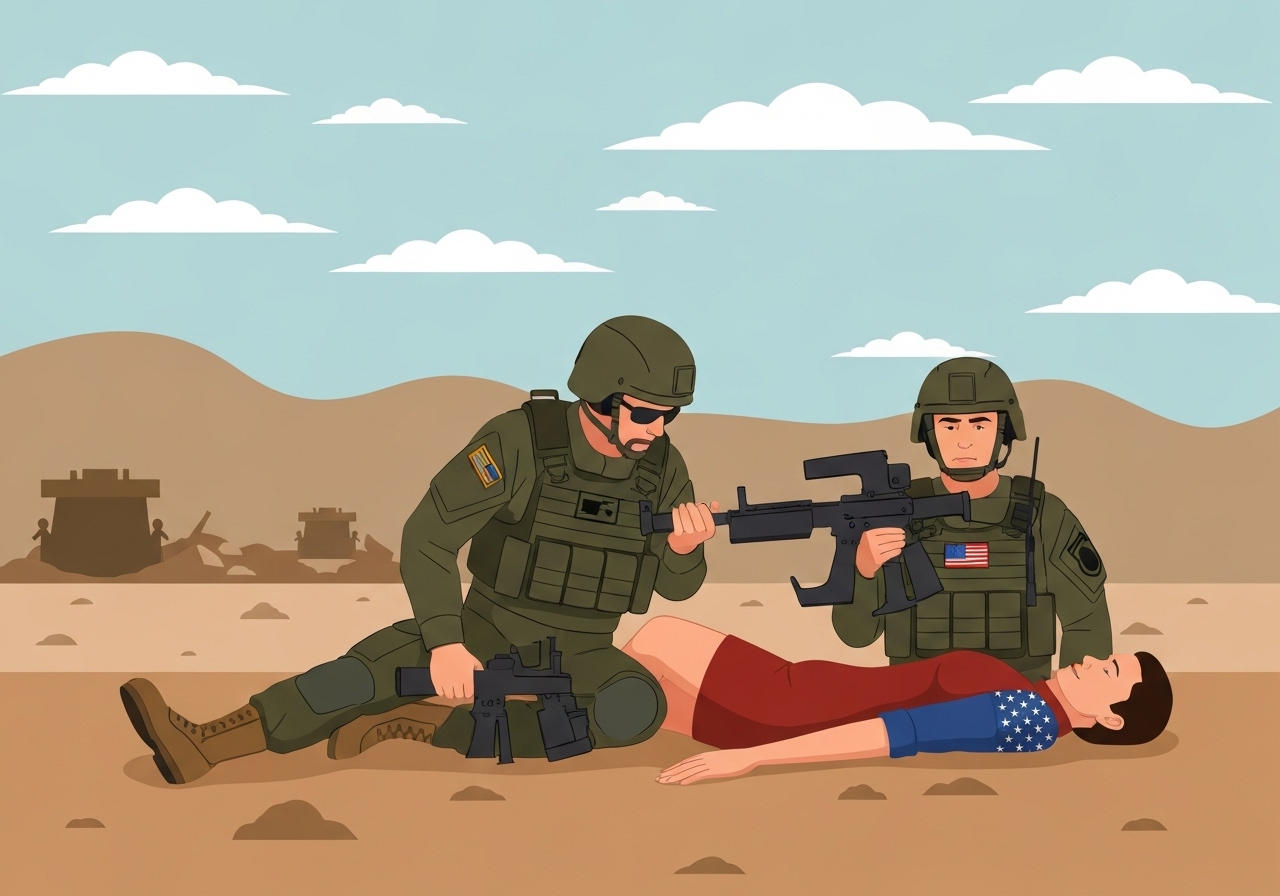
Lead: Two U.S. service members and one American civilian were killed Saturday in an ambush near Palmyra in central Syria, U.S. Central Command and Syrian state media said. The United States has blamed the Islamic State group for the attack and reported three other U.S. service members wounded; the shooter was killed, U.S. officials said. President Donald Trump warned of “very serious retaliation” and said Syrian interim leader Ahmed al-Sharaa expressed deep distress over the incident. The Pentagon identified the slain civilian as a U.S. interpreter and said the operation targeted personnel engaged in counter‑terrorism missions.
Key Takeaways
- The attack occurred near historic Palmyra in central Syria; two U.S. service members and one American civilian were killed, and three service members were wounded, officials said.
- U.S. Central Command reported that a lone assailant carried out the ambush and was subsequently killed by U.S. forces.
- President Donald Trump vowed “very serious retaliation” and said Syrian interim leader Ahmed al-Sharaa was “devastated” by the killings.
- The Pentagon identified the deceased American civilian as an interpreter attached to U.S. counter‑terrorism operations.
- SANA, Syria’s state news agency, reported additional Syrian security wounded and said casualties were evacuated to the al-Tanf garrison near the Iraq–Jordan border.
- The Britain‑based Syrian Observatory for Human Rights and Syria’s Interior Ministry provided differing initial accounts of the attacker’s affiliation.
- The United Nations estimates Islamic State remnants number between 5,000 and 7,000 fighters across Syria and Iraq, underscoring the ongoing threat despite IS battlefield defeats in 2019.
Background
U.S. forces have maintained deployments across eastern and central Syria as part of a multinational campaign to prevent Islamic State (IS) resurgence and to train local partners. One of the principal U.S. positions in the region is the al-Tanf garrison in Homs province, which lies near the tri‑border area with Iraq and Jordan. IS was militarily defeated in Syria in 2019 but has retained an insurgent presence through sleeper cells and sporadic attacks since then.
Political dynamics in Damascus have shifted over the past year: President Bashar al-Assad was ousted when insurgents captured Damascus, and Ahmed al-Sharaa assumed interim leadership in January after leading the rebel coalition that toppled Assad in December 2024. Relations between Syria and the West have warmed, including al-Sharaa’s visit to Washington last month — described by U.S. officials as the first White House visit by a Syrian head of state since 1946 — and the lifting of certain U.S. sanctions imposed during the Assad era.
Main Event
U.S. Central Command said the ambush happened on Saturday in central Syria near Palmyra, a site of repeated security incidents since 2011. According to U.S. statements, a lone gunman opened fire, killing two service members and one American civilian and wounding three other service members; the shooter was later killed at the scene. The Pentagon’s chief spokesman identified the civilian as an interpreter supporting counter‑terrorism operations.
State-run SANA reported that two Syrian security personnel and several U.S. service members were wounded; those injured were airlifted to the al-Tanf garrison, which serves as a logistical and medical hub for coalition forces in the area. Syrian Interior Ministry spokesman Nour al-Din al-Baba described the attacker as linked to IS but said authorities are investigating whether he was an IS member or simply influenced by its ideology.
The Britain‑based Syrian Observatory for Human Rights initially described the attacker as a member of Syrian security forces, a claim that Syrian officials denied. U.S. military sources said the three wounded U.S. service members “seem to be doing pretty well,” according to public remarks by President Trump, while U.S. forces continued to secure the site and collect evidence for an ongoing investigation.
Analysis & Implications
The incident represents a significant escalation because it resulted in U.S. fatalities for the first time since the fall of Bashar al-Assad a year earlier, marking a dangerous moment for stabilizing efforts in central Syria. A deadly strike against U.S. personnel risks prompting kinetic responses that could complicate nascent diplomatic openings between Damascus and Western capitals, including Washington.
If the attacker was indeed affiliated with IS, the strike underlines the group’s continued capacity to strike high‑value targets despite territorial defeat in 2019. The United Nations’ estimate of 5,000–7,000 IS fighters in Syria and Iraq suggests that insurgent networks remain capable of opportunistic violence and targeted assassinations, particularly in areas with fractured authority.
The diplomatic dimension is complex: Damascus is under new interim leadership, and officials describe warming ties with the U.S. after the removal of earlier sanctions and a high‑profile White House visit last month. A retaliatory U.S. response could strain those emerging ties, force clearer alignment choices for local actors, and influence partner forces the U.S. trains and supports in the region.
Comparison & Data
| Event | Date | U.S. Fatalities | Other U.S. Wounded |
|---|---|---|---|
| Palmyra ambush (this incident) | Saturday (reported) | 2 service members, 1 civilian | 3 wounded |
| Manbij blast | 2019 | 2 service members, 2 civilians (U.S.) | several local casualties |
The table highlights that fatalities among U.S. personnel in Syria have been relatively rare since 2019, but high‑profile incidents — such as the 2019 Manbij blast — have occurred. The recent deaths signal a potential return to lethal engagements that could alter force posture or rules of engagement depending on the outcome of U.S. investigations and policy decisions.
Reactions & Quotes
U.S. national leadership framed the attack as an act requiring a strong response. President Trump warned of retaliation on social media and in remarks at the White House, framing the incident as an ISIS attack and noting Syrian leader Ahmed al-Sharaa’s stated distress.
“There will be very serious retaliation.”
President Donald Trump
The Pentagon characterized the deceased civilian as an interpreter, underscoring the role of locally employed staff in U.S. counter‑terrorism missions, while U.S. Central Command provided casualty figures and said the event is under active investigation.
“If you target Americans — anywhere in the world — you will spend the rest of your brief, anxious life knowing the United States will hunt you, find you, and ruthlessly kill you.”
Pete Hegseth (posted on X, described in reports as U.S. Defense Secretary)
Syrian officials offered competing details: SANA reported Syrian security casualties and evacuation to al-Tanf, while the Interior Ministry said it is probing the attacker’s ties to IS. The Britain‑based Syrian Observatory also issued a differing account about the assailant’s identity, reflecting the fragmented flow of information in conflict zones.
Unconfirmed
- Whether the assailant was formally a member of Islamic State or merely inspired by its ideology remains under investigation and unconfirmed by independent forensic evidence.
- Conflicting early reports about the attacker’s identity (Syrian security member vs. IS‑linked gunman) have not been reconciled in a public, verified account.
- The precise motive and whether the strike targeted a specific person or unit within the U.S. contingent have not been conclusively established.
Bottom Line
The assault that killed two U.S. service members and an American civilian marks a dangerous escalation in central Syria and underscores the persistent threat posed by militant cells despite IS’s territorial defeat. Immediate consequences are likely to include intensified investigations, short‑term operational adjustments for U.S. forces in Syria, and pressure on Washington to determine an appropriate response that balances military, diplomatic, and coalition considerations.
Longer term, the incident may complicate fragile diplomatic openings between the United States and the new Syrian interim administration, test the resilience of local security arrangements around strategic sites like al‑Tanf and Palmyra, and serve as a reminder that counter‑terrorism presence in the region continues to carry significant risk.
Sources
- Associated Press — (news report)
- SANA (Syrian Arab News Agency) — (state news agency)
- Syrian Observatory for Human Rights — (UK‑based monitoring group)
- U.S. Central Command — (official military statements)
- United Nations — (international organization estimates on IS strength)