
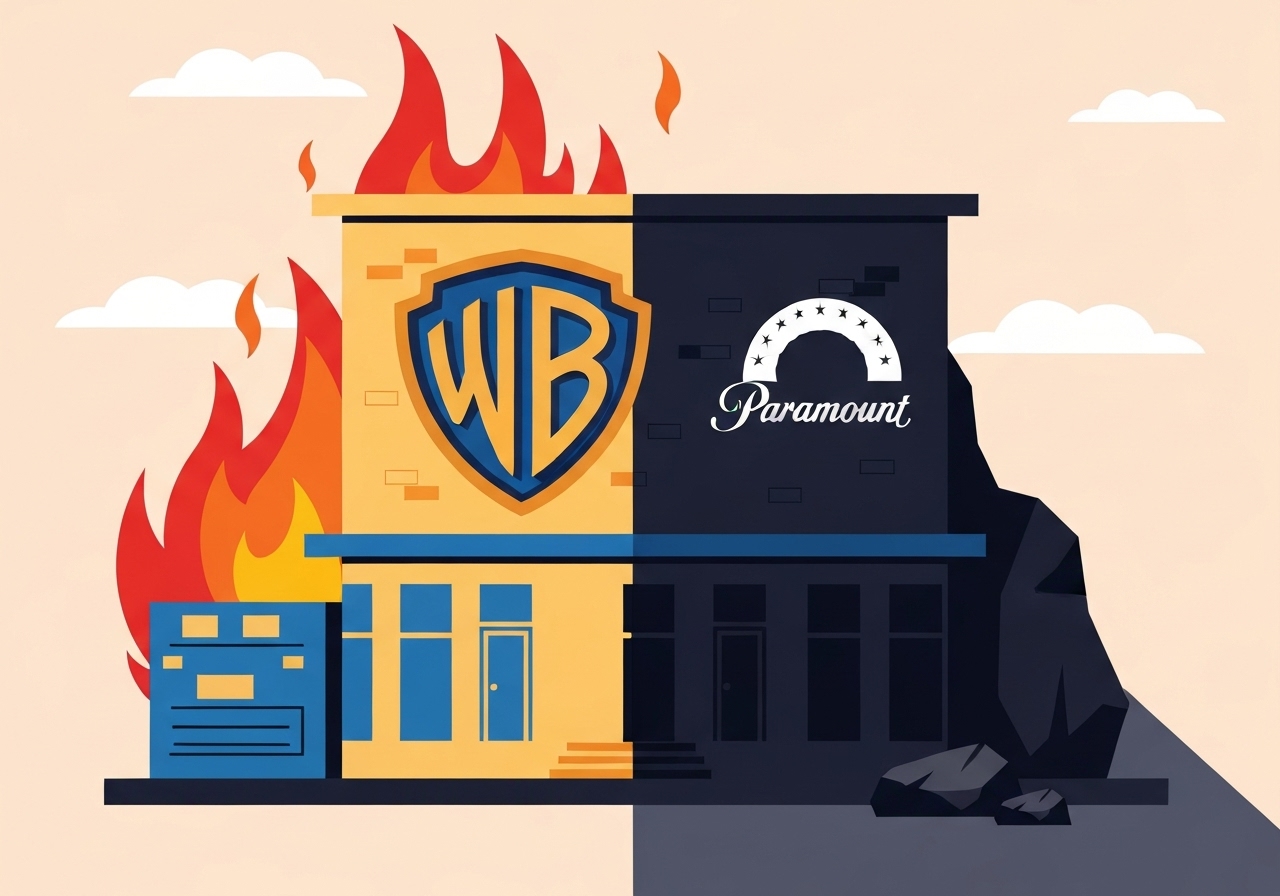
Lead: Warner Bros. Discovery on Wednesday rejected a renewed hostile bid from Paramount for control of the company and reiterated its recommendation that shareholders accept Netflix’s separate offer to buy Warner’s studio and streaming assets for $72 billion. The board said Paramount’s $77.9 billion proposal for the entire company carries excessive financing risk and insufficient protections for shareholders. Warner gave shareholders until Jan. 21 to tender shares in the competing offers. The board concluded the Netflix transaction offers greater certainty and superior value.
Key Takeaways
- Warner’s board again rejected Paramount’s $77.9 billion hostile bid and recommended shareholders stick with a Netflix offer for Warner’s studio and streaming business worth $72 billion.
- Warner cited “an extraordinary amount of debt financing” in Paramount’s proposal and highlighted operating restrictions that could hamper the company during a takeover process.
- Paramount has sweetened its pitch, adding an irrevocable personal guarantee reportedly covering $40.4 billion in equity financing from Larry Ellison and matching Netflix’s $5.8 billion breakup fee.
- Shareholders have until Jan. 21 to tender their shares, a deadline that sets the timetable for any resolution of the competing bids.
- Either transaction would likely trigger a yearlong review and intense U.S. Department of Justice antitrust scrutiny, with potential litigation or required divestitures.
- Cinema United, representing more than 60,000 screens, warned lawmakers that consolidation could harm theaters, jobs and creative diversity, voicing concern about both offers.
Background
Warner Bros. Discovery was formed through earlier media mergers that combined legacy studio assets, cable networks and streaming services; its current structure separates studio and streaming operations from some news and linear networks. The current contest pits Netflix’s targeted bid for Warner’s production and streaming units against Paramount’s all‑in acquisition attempt to buy the entire company, including news networks and Discovery assets.
Paramount’s effort has been framed as a hostile takeover led by Skydance ownership, while Netflix’s approach is a negotiated sale covering a narrower set of assets. Executives and directors on both sides have argued valuation, leverage and strategic fit, and the dispute has rapidly escalated into a high‑stakes corporate and regulatory fight that draws attention from investors, rivals and U.S. antitrust authorities.
Main Event
This week Warner’s board issued a formal letter to shareholders renewing its recommendation that they support the Netflix transaction. The board characterized Paramount’s improved bid as carrying significant financing risk and said it did not sufficiently protect shareholders if the deal fails to close. Warner’s chair, Samuel Di Piazza Jr., framed the Netflix agreement as providing more certainty and greater value.
Paramount, for its part, has increased incentives for shareholders and publicized a large financing commitment tied to an “irrevocable personal guarantee” from Oracle founder Larry Ellison, described by Paramount as backing $40.4 billion in equity financing. The company also offered a $5.8 billion contingent payout to match Netflix’s breakup fee, signaling determination to press the hostile offer.
Warner reiterated that it views the Paramount bid in practice as a leveraged buyout with operating covenants that could constrain WBD’s ability to run its businesses during the takeover process. The board said those terms raise execution risk and reduce the relative attractiveness of Paramount’s price despite the higher headline figure.
With the Jan. 21 tender deadline approaching, shareholders and proxy advisers will weigh competing claims: a narrower but negotiated Netflix sale with a stated breakup fee and a broader, debt‑heavy Paramount bid that aims to acquire the full company. Both sides have signaled they are prepared for extended shareholder and regulatory fights.
Analysis & Implications
If Netflix closes only on Warner’s studio and streaming business, Warner’s remaining assets — notably CNN and other cable networks — would likely be spun out into a standalone public company, a separation already contemplated in prior planning. That split would alter the competitive landscape for streaming and news media and change the balance between subscription and advertising revenue streams.
A Paramount acquisition of the entire company would create a very large media conglomerate combining studio output, streaming reach and linear networks. Regulators will closely examine vertical and horizontal overlaps: the Department of Justice is expected to evaluate whether any combination substantially lessens competition in streaming, theatrical distribution, news markets or advertising intermediation.
Antitrust review could be protracted. The DOJ can sue to block a deal or seek remedies and third‑party regulators overseas could impose their own conditions, increasing the risk that a transaction is delayed, altered or abandoned. Political considerations were flagged in public debate, including commentary about possible involvement by the White House in high‑profile merger reviews.
For shareholders and employees, the choices are trade‑offs between higher headline consideration under Paramount and lower perceived execution risk and narrower regulatory exposure with Netflix. The outcome will shape content spending, studio production pipelines and distribution strategies across Hollywood for years.
Comparison & Data
| Offer | Headline Value | Scope | Financing/Guarantee | Breakup Fee |
|---|---|---|---|---|
| Netflix | $72 billion | Studio & streaming assets only | Negotiated equity/cash financing (company statement) | $5.8 billion |
| Paramount | $77.9 billion | Entire company (networks, studio, streaming) | Includes reported $40.4 billion personal guarantee tied to financing | $5.8 billion (matching Netflix) |
The table highlights the core distinctions: Paramount’s higher nominal price covers more assets but relies heavily on large financing commitments, while Netflix’s lower figure targets a narrower set of businesses and, according to Warner’s board, offers greater certainty of closing.
Reactions & Quotes
Warner’s board framed its position around shareholder protection and execution risk before and after issuing its shareholder letter. Analysts noted that leverage and covenants can materially affect the likelihood of a deal closing even when the headline price is higher.
“Paramount’s offer continues to provide insufficient value, including terms such as an extraordinary amount of debt financing that create risks to close and lack of protections for our shareholders if a transaction is not completed.”
Samuel Di Piazza Jr., WBD Chair (statement)
Industry groups and cinemas warned lawmakers about the wider market consequences. Cinema United addressed Congress with concerns focused on theaters’ role in the film ecosystem and risks from further consolidation.
“We are deeply concerned that a horizontal or vertical consolidation could harm moviegoers and the many people who work in theaters worldwide.”
Cinema United (statement to Congressional antitrust subcommittee)
Unconfirmed
- How the U.S. Department of Justice will rule on competitive harms is unresolved and contingent on formal filings and investigation outcomes.
- Details and enforceability of Larry Ellison’s reported $40.4 billion guarantee have not been fully disclosed in public filings.
- Any informal political influence on the regulatory review process has been discussed publicly but lacks confirmed, direct procedural impact at this stage.
Bottom Line
The dispute between Paramount and Netflix over Warner Bros. Discovery reduces to a choice between a higher, debt‑dependent bid for the whole company and a narrower, negotiated sale that Warner’s board sees as more likely to close. Shareholders must weigh immediate value against execution and regulatory risk before the Jan. 21 tender deadline.
Regardless of the winner, the contest will reshape media ownership and distribution: a Paramount takeover would consolidate networks and studios under one owner, while a Netflix acquisition of studios and streaming assets would accelerate content concentration in the streaming market and leave news and cable networks as a standalone company. Expect prolonged regulatory scrutiny and possible legal challenges before any definitive outcome.
Sources
- ABC News — news report summarizing statements and filings (media)
- Netflix — corporate site for official transaction communications (official)
- Paramount — corporate information on the bid (official)
- U.S. Department of Justice, Antitrust Division — regulatory authority likely to review the transaction (official)