
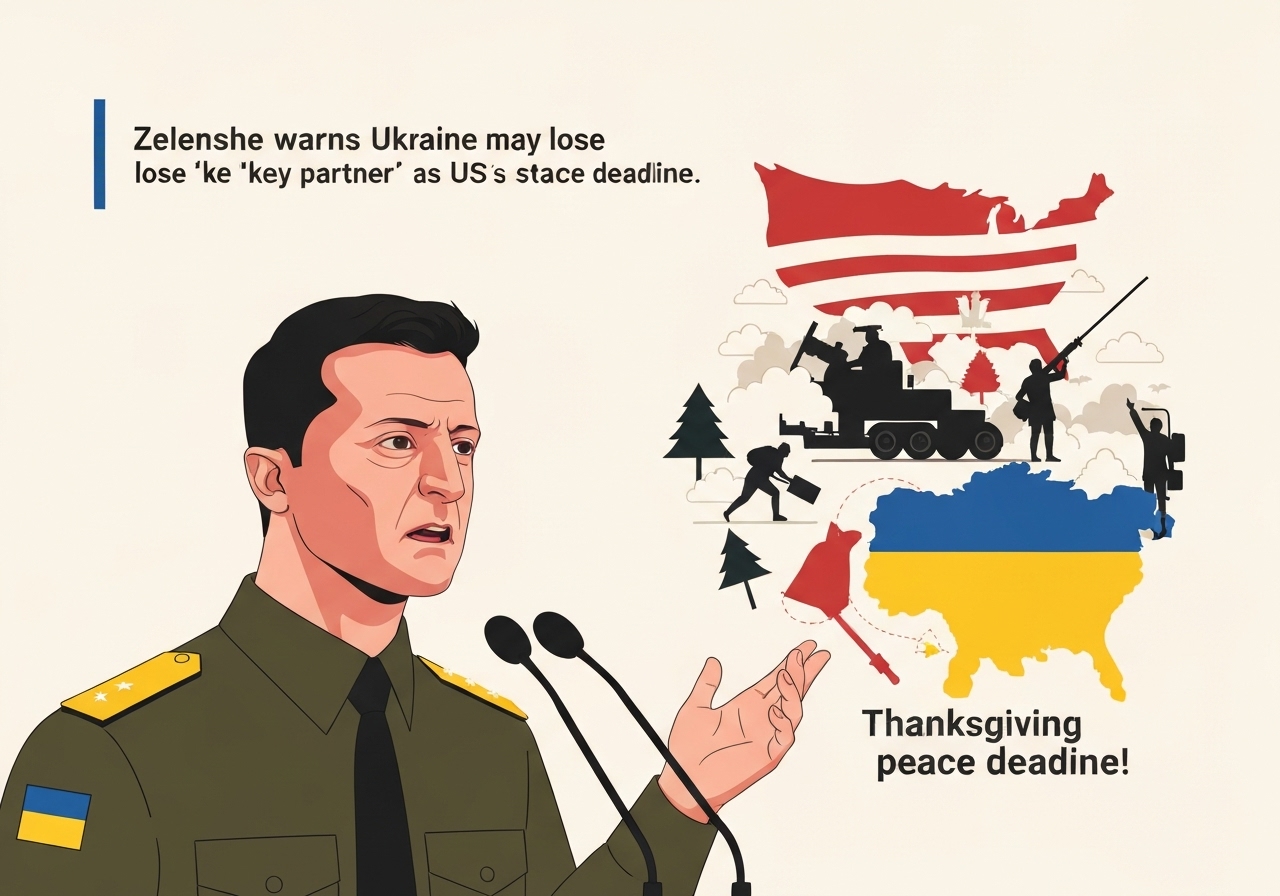
In a national address on 13 November 2024 from outside the presidential palace in Kyiv, President Volodymyr Zelensky warned that Ukraine faces a stark choice between preserving national dignity and risking the loss of a crucial ally. The warning came as the US administration floated a 28-point plan to end the war with Russia and indicated 27 November (Thanksgiving) as a target date for Kyiv to sign. The draft, publicly reported by multiple outlets, would recognise large swathes of territory now under Russian control and set concrete conditions for Ukraine’s military and future elections. Zelensky said Kyiv will present alternatives while working with partners to protect national interests.
Key Takeaways
- The US has circulated a 28-point draft peace plan; officials indicated 27 November 2024 as a possible signing date tied to Thanksgiving.
- Under the leaked draft, the US would treat Crimea, Donetsk and Luhansk as de facto Russian territory and allow Russia to hold additional occupied areas.
- The plan would bar Ukraine from Nato membership and cap its armed forces at 600,000 personnel.
- It calls for Ukrainian elections within 100 days and a recovery package using some $100bn (£76.4bn) of frozen Russian assets.
- The US would promise a “decisive coordinated military response” and reimposition of sanctions if Russia re-invades under the guarantee clause.
- Zelensky told citizens he will propose alternatives and will not “betray” Ukraine, stressing unity amid internal and external pressure.
- The Kremlin says it has not received any formal text from Washington and describes the public reports as unconfirmed.
Background
The Russo‑Ukrainian war escalated into a full‑scale invasion in February 2022 and has since reshaped European security priorities and transatlantic policy. Kyiv’s pursuit of Nato membership became a central point of contention before and after the invasion; the leaked plan would require Kyiv to forswear that route, reversing a constitutional aspiration. International efforts to find a negotiated end to the fighting have repeatedly stalled amid territorial disputes, mass displacement and sanctions on Moscow.
Domestically, Ukraine’s leadership faces added pressure from a corruption scandal involving senior officials and from political forces advocating different end‑game strategies. Externally, the US has been a principal security partner, providing weapons, intelligence and sanctions coordination. Any US‑brokered settlement that substantially changes front lines or security guarantees would alter Kyiv’s relationship with Western backers and the balance of deterrence in Europe.
Main Event
Throughout 13 November, reports circulated that the Trump administration had drafted a 28‑point framework and that the White House viewed 27 November as an “appropriate” moment for Kyiv to agree. Former US President Donald Trump, speaking on Fox Radio, indicated deadlines could be extended if progress justified it but defended the Thanksgiving timing as reasonable. Officials confirm elements of the draft have been discussed with some intermediaries, while a Ukrainian opposition figure made the draft publicly accessible.
The draft’s headline items include an immediate ceasefire if both sides consent; recognition of Russian control over Crimea, Donetsk and Luhansk; and further territorial concessions where Russia currently occupies land. Kyiv would be asked to renounce Nato aspirations and to cap its military strength at 600,000, according to the circulated text. The plan would also require Ukraine to hold national elections within 100 days and accept an economic recovery package leveraging roughly $100bn (£76.4bn) in frozen Russian assets.
President Zelensky addressed the nation, warning citizens of mounting pressure and promising to offer alternatives. He stressed that Ukraine will work calmly with the United States and other partners while defending the country’s national interest. Separately, CBS‑reported contacts indicate US Vice‑Presidential ally JD Vance spoke with Zelensky on the day of the address about the proposal; the Kremlin says it has not received any formal submission from Washington.
Analysis & Implications
If implemented as leaked, the plan would institutionalise major territorial losses for Ukraine and reshape Kyiv’s security posture for decades. Recognition of Crimea and parts of Donetsk and Luhansk as de facto Russian would effectively freeze a large portion of the front lines in Russia’s favour, limiting Kyiv’s options for future recovery and defence. For many Ukrainians and their political leadership, such concessions intersect with national identity and sovereignty in ways that make rapid acceptance politically fraught.
From a transatlantic perspective, asking Kyiv to renounce Nato membership would signal a significant shift in US policy and could divide European capitals. Some NATO members might welcome a de‑escalation, while others warn that conceding territorial changes to a revanchist neighbour undermines the alliance’s deterrent credibility. The pledge of a US military response if Russia re‑invades is a form of deterrence, but the details—timing, scope and legal basis—would determine its credibility.
Economically, using about $100bn in frozen Russian assets to fund reconstruction would provide Kyiv with a major infusion but also face legal and diplomatic hurdles. Russia’s demand for sanctions relief in exchange for territorial recognition and negotiation could lead to protracted talks. The short election timetable (100 days) raises practical questions about conducting free and secure polls amid conflict and displacement.
Comparison & Data
| Plan Element | Leaked Proposal | Ukraine’s prior position |
|---|---|---|
| Territorial status | Recognise Crimea, Donetsk, Luhansk as de facto Russian | Non‑recognition; aim to restore territorial integrity |
| Nato membership | Renounce path to Nato | Constitutional aspiration to join Nato |
| Military size | Cap at 600,000 | No imposed cap; build for defence |
| Elections | Within 100 days | Elections deferred from early 2024 due to war |
| Reconstruction funds | Use ~$100bn frozen Russian assets | Seek international aid and investment |
The table highlights how the draft contrasts with Kyiv’s public red lines. Practical implementation would require legal mechanisms, international coordination and verification arrangements; absent those, the plan risks producing a fragile settlement that may not address root causes of the conflict.
Reactions & Quotes
Domestic and international responses were swift and varied, reflecting the political sensitivity of the proposals. Zelensky framed his remarks around national dignity and partnership with the West, while US spokespeople emphasised the aim of securing a ceasefire and a guaranteed deterrent against renewed invasion. Moscow has said it has seen media reports but received no official text from Washington.
“Either losing our dignity, or risk losing a key partner.”
Volodymyr Zelensky — President of Ukraine (excerpted)
Zelensky used the phrase to encapsulate the dilemma he says Ukraine now faces, adding that Kyiv will present alternatives and work constructively with allies. His remarks were delivered outside the presidential palace to underscore national resolve amid pressure.
“Thursday 27 November is an appropriate time.”
Donald Trump — Former US President (interview)
Trump’s remark to media set the public deadline, a timeline the White House described as flexible if negotiations required more time. The Thanksgiving date has become the focal point for diplomatic urgency in public reporting.
“We haven’t received anything officially.”
Dmitry Peskov — Kremlin spokesperson
The Kremlin spokesman said Moscow had not seen an official plan from Washington and characterized public accounts as speculative, while reiterating that Russia remained open to talks in principle.
Unconfirmed
- Whether Washington has delivered a formal, signed text of the 28‑point plan to Moscow; the Kremlin says it has not officially received anything.
- The exact mechanisms and thresholds that would trigger the US “decisive coordinated military response” are not publicly specified and remain unverified.
- The scope and legal pathway for unlocking approximately $100bn in frozen Russian assets for Ukraine have not been detailed and face likely legal challenges.
Bottom Line
The leaked US plan and its Thanksgiving timetable have intensified a diplomatic and domestic crisis for Kyiv. Accepting the draft as reported would resolve fighting in the near term but at the cost of significant territorial and security concessions that many Ukrainians may find unacceptable. Refusing the draft risks straining ties with the US and other Western partners, especially if they view the proposal as the most realistic path to stop the bloodshed quickly.
For now, Zelensky is signaling a careful, negotiated response: he will propose alternatives while keeping channels with the United States open. The viability of any settlement will hinge on enforceable guarantees, broad domestic consent in Ukraine, and clarity about reconstruction financing—elements that remain unresolved as of the latest reporting.