
Lead
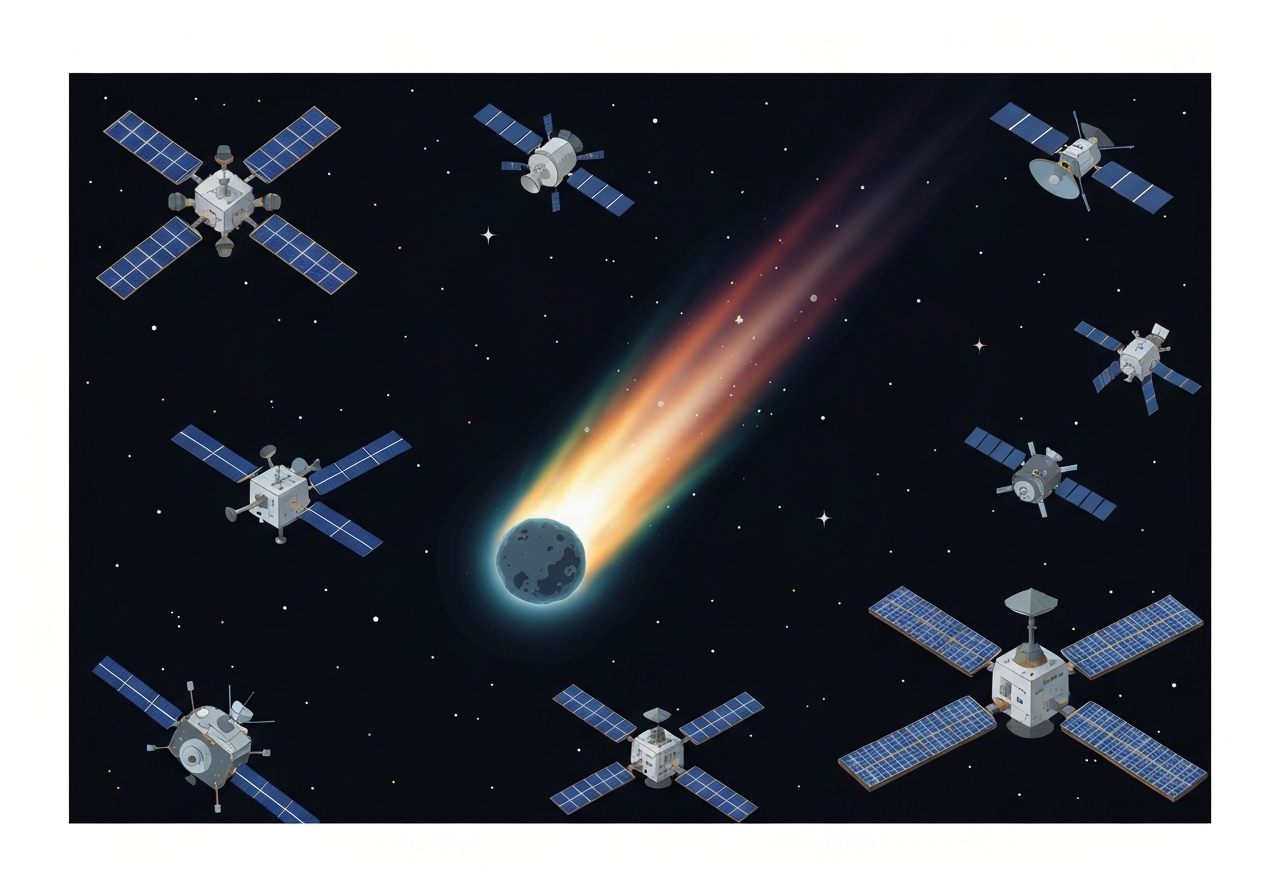
In a coordinated, solar-system wide campaign this year, NASA redirected twelve spacecraft and space telescopes to observe interstellar comet 3I/ATLAS after its discovery on July 1. Observations spanned locations from the surface of Mars to Sun-focused observatories, producing multi-angle imagery and spectral data. Those measurements aim to reveal how 3I/ATLAS compares to comets formed inside our solar system and to refine its trajectory through space. The campaign will continue as the comet moves past Earth’s orbit toward Jupiter in 2026.
Key Takeaways
- Discovery: The ATLAS facility in Chile discovered 3I/ATLAS on July 1, 2024, triggering a coordinated observing response.
- Scale of campaign: Twelve NASA assets have imaged or processed imagery of the comet, with additional opportunities remaining as it travels through the solar system.
- Mars observations: The comet passed about 19 million miles from Mars, where MRO, MAVEN and the Perseverance rover obtained visual and ultraviolet data.
- Heliophysics coverage: STEREO imaged the comet from Sept. 11 to Oct. 2; SOHO observed it Oct. 15–26; PUNCH collected tail imagery from Sept. 20 to Oct. 3.
- Deep-space platforms: Psyche imaged 3I/ATLAS on Sept. 8–9 from ~33 million miles and Lucy on Sept. 16 from ~240 million miles, helping refine trajectory and coma structure.
- Space telescopes: Hubble observed the comet in July; James Webb and SPHEREx acquired imagery in August, contributing compositional clues.
- Closest Earth approach: 3I/ATLAS will be nearest to Earth around Dec. 19 at roughly 170 million miles, nearly twice the Earth–Sun distance.
- Future path: The object is on a trajectory that will carry it past Jupiter’s orbit in spring 2026, offering further remote-observation opportunities.
Background
Interstellar object 3I/ATLAS is the third confirmed object known to have originated beyond our solar system and to transit our planetary neighborhood. Its discovery by the ATLAS survey in Chile on July 1 prompted an unusually broad observing effort because it offers a rare, direct sample of material formed around another star. Prior interstellar visitors provided limited observational windows; this apparition’s geometry allowed instruments across heliocentric distances to track it over an extended interval. Key stakeholders include NASA heliophysics teams, planetary missions at Mars, deep-space asteroid-mission teams, and operators of flagship observatories like Hubble and Webb.
The scientific value of multi-point observations is significant: different vantage points and wavelength coverages reduce degeneracies in interpreting coma structure, dust production, and gas composition. Heliophysics missions can observe regions near the Sun where ground-based telescopes cannot, while deep-space probes deliver long-baseline views that help constrain motion. Past examples of coordinated campaigns—such as for Comet ISON and for active asteroids—show that combining remote-sensing datasets improves estimates of size, activity, and non-gravitational forces. For 3I/ATLAS, the combined approach is intended to test whether interstellar comets present systematically different volatiles or dust properties than solar-system natives.
Main Event
Following the July 1 discovery, NASA added 3I/ATLAS to observing schedules across a range of missions. In July, Hubble captured targeted imagery that established baseline photometry and morphology. August brought infrared and spectrophotometric coverage from the James Webb Space Telescope and SPHEREx, expanding wavelength coverage into thermal and near-infrared bands. These early observations shaped predictions of dust production and helped mission teams plan subsequent encounters.
As the comet approached the inner solar system, assets at Mars provided the closest views. During an early fall flyby that brought the comet within about 19 million miles of Mars, the Mars Reconnaissance Orbiter returned one of the nearest optical images, MAVEN recorded ultraviolet signatures useful for volatile identification, and the Perseverance rover obtained a faint surface-based detection. Those datasets are being combined to infer coma composition and activity levels at that heliocentric distance.
Sun-focused heliophysics platforms filled a gap when the comet moved behind the Sun from Earth’s perspective. STEREO tracked 3I/ATLAS from Sept. 11 to Oct. 2, while the joint ESA–NASA SOHO mission observed it Oct. 15–26. Newer missions also contributed: PUNCH imaged the comet’s tail from Sept. 20 to Oct. 3, revealing dust morphology in the Sun’s extended environment. Simultaneously, outbound asteroid missions added distant viewpoints: Psyche acquired four observations over Sept. 8–9 from roughly 33 million miles, and Lucy imaged it on Sept. 16 from about 240 million miles, enabling image stacking to resolve faint features.
Analysis & Implications
Combining measurements from twelve instruments across diverse platforms reduces observational bias and strengthens inferences about composition and structure. Multi-wavelength data—UV from MAVEN, visible from MRO and Hubble, infrared from JWST and SPHEREx, and heliospheric imaging—allow cross-validation of dust-to-gas ratios and volatile signatures. If 3I/ATLAS shows compositional markers distinct from typical solar-system comets, that would indicate diversity in planetesimal formation conditions across stellar systems. Conversely, similarities would suggest common chemical pathways in protoplanetary disks.
The heliophysics missions’ deliberate observation of an interstellar object is notable because these instruments usually study the Sun and the near-Sun environment; applying them to an interstellar target expands their scientific portfolio. Observations near the Sun can reveal how solar heating alters coma properties and tail dynamics at small solar elongations—conditions often inaccessible to ground telescopes. That information helps constrain dust sublimation rates and the response of different volatile species to intense solar radiation.
Trajectory refinement is another concrete outcome of multi-platform imaging. Psyche’s and Lucy’s distant-line-of-sight observations, combined with higher-resolution imaging from Hubble and MRO, improve orbital solutions and predictions for future positions. Better orbits allow more precise planning for follow-up observations when the comet passes near key regions—most immediately its December 19 closest approach to Earth at ~170 million miles and later when it nears Jupiter’s orbit in spring 2026. Any detection of non-gravitational accelerations would also inform models of outgassing and mass loss.
Comparison & Data
| Platform | Date Range | Approx. Distance | Primary Data |
|---|---|---|---|
| ATLAS (Chile) | July 1, 2024 | Discovery | Optical survey detection |
| Hubble Space Telescope | July 2024 | — | High-resolution visible imaging |
| JWST / SPHEREx | August 2024 | — | Infrared/spectrophotometry |
| MRO / MAVEN / Perseverance | Early fall 2024 | ~19 million miles (Mars) | Visible, UV, surface imaging |
| STEREO | Sept. 11–Oct. 2, 2024 | Heliocentric vantage | Coronal and wide-field imaging |
| SOHO | Oct. 15–26, 2024 | Heliocentric vantage | Solar-environment imaging |
| PUNCH | Sept. 20–Oct. 3, 2024 | Heliocentric vantage | Tail polarization/structure |
| Psyche | Sept. 8–9, 2024 | ~33 million miles | Long-baseline optical observations |
| Lucy | Sept. 16, 2024 | ~240 million miles | Stacked distant imaging |
The table summarizes primary dates, approximate distances, and data types. These multi-platform records provide complementary sensitivity: ultraviolet constrains gas species, infrared constrains thermal and ice signatures, and coronagraph-style imagers capture dust tail geometry near the Sun. Together the datasets permit cross-calibration and a more complete physical model than any single instrument could deliver.
Reactions & Quotes
Mission teams and scientific partners framed the campaign as both opportunistic and methodical, emphasizing collaboration across science divisions.
“Observing an object from another star with our heliophysics fleet is unprecedented and yields perspectives we could not get from Earth alone,”
NASA Heliophysics Division (official statement)
Heliophysics leads noted that coronagraph and wide-field imagers filled observational gaps when the comet was sunward of Earth.
“Psyche and Lucy provided long-range views that helped pin down the comet’s path and faint coma structure,”
Psyche Mission Team (mission update)
Planetary scientists highlighted the value of Mars-based observations for compositional work.
“MAVEN’s ultraviolet measurements and MRO’s imaging give us local detail at a distance we rarely achieve for distant comets,”
MAVEN Science Team (research brief)
Unconfirmed
- No peer-reviewed analysis yet definitively shows that 3I/ATLAS has a composition distinct from solar-system comets; current spectral hints remain preliminary.
- Reports of any solid nucleus size estimate vary across teams; size determinations are still being refined and await consolidated modeling.
Bottom Line
NASA’s coordinated use of twelve spacecraft and observatories to track interstellar comet 3I/ATLAS represents an unprecedented, cross-disciplinary effort to study material formed around another star. The campaign’s multi-angle, multi-wavelength data improve trajectory estimates and provide complementary constraints on dust and volatile properties that single-platform studies cannot match. While preliminary results are promising, definitive compositional comparisons require integrated analysis and peer review; investigators will continue to refine models as more data are processed.
Observers should note two near-term milestones: the comet’s closest approach to Earth around Dec. 19 at ~170 million miles and its passage past Jupiter’s orbit in spring 2026. Those dates will guide further remote observations and data synthesis, and they will be key opportunities to test whether interstellar comets routinely differ from the bodies formed in our own solar system.
Sources
- NASA Science — Official release on 3I/ATLAS observations (official NASA page)
- NASA short link resource for 3I/ATLAS (official NASA resource)
- SOHO mission pages (ESA/NASA mission information)