
Lead
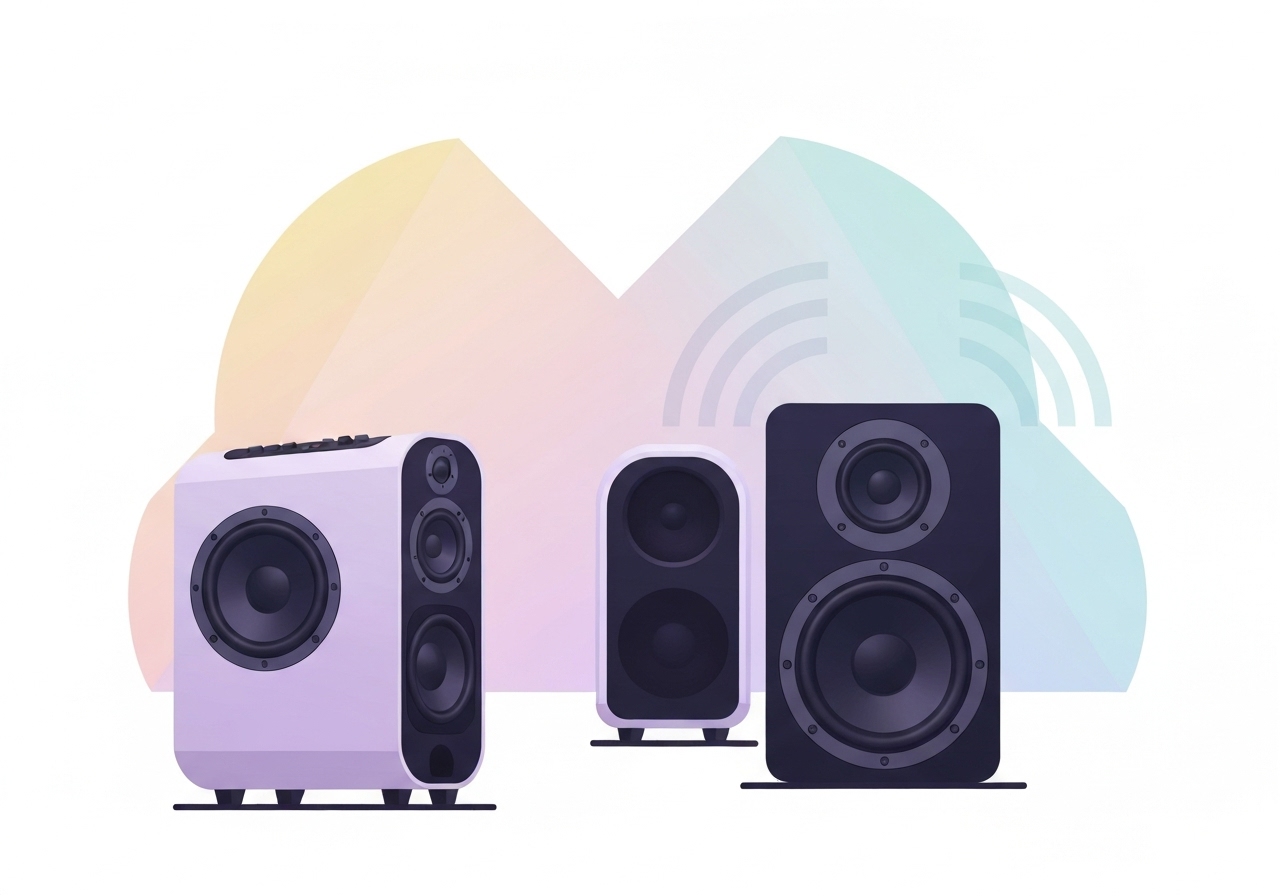
Samsung announced two new wireless speakers, the Music Studio 5 and Music Studio 7, at CES 2026, pairing audio engineering with a gallery-focused design collaboration. The line was developed with designer Erwan Bouroullec and leans on a visual motif Samsung calls the “timeless dot concept.” The Studio 5 packs a 4-inch woofer and dual tweeters with integrated waveguides, while the Studio 7 offers a 3.1.1-channel configuration and native high-resolution playback up to 24-bit/96kHz. Both models use Samsung’s AI Dynamic Bass Control to broaden low-frequency response and can integrate with Samsung’s wider audio ecosystem.
Key Takeaways
- Two new models: Music Studio 5 (compact) and Music Studio 7 (larger 3.1.1-channel) were revealed at CES 2026.
- The Studio 5 features a 4-inch woofer plus dual tweeters with built-in waveguides for controlled dispersion.
- The Studio 7 supports 3.1.1 channels, can operate alone or in stereo pairs, and sync with Samsung Wi‑Fi speakers, soundbars, and TVs via Q‑Symphony.
- High-resolution audio support: Studio 7 can play up to 24‑bit/96kHz files; both models employ AI Dynamic Bass Control for extended bass.
- Design collaboration: French designer Erwan Bouroullec helped turn the speakers into sculptural objects inspired by a “timeless dot” motif.
- Samsung continues a visual-first approach following products such as The Frame TV and last year’s Music Frame speaker.
- Official pricing, regional availability, and independent measured performance were not announced at CES.
Background
Samsung has for years pursued a strategy of blending consumer electronics with interior design, most visibly through The Frame TV line that mimics wall art. That aesthetic ambition expanded into audio last year with the Music Frame, a speaker that presented itself as a picture frame rather than a conventional audio box. The Music Studio series represents a subtle shift: instead of hiding electronics, Samsung and Bouroullec intentionally make the device read as an art object.
The partnership with Erwan Bouroullec ties Samsung’s industrial design to a contemporary art vocabulary; Samsung describes the visual language as a “timeless dot concept” recurring across music and visual arts. The move fits into a broader industry trend where premium audio products emphasize both form and function to command higher retail positioning and fit into lifestyle-focused categories. Samsung also leverages its existing Q‑Symphony ecosystem—previously used to align soundbars with TV speakers—to position the Studio 7 as part of an expandable home audio setup.
Main Event
At CES 2026, Samsung introduced the Music Studio 5 and Music Studio 7, detailing driver complements and connectivity modes. The Studio 5 is the smaller model with a 4‑inch woofer and two tweeters that use waveguides to shape dispersion, intended for personal or near‑field listening. The larger Studio 7 is a 3.1.1‑channel unit capable of standalone playback or functioning as part of a stereo pair; it also pairs with compatible Samsung Wi‑Fi speakers, soundbars, and televisions using Q‑Symphony.
Samsung emphasized high‑resolution playback for the Studio 7, citing support up to 24‑bit/96kHz, and said both speakers use AI Dynamic Bass Control to extend perceived bass without increasing enclosure size. The company framed the products around a design philosophy rather than raw specification battles, showcasing finishes and shapes developed with Bouroullec to make the speakers appear as sculptural pieces in a room.
Samsung presented the Studio models as flexible: consumers can deploy the Studio 7 alone, as left/right stereo partners, or integrated into a broader Samsung audio system. Samsung did not release comprehensive measurement data, exact retail pricing, or firm regional launch windows during the CES reveal, leaving several purchase details to be announced later.
Analysis & Implications
Samsung’s approach continues the convergence of lifestyle design and audio performance in consumer electronics. By working with a named designer and foregrounding a visual motif, Samsung targets buyers who value interior aesthetics as much as sonic fidelity; that strategy can expand margins and differentiate products in a crowded wireless speaker market. However, aesthetic emphasis raises expectations that sound tuning and objective performance must match the premium presentation.
Technically, the Studio 7’s 3.1.1 architecture and 24‑bit/96kHz playback position it to compete with premium multi‑driver wireless speakers, particularly if Samsung’s AI Dynamic Bass Control delivers extended low end without distortion. Integration via Q‑Symphony could be a practical advantage in households that already own Samsung TVs or soundbars, simplifying multiroom and home‑cinema setups while encouraging brand‑lock‑in.
Commercially, Samsung benefits from scale and a broad retail footprint to bring design‑centric products into mainstream channels; the key risk is whether consumers perceive commensurate audio value. Independent measurements and third‑party reviews will be critical to determine whether the Music Studio line is mostly a decorative object with respectable sound or a genuinely competitive acoustic product in its class.
Comparison & Data
| Model | Drivers | Channels | Max Res | Key Tech |
|---|---|---|---|---|
| Music Studio 5 | 1×4″ woofer, 2× tweeters (waveguide) | Stereo-capable | Not specified | AI Dynamic Bass Control, design by Bouroullec |
| Music Studio 7 | Multi-driver (3.1.1 configuration) | 3.1.1 / pairable | 24‑bit/96kHz | AI Dynamic Bass Control, Q‑Symphony compatibility |
The table summarizes the specs Samsung disclosed at CES. While driver counts and high‑resolution capability for the Studio 7 were specified, Samsung withheld many detailed measurements such as frequency response, total harmonic distortion, and output levels. Those objective metrics will be necessary to compare the Studios to similarly priced rivals from dedicated audio brands.
Reactions & Quotes
“The design draws on a ‘timeless dot concept’ that bridges music and visual art,”
Samsung (product announcement)
Samsung presented the phrase as the guiding aesthetic for the Music Studio series, positioning the speakers as both functional audio devices and sculptural objects for living spaces.
“As a musician, the Music Studio 5 reminds me of a fermata, the symbol meant to hold a note or silence,”
Senior AV reviewer (commenting at CES)
This observation, made by an experienced AV reviewer covering the event, was offered as a subjective reaction to the Studio 5’s shape and presence; it reflects journalistic impression rather than measured acoustic assessment.
Unconfirmed
- Retail pricing and precise launch dates across regions were not released at CES and remain unconfirmed.
- Independent acoustic measurements (frequency response, SPL, THD) for the Studio 5 and Studio 7 are not yet available.
- Long‑term software support policies and firmware update cadence for features like AI Dynamic Bass Control were not specified.
Bottom Line
Samsung’s Music Studio 5 and 7 continue the company’s push to blur the line between consumer electronics and interior design, partnering with Erwan Bouroullec to make speakers that read as art pieces. The Studio 7’s 3.1.1 layout and 24‑bit/96kHz capability suggest a serious attempt at premium audio, while the Studio 5 targets buyers seeking a compact, design‑forward option.
Crucially, the products’ market impact will depend on measurable sound performance, final pricing, and how well Samsung balances aesthetic ambitions with audio engineering. Independent reviews and full specification disclosures will determine whether these models set a new benchmark for design‑led speakers or primarily serve as stylish lifestyle accessories.
Sources
- The Verge (technology news report summarizing CES 2026 reveal)