
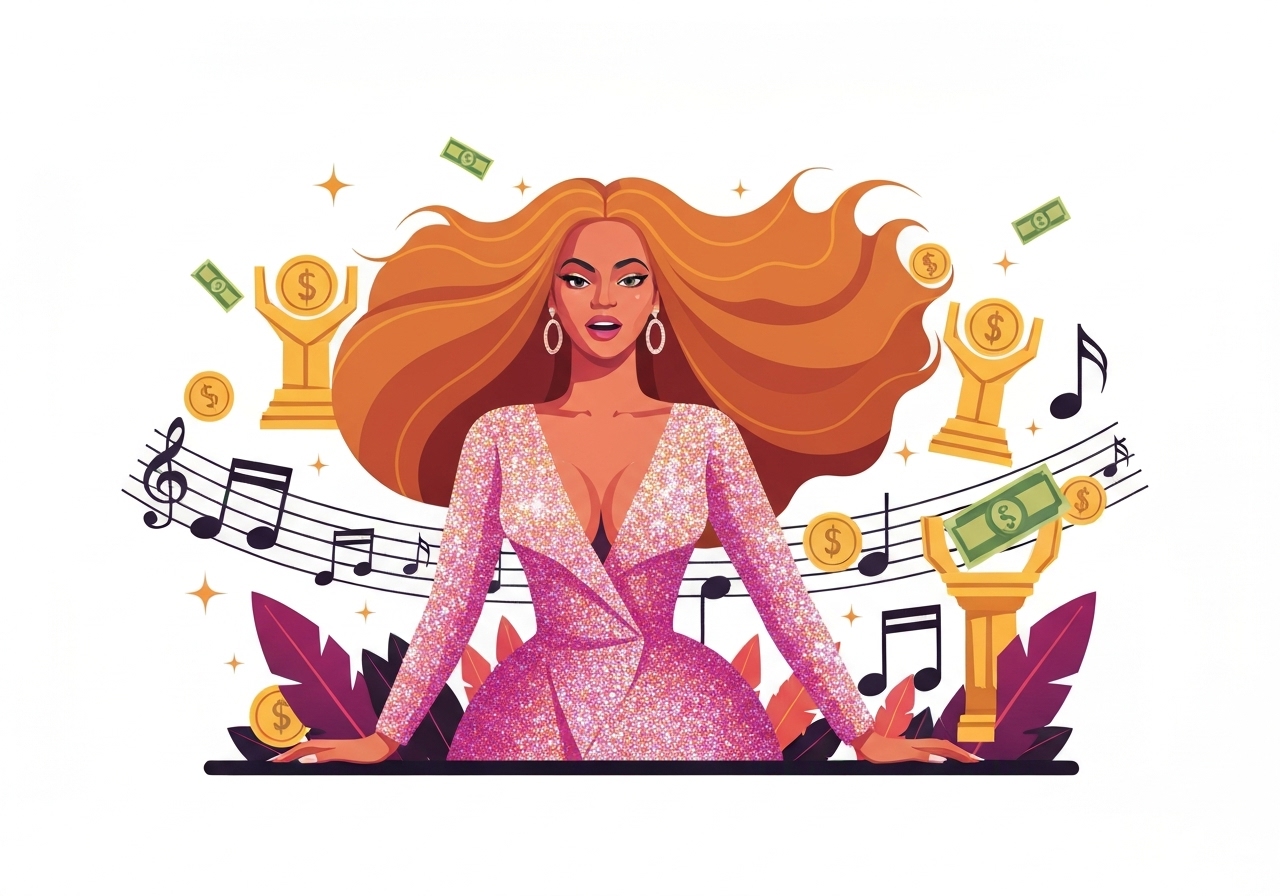
Forbes has placed Beyoncé, 44, among the world’s billionaires after the commercial success of her Cowboy Carter era and related businesses. The designation follows a stadium tour that generated more than $400 million in ticket sales and roughly $50 million in merchandise revenue, and builds on past touring receipts including the Renaissance tour’s roughly $579 million. The recognition makes her the fifth musician to reach billionaire status on Forbes’ roster, joining Jay‑Z, Rihanna, Bruce Springsteen and Taylor Swift. Parkwood Entertainment and a string of commercial deals and catalog income are cited as principal contributors to her wealth.
Key takeaways
- Beyoncé, age 44, is now listed as a billionaire by Forbes after revenues tied to the 2024 album Cowboy Carter and its global tour.
- The Cowboy Carter tour produced more than $400 million in ticket sales plus about $50 million in merchandise revenue, according to reporting cited by Forbes.
- Her earlier Renaissance world tour earned approximately $579 million in gross receipts, underpinning her touring track record.
- Beyoncé founded Parkwood Entertainment in 2010, consolidating management and production of her projects, which Forbes lists as a core asset.
- Other income streams noted include an estimated $50 million for a 2024 NFL halftime appearance and about $10 million from a Levi’s campaign.
- The Cowboy Carter stage production required a large logistical operation: roughly 350 crew, 100 semi‑trucks of gear and eight 747 cargo planes for city‑to‑city moves.
- She is the fifth musician on Forbes’ billionaire list; Jay‑Z first appeared in 2019, with Rihanna, Bruce Springsteen and Taylor Swift also previously included.
Background
Beyoncé rose to prominence in the late 1990s with Destiny’s Child and launched a solo career in the early 2000s that expanded into recording, touring and multimedia projects. Over two decades she has turned major album releases into arena and stadium tours that are consistently among the highest grossing in the business, creating a pattern of recurring, large‑scale revenue. In 2010 she established Parkwood Entertainment to bring management, production and creative control under one corporate umbrella, a move that also centralized how income and rights are administered. Across the modern music industry, ownership of masters, publishing and touring routes has become a decisive factor in long‑term artist wealth accumulation.
The last decade has seen several musicians reach billionaire status on Forbes’ list, beginning with Jay‑Z in 2019 and more recently including Rihanna and Taylor Swift. That shift reflects broader changes in the economics of music: superstar tours, bulk catalog sales and cross‑brand endorsements now account for the majority of outsized artist fortunes. Live performance in particular produces concentrated returns that dwarf many other entertainment revenue lines when shows consistently sell out large venues. The global billionaire population exceeded 3,000 in 2025, a context Forbes used to situate Beyoncé’s entry among extreme wealth holders.
Main event
The immediate trigger cited by Forbes for Beyoncé’s billionaire status is the commercial run tied to Cowboy Carter, her 2024 album, and its follow‑up stadium tour. The album received strong critical response and earned her a Grammy for album of the year, while the subsequent tour became the top grossing music tour of 2025. Ticket sales for the run surpassed $400 million, and merchandise tied to the production brought in an additional estimated $50 million, figures Forbes used in its financial accounting.
Onstage, the three‑hour Cowboy Carter production featured elaborate staging and a roster of guest appearances, which Forbes noted as enhancing ticket demand. The tour’s logistics were sizeable: roughly 350 crew members handled show operations, about 100 semi‑trucks transported equipment, and eight 747 cargo aircraft moved sets internationally—details Forbes highlighted to illustrate the scale and cost structure of stadium touring. Those same scale factors also explain how gross revenues translate into substantial net returns for top acts when managed efficiently.
Beyond live revenue, Forbes attributes much of Beyoncé’s net worth to catalog income, licensing and business ventures run through Parkwood Entertainment. The company produces music, films and concert content and consolidates related commercial deals. She also operates or licenses consumer brands—including a hair care line and other lifestyle ventures—but Forbes emphasizes that touring and catalogue receipts remain the dominant contributors to her wealth profile.
Analysis & implications
Beyoncé’s elevation to billionaire status underscores a modern music economy where touring and rights ownership trump recorded‑music unit sales. For artists who can consistently sell stadium tickets, the economics create a feedback loop: larger tours boost catalog valuations, which in turn generate licensing and streaming income that support long‑term wealth. That model favors established global stars with durable fanbases and strong management structures like Parkwood.
The business implications extend beyond artist compensation. Promoters, venue operators and production suppliers realize significant revenue, concentrating economic impact in cities that host major shows. Large tours can drive short‑term local spending on hotels, restaurants and transport, while creating sustained demand for production crews and technical services. This concentration raises questions about bargaining power across the touring supply chain and the distribution of economic gains among performers, crews and promoters.
For the music industry itself, the case highlights the strategic value of rights consolidation and diversified revenue streams. Artists who retain ownership stakes in masters and publishing—or who consolidate creative services under an owned management entity—can capture a larger share of downstream income. The trend also affects how investors, labels and private equity evaluate music assets, often pegging valuations to touring potential and catalog earnings streams rather than to one‑off releases.
Comparison & data
| Metric | Cowboy Carter (2024–25) | Renaissance Tour (earlier) |
|---|---|---|
| Ticket sales (gross) | More than $400 million | About $579 million |
| Merchandise | About $50 million | Not specified |
| Production crew | ~350 people | Not specified |
| Transport | 100 semi‑trucks; eight 747s | Not specified |
The table isolates publicly reported gross figures and logistical metrics cited in recent coverage to show how touring scale translates into revenue. Gross ticket and merchandise tallies feed into broader net‑worth calculations, but variables such as costs, contractual splits with promoters and tax treatments materially affect final artist income. That complexity helps explain why gross tour receipts are an imperfect but useful proxy for an artist’s capacity to generate large, sustained earnings.
Reactions & quotes
Forbes framed the phenomenon as an example of how stadium‑selling artists can generate outsized returns across entertainment sectors.
Forbes (media)
Industry observers have pointed to Parkwood’s centralized control of creative and commercial work as a factor that magnifies the financial benefits of Beyoncé’s projects.
Music industry analysis (media summary)
Fans and commentators on social platforms marked the milestone as recognition of a multi‑decade career spanning group and solo success, catalog control and global touring prowess.
Public reaction (social channels)
Unconfirmed
- The precise net‑worth figure Forbes assigned in its valuation summary was not consistently reported in all summaries and may vary by methodology.
- Market valuations of Beyoncé’s consumer ventures (hair care, spirit labels, fashion) are not publicly audited and their individual contributions to the total estimate remain partially opaque.
- Public accounts report gross tour receipts; exact profit margins after costs, promoter shares and taxation have not been published in full detail.
Bottom line
Beyoncé’s inclusion on Forbes’ billionaire list reflects the contemporary mechanics of superstar economics: repeated stadium sell‑outs, catalog ownership and centralized business management can convert cultural prominence into sustained wealth. The Cowboy Carter tour’s large gross receipts, combined with prior touring success and corporate structure under Parkwood, provided the primary basis for the designation.
For the industry, the milestone spotlights how a small number of global artists capture a disproportionate share of touring and catalog value, reshaping discussions about revenue distribution, labor in touring operations and the role of rights ownership. Observers should watch subsequent public disclosures, licensing deals and any sales of catalog assets for clearer, auditable figures.
Ultimately, the designation is both a personal milestone and a data point in a broader shift: in 2025, artist fortunes are more tightly linked than ever to live performance scale and rights management. Future reporting may refine the underlying numbers, but the pattern—touring as the dominant value engine for top artists—appears to be durable.