
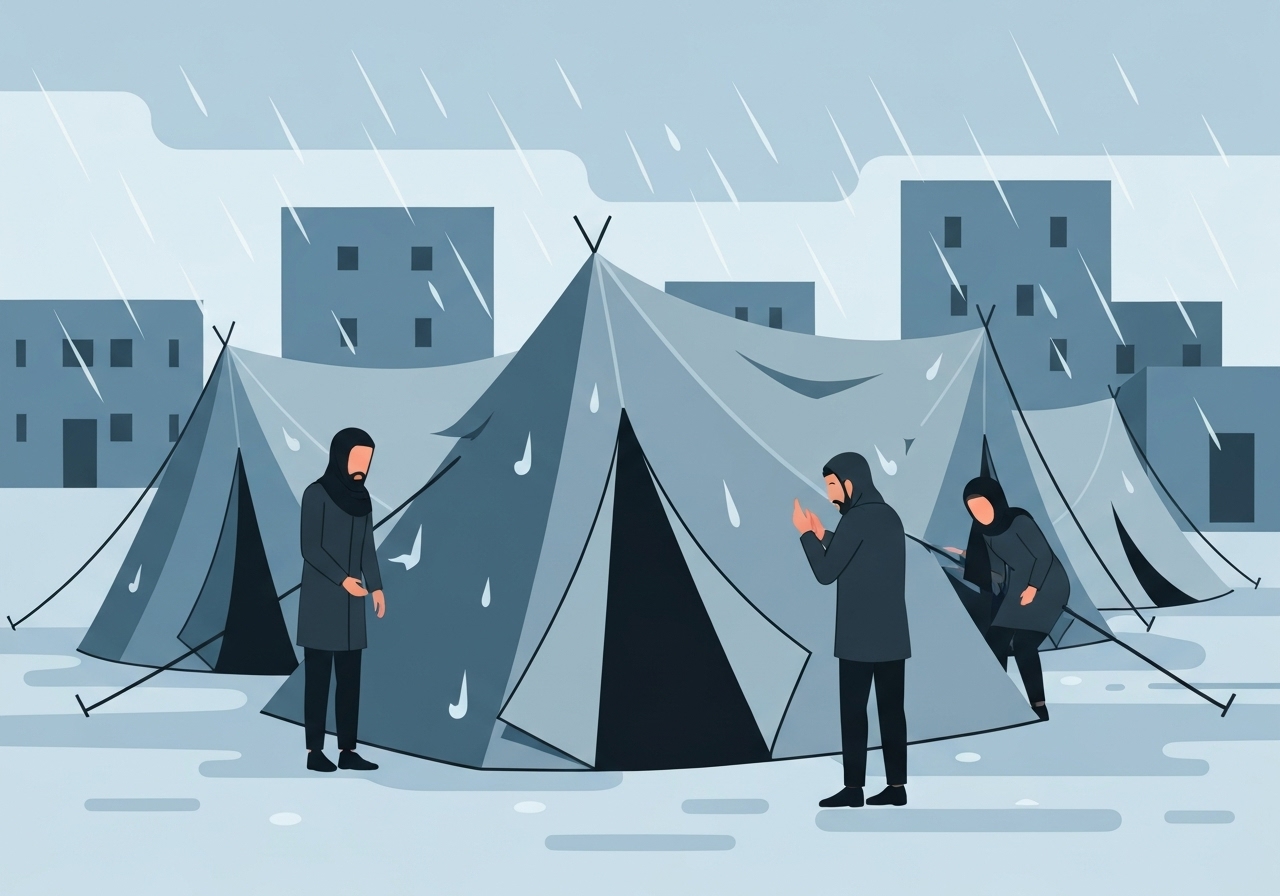
On Jan. 11, 2026, heavy rain and gale-force winds struck southern Gaza, tearing through improvised shelters and flooding tents in areas including Khan Younis and coastal displacement camps. Families sleeping in small tarpaulins woke to soaked bedding and collapsed poles as makeshift shelters failed to hold. Humanitarian agencies warn that hundreds of thousands of people — part of Gaza’s roughly 2 million residents — face heightened risk from cold, illness and further displacement as winter deepens. Local civil defense officials and aid groups say insufficient construction materials and restricted aid deliveries have left many living in dangerously flimsy cover.
Key takeaways
- Storms on Jan. 11–12 battered Gaza camps, with officials reporting thousands of tents damaged or destroyed, particularly along beach settlements.
- Gaza’s population is about 2 million; hundreds of thousands remain displaced after two years of strikes that damaged infrastructure and sanitation.
- Palestinian health authorities reported the death of a two-month-old, Muhammad Wissam Abu Harbid, from extreme cold; four infant cold-related deaths have been recorded this winter.
- Israeli authorities say over 430,000 tents and tarpaulins and more than 4,000 truckloads of blankets and winter clothing have entered Gaza, per COGAT statements.
- Israel suspended the permits of roughly 25 humanitarian groups on Jan. 1 for failing to meet new vetting requirements, a move aid agencies say risks curbing relief capacity.
- UN officials, including the U.N. spokesperson, have called scaling up winter assistance a “critical priority.”
Background
Much of Gaza’s population has lived uprooted for the third consecutive winter after extensive damage to housing and public works during a prolonged period of strikes. Crowded displacement sites often lack adequate toilets, drainage or heating, leaving families in tents and tarpaulins that were never intended for prolonged use. Rebuilding and shelter upgrades have been constrained by restrictions on the import of construction materials, which Israeli authorities say are necessary for security screening because of potential dual-use risks.
Humanitarian groups and Gaza officials say the shortfall in shelter materials and insulation has been compounded by new administrative hurdles for international NGOs. On Jan. 1, Israeli authorities suspended permits for about 25 organizations, a step that international aid providers say removes experienced staff and cuts operational capacity at a crucial moment. The resulting gap in trusted local and international actors has amplified worries that winter conditions will deepen malnutrition, disease and displacement.
Main event
In Khan Younis on the night of the storms, families described pulling wet bedding and sodden clothing from collapsed tents after strong gusts and heavy rain overwhelmed their shelters. The Abu Asi family, seven people sharing a small tent, placed containers to catch leaks but were still inundated while children slept. Residents reported wooden poles snapping, tarpaulin seams splitting and entire shelters shifting off muddy ground.
Civil Defense spokesman Mahmoud Basal reported on Saturday that recent storms caused “significant damage, particularly to tents erected on the beach,” and said thousands of tents for displaced people had been damaged or destroyed. He tied the fragile shelter situation to limits on reconstruction materials, saying recurring storms were turning into humanitarian disasters for those still living in makeshift cover.
Local coping measures were improvised and visible: families dug trenches to divert water, neighbors pooled covers, and some moved into slightly more secure nearby tents after partial collapses. In one camp, a father of 13, Asaad Abu Shaab, explained he had to shift his family to a neighbor’s shelter after his own tent collapsed, propping a tarpaulin with a single wooden pole to keep out the rain.
Analysis & implications
Winter damage to tents compounds an already dire humanitarian picture. Even where basic items have entered Gaza, aid agencies stress that quantity, distribution and suitability of supplies fall short of need — particularly for durable shelter materials, weatherproofing, and sanitation. The immediate health risk is acute for infants, elderly people and those with compromised nutrition; cold exposure and wet conditions increase respiratory and other infections.
Politically, the storm damage comes amid heightened scrutiny of aid governance and new Israeli vetting rules for NGOs. Suspending organizations removes institutional memory and local trust built over decades, according to agency officials, and could slow delivery of specialized winterization materials. Conversely, the Israeli government frames restrictions as necessary security measures; the tension between security screening and rapid humanitarian access is likely to remain a central policy fault line.
Economically and logistically, winter losses can delay reconstruction and raise the cost of future rebuilding. Replacing destroyed tents and delivering insulation at scale requires coordinated corridors, vetted lists of suppliers and storage facilities — capacities that have been eroded by years of conflict and administrative barriers. If restrictions remain or aid flows fluctuate, the coming weeks could see further displacement, higher shelter needs, and greater pressure on regional and international donors.
Comparison & data
| Indicator | Figure |
|---|---|
| Gaza population | ~2,000,000 |
| Tents/tarpaulins reported entered (COGAT) | >430,000 |
| Trucks of blankets/warm clothing reported | >4,000 |
| Infant deaths from cold this winter (Palestinian health officials) | 4 |
| NGOs suspended by Israel (approx.) | ~25 (about 15% of groups) |
These figures show a gap between supplies reported as entering Gaza and the scale of needs on the ground. Delivery totals do not directly measure functional shelter upgrades, site drainage, or equitable distribution, which humanitarian coordinators say are essential to converting shipments into protection against cold. Historical comparisons suggest that repeated winters without durable shelter accelerate long-term health deterioration among displaced populations.
Reactions & quotes
Officials and aid actors reacted with concern, emphasizing both the immediate humanitarian need and broader operational constraints.
“Our tent does not protect anything, neither our bedding nor our children,”
Nida’a Abu Asi, displaced resident, Khan Younis
The mother’s remark came as volunteers and neighbors tried to remove pooled water and salvage wet blankets in the early hours after the storm.
“Thousands of tents belonging to displaced people in the Gaza Strip were damaged or destroyed by the current storm,”
Mahmoud Basal, Gaza Civil Defense (official)
Basal warned that repeated storms are increasingly acting as humanitarian emergencies because many residents remain in fragile shelters and reconstruction materials face import restrictions.
“Scaling up efforts remains a critical priority,”
Stéphane Dujarric, U.N. spokesperson (official)
The U.N. echoed calls for easier, expedited access for winter-related items and reiterated concern that access limits will worsen suffering.
Unconfirmed
- Exact total of tents destroyed across Gaza remains provisional; field tallies are incomplete and vary by camp.
- Claims that specific suspended organizations had direct ties to militant groups are contested and have not been publicly substantiated with transparent evidence.
- The full extent to which shipments reported by COGAT have reached intended beneficiaries — versus being stockpiled or redirected — is not independently verified.
Bottom line
The storms that struck Gaza in mid-January 2026 have illuminated a chronic humanitarian vulnerability: improvised winter shelter in a densely populated enclave is insufficient against repeated extreme weather. Immediate needs include waterproofing, insulated bedding, secure tarpaulins and basic drainage works, alongside medical care for cold-related illness.
Longer term, reducing this seasonal risk will require both safe, vetted pathways for construction and shelter supplies and a restoration of trusted humanitarian actors able to manage distribution and technical installation. Without clear, accelerated arrangements to get appropriate materials and expertise into Gaza, more families face repeated exposure and escalating health and protection crises as winter continues.
Sources
- NBC News (media report)
- UNRWA (UN agency)
- COGAT (Israeli government – humanitarian coordination)
- Associated Press (news agency – photo coverage cited)