
Lead
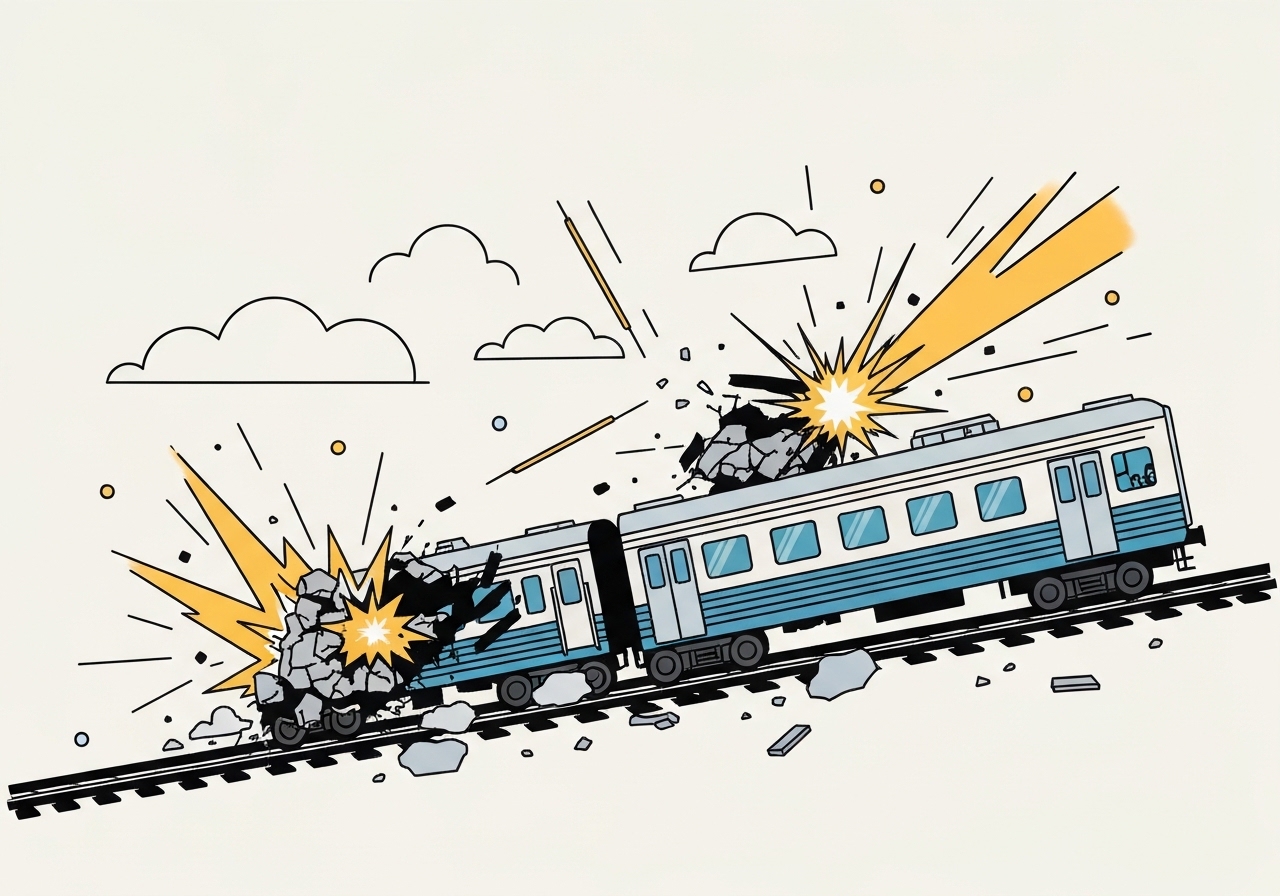
On 27 January 2026 a Russian drone strike struck a passenger train near a village in Kharkiv region, north-eastern Ukraine, killing five people, prosecutors said. The train, running from Chop to Barvinkove, had dozens to hundreds of passengers on board; officials report one carriage was directly hit and at least two carriages caught fire. President Volodymyr Zelenskyy described the attack as terrorism and said it would undermine diplomatic efforts. Prosecutors reported one drone hit the train and two others struck area alongside the line as rescue teams evacuated survivors.
Key Takeaways
- Five people were killed when a drone struck a passenger train near Barvinkove, Kharkiv region, on 27 January 2026, according to prosecutors.
- Officials said one drone hit the train and two additional drones struck an adjacent area; photographs show at least two carriages ablaze beside a snow-covered rail bed.
- Passenger counts differ: President Zelenskyy said the train carried more than 200 passengers, including 18 in the carriage hit; prosecutors earlier reported 155 passengers on board.
- Ukraine’s deputy prime minister called the attack a “direct act of Russian terror,” and the president urged allies to intensify pressure on Moscow.
- Ukrzaliznytsia, the national railway, pledged continued operations with increased security and thanked rescue teams and passengers who assisted evacuation.
- Separately, a barrage of more than 50 Russian drones struck Odesa on the same day, killing three people and wounding more than 30, regional officials said.
Background
The strike occurred amid nearly four years of large-scale war following Russia’s 2022 invasion of Ukraine, a conflict that has seen regular attacks on both military and civilian infrastructure. Drones have been an increasingly prominent weapon in the campaign, employed for strikes on facilities, logistics lines and urban areas across the country. Civilian rail remains a critical lifeline for internal movement, evacuation and freight, particularly along routes linking western entry points such as Chop to eastern and central towns including Barvinkove.
Kharkiv region, bordering the front lines in some periods of the war, has experienced repeated shelling and drone attacks since 2022, stretching emergency response capacity. Ukrainian institutions including the Prosecutor General’s office and Ukrzaliznytsia routinely investigate incidents and adjust security protocols on key lines. International partners have repeatedly condemned strikes on civilian targets and elevated scrutiny on methods and weapon types used in cross-border attacks.
Main Event
Prosecutors reported that fragments of five bodies were recovered at the strike site after one drone struck the moving train and two others hit the area alongside the tracks. Photographs shared publicly show at least two carriages burning adjacent to a snow-covered rail bed; rescue teams and fellow passengers assisted evacuations. Officials said the train traveled from Chop, near Ukraine’s western borders with Hungary and Slovakia, toward Barvinkove in Kharkiv region when the strike happened.
President Volodymyr Zelenskyy, writing on Telegram, condemned the strike as terrorism and argued there was no military justification for attacking a civilian passenger train. He said this and similar strikes erode diplomacy and urged allies to increase pressure on Moscow. The deputy prime minister, Oleksiy Kuleba, described the attack as a “direct act of Russian terror,” characterizing it as intentional targeting of civilians rather than an incidental hit.
Ukrzaliznytsia chief Oleksandr Pertsovskyi thanked rescuers and passengers who helped evacuate others and said the railway would continue operating with additional security in some locations. Officials emphasized that keeping transport running is both a logistical necessity and a morale issue for communities reliant on trains. Investigations at the scene were ongoing as emergency services completed recovery and damage assessments.
On the same day a separate large-scale drone barrage struck Odesa, the Black Sea port crucial for Ukrainian exports; regional officials reported three deaths and more than 30 wounded. Local governor Oleh Kiper noted that among the wounded was a woman who was 39 weeks pregnant and two girls, highlighting the civilian toll in densely populated areas.
Analysis & Implications
The attack sits at the intersection of military tactics and information warfare. Using drones against transport infrastructure raises both legal and strategic questions: it can disrupt logistics and civilian movement while signaling willingness to target non-military sites. That erodes the space for diplomacy Zelenskyy referenced, making mediated talks more politically fraught for partners who fear domestic backlash when civilians are killed.
Practically, strikes on passenger services force Ukrainian authorities to recalibrate security measures on rail lines, potentially slowing traffic and adding screening that reduces capacity. Ukrzaliznytsia’s pledge to keep services running reflects a calculation that maintaining mobility and supply chains is essential, but sustained threats may raise costs, delay goods, and complicate evacuation plans for vulnerable populations.
Internationally, attacks on civilian trains strengthen legal cases presented by Ukraine and others that certain strikes amount to war crimes or unlawful attacks on civilians. Evidence collection at strike sites, eyewitness accounts and forensic analysis of munitions will be central to any accountability efforts. Diplomatically, allies may respond with targeted sanctions, additional military aid, or moves to tighten export controls on components perceived to enable drone proliferation.
Comparison & Data
| Incident | Date | Location | Drones | Dead | Wounded |
|---|---|---|---|---|---|
| Train strike (Kharkiv region) | 27 Jan 2026 | Near Barvinkove | One hit train; two hit adjacent area | 5 | Multiple (investigation ongoing) |
| Odesa drone barrage | 27 Jan 2026 | Odesa | More than 50 | 3 | 30+ |
The table compares the two incidents reported on 27 January 2026; the Kharkiv-region event directly involved a passenger train and resulted in five confirmed fatalities, while the Odesa barrage involved many more incoming drones and produced a higher number of wounded. The scale and concentration of drones in Odesa indicate broader targeting patterns in southern Ukraine, while the train strike underscores risk to civilian mobility across the network.
Reactions & Quotes
“In any country, a drone strike on a civilian train would be considered in exactly the same way – purely as terrorism.”
Volodymyr Zelenskyy, President of Ukraine (Telegram)
Zelenskyy framed the strike as an attack on diplomacy and a direct assault on civilians, urging international partners to increase pressure on Russia. His statement emphasized that such strikes undermine ongoing diplomatic efforts and sought to galvanize allied action.
“This was a direct act of Russian terror.”
Oleksiy Kuleba, Deputy Prime Minister of Ukraine
Kuleba used strong language to classify the event as intentional and politically motivated, reinforcing Kyiv’s position that civilian infrastructure has been deliberately targeted. His comments aim to shape both domestic resolve and international responses to the incident.
“Keeping things moving is becoming more difficult. We are regrouping. There will be additional strict security measures… but we cannot give up.”
Oleksandr Pertsovskyi, Head of Ukrzaliznytsia (Facebook)
Pertsovskyi acknowledged heightened operational difficulty while committing to continued rail services and added security. His remarks highlighted the balance Ukrainian rail authorities seek between protecting passengers and maintaining essential transport links.
Unconfirmed
- Passenger total: reports vary between 155 (prosecutors’ earlier figure) and more than 200 (presidential post); final manifest and passenger list require confirmation.
- Drone type and origin: prosecutors reported drones struck the area, but technical identification of munitions and launch sites has not been publicly confirmed.
- Exact casualty and injury counts may change as searches and hospital reports are completed; initial body fragment reports indicate the recovery effort was underway.
Bottom Line
The 27 January 2026 strike on a civilian passenger train near Barvinkove that killed five people highlights the acute risks drones pose to everyday mobility in Ukraine and the broader humanitarian toll of the conflict. It deepens calls from Kyiv for stronger allied responses and for targeted measures aimed at preventing similar strikes. For the public and for partners, the incident underscores that transport networks remain vulnerable and that maintaining evacuation and supply routes will require both reinforced protection and international support.
Immediate next steps to watch include the prosecutor-led forensic probe, Ukrzaliznytsia’s security adjustments on key routes, official international reactions and any concrete moves to restrict technologies or networks used in drone strikes. Accountability efforts will depend on evidence collection and diplomatic pressure; the attack is likely to factor into discussions on both aid and sanctions in the coming days.
Sources
- The Guardian — news report consolidating local prosecutors’ statements and official comments (news)